Home
Class 12
CHEMISTRY
How is rate constant of a reaction relat...

How is rate constant of a reaction related to its activation energy?

Text Solution

Verified by Experts
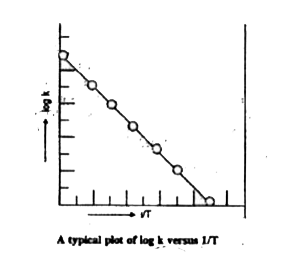
Arrhenius (1889) developed a mathematical relationship between temperature and the rate constant on the basis of the observations from the large number of experiments. The temperature dependence of the rate constant, k is expressed algebraically as follows.
`k prop e^(-Ea//RT)`
`k=Ae^(-Ea//RT)`

This equation is known as Arrhenius equation. Here, A is a constant of proportionality and is known as frequency factor:-This-factor is related to the number of binary molecular collisions per second per litre. E is the activation energy, R is gas constant and T is the absolute temperature. Taking logarithm, egn. (1) may be written as ,
In k=In A+ In `e^(-Ea//RT)`
In k=In A-`(E_a)/(RT)In e`
In `k=In A-(E_a)/(RT)` [`because`In e=1] ...(ii)
Converting to common logarithm, we get
`logk=logA-(E_a)/(2.303R)1/T` ... (iii)
or logk=`(-E_a)/(2.303R)1/T+logA`
This equation is of the form y = mx + ci.e., the equation of a straight line. Thus, if a plot of log k versús `1//T` is a straight line, the valdity of the equation is confirmed. From eqn: (lin) we havė,
Slope of the line = `(E_a)/(2.303R)`
Thus, by knowing the value of the slope and gas constant R, the activation energy `E_` can be calculated.
Alternatively, `E_a`, can be determined by using another form of the Arrhenius equation in which A is eliminated. This is because frequency factor A cannot be determined accurately for the reactions. From eqn. (iii)
In k=In A-`(E_a)/(RT)`
In k = In `k_1` and `k_2` are the values of rate constants at temperatures `T_1` and `T_2`, then,
In `k_1=In A-(E_a)/(RT_1)` ...(iv)
and `In k_2=In A-(E_a)/(RT_2)`
In Subtracting eqn. (iv) from egn. (v), we get
In `k_2`-In `k_1`=`-(E_a)/(RT_2)-(-E_a)/(RT_1)`
In `k_2-In k_1=(E_a)/(RT_1)-(E_a)/(RT_2)`
In `(k_2)/(k_1)=(E_a)/(2.303R)[(T_2-T_1)/(T_1T_2)]`
Converting to common iogarithm,
log `(k_2)/(k_1)=(E_a)/(2.303R)[(T_2-T_1)/(T_1T_2)]`
Promotional Banner

Topper's Solved these Questions

  • CHEMICAL KINETICS

    BETTER CHOICE PUBLICATION|Exercise Numerical Problems|63 Videos
  • BIOMOLECULES

    BETTER CHOICE PUBLICATION|Exercise QUESTION BANK|85 Videos
  • CHEMISTRY IN EVERYDAY LIFE

    BETTER CHOICE PUBLICATION|Exercise QUESTIONS|76 Videos

Similar Questions

Explore conceptually related problems

Rate constant of a reaction depends upon:

How is standard Gibbs energy of a reaction related to its equilibrium constant?

What is the effect of temperature on the rate constant of a reaction? How can this effect of temperature on rate constant be represented quantitatively?

The rate constant of a reaction increases four times when the temperature changes from 300 K to 320 K, Calculate the activation energy for the reaction. (R = 8.314 Jmol ^(-1) K ^(-1))

Arrhenius studies the effect of temperature on the rate of a reaction and postulted that rate constant varies with temperature exponentially as k=Ae^(E_(a)//RT) . Thuis method is generally used for finding the activation energy of a reaction. Keeping temperature constant, the effect of catalyst on the activation energy has also been studied. If the rate of reaction doubles for 10^(@)C rise of temperature form 290K to 300K, the activation energy of the reaction will be approximately: a) 40 Kcal mol^(-1) b) 12 Kcal mol^(-1) c) 60 Kcal mol^(-1) d) 70 Kcal mol^(-1)

The rate constant of a reaction has same units as the rate of reaction. The reaction is of …..

Arrhenius studies the effect of temperature on the rate of a reaction and postulated that rate constant varies with temperature exponentially as k=Ae^(-E_(a)//RT) . This method is generally used for finding the activation energy of a reaction. Keeping temperature constant, the effect of catalyst on the activation energy has also been studied. If x is the fraction of molecules having energy greater than E_(a) it will be given by : a) x=-(E_(a))/(RT) b) In x=-(E_(a))/(RT) c) x=e^(E_(a)//RT) d) Any of these

Arrhenius studies the effect of temperature on the rate of a reaction and postulted that rate constant varies with temperature exponentially as k=Ae^(E_(a)//RT) . Thuis method is generally used for finding the activation energy of a reaction. Keeping temperature constant, the effect of catalyst on the activation energy has also been studied. The pre-exponetial factor in the Arrhenius equation of a first order reaction has the unit : a) mol L^(-1)s^(-1) b) L mol^(1)s^(-1) c) s^(-1) d) dimensionless

The rate of reaction is equal to rate constant of the reaction. What is the order of reaction?

BETTER CHOICE PUBLICATION-CHEMICAL KINETICS-Numerical Problems
  1. How is rate constant of a reaction related to its activation energy?

    Text Solution

    |

  2. The rate constant of a reaction is 1.5 xx 10^7 sec^(-1) at 50^@C and 4...

    Text Solution

    |

  3. The rate constant for the decomposition of N2O6, N2O6 rarr N2O4+1/...

    Text Solution

    |

  4. The first order rate constant for the decomposition of ethyl iodide by...

    Text Solution

    |

  5. The three fourth of a first order reaction is completed in 32 minutes....

    Text Solution

    |

  6. 60% of a first order reaction was completed in 60 minutes. When was it...

    Text Solution

    |

  7. A first order reaction is 75% complete in 60 min. Find the half-life o...

    Text Solution

    |

  8. Ammonia and oxygen react at high temperature as : 4 NH (3)(g) to 4NO (...

    Text Solution

    |

  9. The reaction 2 N (2) O (5) (g) to NO (2) (g) + O (2) (g) takes place i...

    Text Solution

    |

  10. A reaction 3X rarr 2Y+Z procees in a closed vessel. The rate of disapp...

    Text Solution

    |

  11. A first order reaction is 50% complete in 69.3 minutes. Calculate the ...

    Text Solution

    |

  12. A first order reaction is 20% complete in the 10 minutes. Calculate th...

    Text Solution

    |

  13. A first order reaction is 15% complete in 20 minutes. How long will it...

    Text Solution

    |

  14. A first order reaction is 20% complete in the 10 minutes. Calculate th...

    Text Solution

    |

  15. A first order reaction is 15% complete in 20 minutes. How long will it...

    Text Solution

    |

  16. A first order reaction is 40% complete in 50 minutes. In what time wil...

    Text Solution

    |

  17. The rate constant for the first order reactior becomes three times whe...

    Text Solution

    |

  18. The rate constant for a first order reaction becomes six times when th...

    Text Solution

    |

  19. The rate constant for a first order reaction becomes six times when th...

    Text Solution

    |

  20. For the reaction : N (2) + 3H(2) to 2 NH (3) The rate of reaction meas...

    Text Solution

    |

  21. The decomposition of hydrogen peroxide in the presence of iodide ion h...

    Text Solution

    |

