Home
Class 9
PHYSICS
A 3kg block is placed over a 10kg block ...

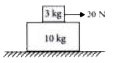
A 3kg block is placed over a 10kg block and both are placed on a smooth horizontal surface. The coefficient of friction between the blocks is 0.2. IF a horizontal force of 20N is applied to 3kg block. Find the acceleration of the two blocks.

Text Solution

Verified by Experts
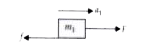
Here , mass of upper block `m_1=3kg`
Mass of lower block `m_2=10kg `
horizontal force `F=20N`
Coefficient of friction between the blocks
`mu=0.2`
Let `a_1 and a_2` be accelerations of upper and lower blocks respectively then
the equation of motion of upper block is
`F-f=m_1a_1`
`a_1= (F-f)/m_1= (F-mu m_1 g)/m_1`
`=(20 N -(0.2)(3kg) (10 ms^-2))/(3 kg)`
`=(20 N-6N)/(6 kg)=14/3 ms^-2`

The equation of motion of lower block is `f=m_2a_2`

`a_2=f/m_2= (mum_1 g)/m_2`
`=((0.2)(3kg) (10ms^-2))/(10 kg)=(6N)/(10 kg)=0.6 ms^-2`
Promotional Banner

Topper's Solved these Questions

  • FORCE AND LAWS OF MOTION

    MTG IIT JEE FOUNDATION|Exercise EXERCISE (INTEGER VALUE TYPE )|5 Videos
  • FORCE AND LAWS OF MOTION

    MTG IIT JEE FOUNDATION|Exercise OLYMPIAD /HOTS CORNER |20 Videos
  • FORCE AND LAWS OF MOTION

    MTG IIT JEE FOUNDATION|Exercise EXERCISE (SHORT ANSWER QUESTION)|10 Videos
  • FOOTSTEPS TOWARDS NEET

    MTG IIT JEE FOUNDATION|Exercise Multiple Choice Question|45 Videos
  • GRAVITATION

    MTG IIT JEE FOUNDATION|Exercise Olympiad/HOTS Corner|20 Videos

Similar Questions

Explore conceptually related problems

A 3 kg block is placed over a 10 kg block and both are palced on a smooth horizontal surface. The coefficient of friction between the block is 0.2 . If a horizontal force of 20 N is applied to 3 kg block, accelerations of the two block in ms^(-2) are (take, g=ms^(-2) )

A 2 kg block iks placed over a 4 kg block and both are plced on a smooth horizontal surfae. The coefficient of friction between the blocks is 0.20. Find theacceleration of the two blocks if a horizontal force os 12 N is applied to a. the upper block, b. the lower block. Take g=10 m/s^2 .

Two blocks A and B of masses 10 kg and 15 kg are placed in contact with each other rest on a rough horizontal surface as shown in the figure. The coefficient of friction between the blocks and surface is 0.2. A horizontal force of 200 N is applied to block A. The acceleration of the system is ("Take g"=10ms^(-2))

A block A of mass 2 kg is placed over smooth block B of mass 4 kg which is placed over a smooth horizontal floor The coefficient of friction between A and B is 0.4 when a horizontal forces of magnitude 10 N is applied on A the acceleration of block of A and B are

A block of mass 10kg is placed on a rough horizontal surface having coefficient of friction mu=0.5 . If a horizontal force of 100N is acting on it, then acceleration of the will be.

Two blocks of masses 4kg and 2kg are placed side on a smooth horizontal surface as shown in the figure. A horizontal force of 20N is applied on 4kg block. Find (a) the acceleration of each block. (b) the normal reaction between two blocks.

Two blocks of masses 1 kg and 2 kg are placed in contact on a smooth horizontal surface as shown in fig. A horizontal force of 6N is applied d(a) on a 1-kg block. Find the force of interaction of the blocks. .

A block of mass 2kg is placed on the surface of trolley of mass 20kg which is on a smooth surface.The coefficient of friction between the block and the surface of the trolley is 0.25 .If a horizontal force of 2 N acts on the block, the acceleration of the system in ms^(-2) is (g=10ms^(-2))

A block of mass m is kept over another block of mass 2m and the system rests on a smooth horizontal surface. The coefficient of friction between the block is 0. 50 . Find the work done by the force of friction on the smaller block by the bigger block during a displacement the of the system when a force mg is applied to the lower block

Block A of mass 5 kg is resting on a frictionless floor. Another block B of mass 7kg is resting on it as shown in the figure. The coefficient of friction between the blocks is 0.5 while kinetic friction is 0.4. If a force of 100 N is applied to block B, the acceleration of the block A will be ( g =10 ms^(-2)) :

