Home
Class 9
PHYSICS
For what value of F will the block of ma...

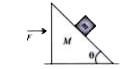
For what value of F will the block of mass m remains at rest with respect to the wedge. All surfaces are frictionless.

Text Solution

Verified by Experts
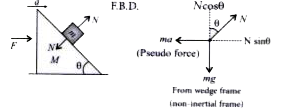
If the block is at rest w.r.t to the wedge then both will have the same acceleration.

`a=F/(M+m)`
From wedge, the block must be read
`N cos theta= mg , N sin theta= ma`
`implies tan theta=a/g`
From eqns. (i) and (ii) `F=(M+m) g tan theta`
Promotional Banner

Topper's Solved these Questions

  • FORCE AND LAWS OF MOTION

    MTG IIT JEE FOUNDATION|Exercise EXERCISE (INTEGER VALUE TYPE )|5 Videos
  • FORCE AND LAWS OF MOTION

    MTG IIT JEE FOUNDATION|Exercise OLYMPIAD /HOTS CORNER |20 Videos
  • FORCE AND LAWS OF MOTION

    MTG IIT JEE FOUNDATION|Exercise EXERCISE (SHORT ANSWER QUESTION)|10 Videos
  • FOOTSTEPS TOWARDS NEET

    MTG IIT JEE FOUNDATION|Exercise Multiple Choice Question|45 Videos
  • GRAVITATION

    MTG IIT JEE FOUNDATION|Exercise Olympiad/HOTS Corner|20 Videos

Similar Questions

Explore conceptually related problems

For the figure shown, block of mass m is released from the rest. Find the distance of the wedge from initial position, when block m arrives at the bottom of the wedge. All surfaces are frictionless.

A block of mass m is at rest over the rough surface of the fixed wedge.

Find the acceleration of the block of mass M in the situation shown in figure. All the surfaces are frictionless.

find the acceleration of the block of mass M in the situation shown in figure. All the surfaces are frictionless and the pulleys and the string are light.

Two identical blocks, each having mass M, are placed as shown in figure. These two blocks A and B are smoothly conjugated, so that when another block C of mass m passes from A to B there is no jerk. All the surfaces are frictionless, and all three blocks are free to move. Block C is released from rest, then

A system of wedge and block as shown in figure, is released with the spring in its natural length. All surfaces are frictionless. Maximum elongation in the spring will be .

A triangular wedge (A) has inclined surface making an angle theta = 37^(@) to the horizontal. A motor (M) is fixed at the top of the wedge. Mass of the wedge plus motor system is 3m. A small block (B) of mass m = 1kg is placed at the bottom of the incline and is connected to the motor using a light string. The motor is switched on and it slowly hauls block B through a distance L = 2.0 meter along the incline. Calculate the work done by the string tension force on the wedge plus motor system. All surfaces are frictionless.

A block of mass M is placed on the top of a bigger block of mass 10 M as shown in figure. All the surfaces are frictionless. The system is released from rest, then the distance moved by the bigger block at the instant the smaller block reaches the ground :

A block of mass m rests on a wedge of mass M which, in trun, rests on a horizontal table, as shown in figure. All surfaces are frictionless. If the system starts at rest with point P of the block a distance h above the table, find the speed of the wedge the instant point P touches the table.

