

Home
Class 9
MATHS
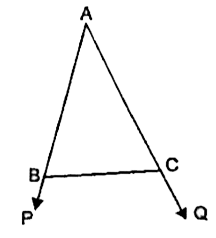
sides AB and AC of ABC are extended to p...

sides AB and AC of `ABC` are extended to points P and Q respectively. Also `angle PBC lt angle QCB.` Show that `AC gt AB.`

Promotional Banner

Topper's Solved these Questions

  • TRIANGLES

    SWAN PUBLICATION|Exercise EXERCISE 7.5|4 Videos
  • TRIANGLES

    SWAN PUBLICATION|Exercise OBJECTIVE TYPE QUESTIONS |20 Videos
  • TRIANGLES

    SWAN PUBLICATION|Exercise EXERCISE 7.3|10 Videos
  • SURFACE AREAS AND VOLUMES

    SWAN PUBLICATION|Exercise Objective Type Questions (Fill in the Blanks ) |7 Videos

Similar Questions

Explore conceptually related problems

In Fig. , sides AB and AC of DeltaABC are extended to points P and Q respectively. Also anglePBC AB .

In Fig. , sides AB and AC of DeltaABC are extended to points P and Q respectively. Also anglePBC AB .

In Fig. 6.38, the sides AB and AC of Delta ABC are produced to points E and D respectively. If bisectors BO and CO of angle CBE and angle BCD respectively meet at point O, then prove that angle BOC = 90^@ -1/2 angle BAC .

In Fig, 6.21 , A, B and C are points on OP, OQ and OR respectively such that AB||PQ and AC||PR. Show that BC||QR.

In fig., A, B and C are points on OP, OQ and OR respectively such that AB || PQ and AC || PR. Show that BC || QR. .

Points P and Q have been taken on opposite sides AB and CD. Respectively of a aprallelogram ABCD such that AP=CQ. Show that AC and PQ bisect each other

if a line intersects sides AB and AC of a DeltaABC at D and E respectively and is parallel to BC, prove that (AD)/(AB)=(AE)/(AC) (see Fig. 6,13).

Two chords AB and AC of a circle subtend angles equal to 90^@ and 150^@ , respectively at the centre. Find angleBAC , if AB and AC lie on the opposite sides of the centre.

ABCD is a quadrilateral in which P, Q, R and S are the mid-points of sides AB, BC, CD and DA respectively (See Fig. AC is a diagonal Show that SR II AC and SR = 1/2 AC .

ABCD is a quadrilateral in which P, Q, R and S are the mid-points of sides AB, BC, CD and DA respectively (See Fig. AC is a diagonal Show that SR II AC and SR = 1/2 AC .