Home
Class 11
CHEMISTRY
For an ideal gas, consider onlyp-V work ...

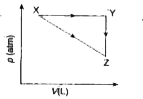
For an ideal gas, consider onlyp-V work in going from an initial state X to the final state Z. The final state can be reached by either of the two paths shown in the below figure. Which of the following choices ar correct? [Take `Delta S` as change in entropy and was work done.]

A

`Delta S _( x to z) = Delta S _(x to y) + Delta S _( y to z)`

B

`W _( x to z ) = W _( x to y) + W _( y to z)`

C

`W _( x to y to z ) = W _( x to y)`

D

`Delta S _(x to y to z) = Delta S _( x to y)`

Text Solution

Verified by Experts

As entropy is a state function and is additive `Delta S _( x to z) = Delta S _( x to y) + Delta S _( y to x )`
On moving from Y to Z, the work done is zero as the volume is kept constant (isochoric process)
`W _( x to Y to Z) = W _( x to Y)`
Promotional Banner

Topper's Solved these Questions

  • CHEMICAL THERMODYNAMICS

    BRILLIANT PUBLICATION|Exercise LEVEL-II (Assertion-Reason Type)|18 Videos
  • CHEMICAL BONDING AND MOLECULAR STRUCTURE

    BRILLIANT PUBLICATION|Exercise QUESTION (LEVEL -ll)|42 Videos
  • CLASSIFICATION OF ELEMENTS AND PERIODICITY IN PROPERTIES

    BRILLIANT PUBLICATION|Exercise QUESTIONS (LEVEL-III ( Linked Comprehension Type ))|12 Videos

Similar Questions

Explore conceptually related problems

Explain why Boyle's law cannot be used to calculate the volume of a real gas which is changed from its initial state to its final state by an adiabatic expansion.

1.0 mole of a monoatomic ideal gas is expanded from state (1) to state (2) as shown in the figure. Calculate ti work done for the expansion of gas from state (1) to state (2) at 298 K

For an ideal gas, an illustration of three different paths A, (B +C) and (D+E) from an initial state P _(1) , V _(1), T _(1) to a final state P _(2), V _(2), T _(1) is shown in the given Path A represents a reversible isothermal expansion from P _(1), V _(1), to P _(2), V _(2) Path (B +C) represents a reversible adiabatic expansion (B) from P _(1), V _(1), T _(1) to P _(3), V _(2) , T _(2) followed by reversible heating the gas at constant volume (C) from P _(3), V _(2), T _(2) to P _(2), V _(2), T _(1). Path (D+E) represents a reversible expansion at constant pressure P _(1) from P _(1) , V _(1), T _(1) to P _(1), V _(2), T _(3) followed by a reversible cooling at constant volume V _(2) (E) frm V _(1) , V _(2) T _(3) to P _(2) , V _(2), T _(1). What is Delta S for path A ?

For an ideal gas, an illustration of three different paths A, (B +C) and (D+E) from an initial state P _(1) , V _(1), T _(1) to a final state P _(2), V _(2), T _(1) is shown in the given Path A represents a reversible isothermal expansion from P _(1), V _(1), to P _(2), V _(2) Path (B +C) represents a reversible adiabatic expansion (B) from P _(1), V _(1), T _(1) to P _(3), V _(2) , T _(2) followed by reversible heating the gas at constant volume (C) from P _(3), V _(2), T _(2) to P _(2), V _(2), T _(1). Path (D+E) represents a reversible expansion at constant pressure P _(1) from P _(1) , V _(1), T _(1) to P _(1), V _(2), T _(3) followed by a reversible cooling at constant volume V _(2) (E) frm V _(1) , V _(2) T _(3) to P _(2) , V _(2), T _(1). What is Delta S for path A ?

For an ideal gas, an illustration of three different paths A, (B +C) and (D+E) from an initial state P _(1) , V _(1), T _(1) to a final state P _(2), V _(2), T _(1) is shown in the given Path A represents a reversible isothermal expansion from P _(1), V _(1), to P _(2), V _(2) Path (B +C) represents a reversible adiabatic expansion (B) from P _(1), V _(1), T _(1) to P _(3), V _(2) , T _(2) followed by reversible heating the gas at constant volume (C) from P _(3), V _(2), T _(2) to P _(2), V _(2), T _(1). Path (D+E) represents a reversible expansion at constant pressure P _(1) from P _(1) , V _(1), T _(1) to P _(1), V _(2), T _(3) followed by a reversible cooling at constant volume V _(2) (E) frm V _(1) , V _(2) T _(3) to P _(2) , V _(2), T _(1). What is q _(rav), for path (A) ?

Thermodynamics deals with energy changes of macroscopic system. a) Consider a chemical reaction taking place in a closed insulated vessel. To which type of thermodynamic system does it belong? b) State the first law of thermodynamics. c) 3 mol of an ideal gas at 1.5 atm and 25^oC expands isothermally in a reversible manner to twice its original volume against an external pressure of 1 atm. Calculate the work done. [R = 8.314 JK^-1mol^-1]

BRILLIANT PUBLICATION-CHEMICAL THERMODYNAMICS -LEVEL-III
  1. Which is not correct relationship between Delta G^(Ө) and equilibrium ...

    Text Solution

    |

  2. The following is(are) endothermic reaction(s)

    Text Solution

    |

  3. For an ideal gas, consider onlyp-V work in going from an initial state...

    Text Solution

    |

  4. An ideal gas in a thermally insulated vessel at internal pressure =p(1...

    Text Solution

    |

  5. For the C(s) + H (2) O (g) to CO (g) + H (2) (g ) reaction, Delta H ^(...

    Text Solution

    |

  6. Which of the following statement(s) is/are correct?

    Text Solution

    |

  7. Which of the following sets show the intensive properties?

    Text Solution

    |

  8. Which of the following are endothermic processes?

    Text Solution

    |

  9. Which of the options given below are correct?

    Text Solution

    |

  10. Enthalpy change equals internal energy change for a chemical reaction ...

    Text Solution

    |

  11. The enthalpy of fusion of ice is 6.02 kJ mol^(-1). The heat capacity o...

    Text Solution

    |

  12. Temperature of one mole of helium gas is increased by 1^(@)C. Hence, t...

    Text Solution

    |

  13. 4.48 Lofan ideal gas at S.T.P requires 12 calories to raise its temper...

    Text Solution

    |

  14. The polymerisation of propene to linear polypropene is represented by ...

    Text Solution

    |

  15. The lattice energy of solid KCI is 181 kcal mol^(-1) and the enthalpy...

    Text Solution

    |

  16. A heated iron block at 127^(@)C loses 300 J. of heat to the surroundin...

    Text Solution

    |

  17. What work is to be done on 2 mole of a perfect gas at 27^(@)C if it is...

    Text Solution

    |

  18. The heat of neutralisation of oxalic acid is -25.4 kcal mol^(-1) using...

    Text Solution

    |

  19. 100 mole of an ideal gas at 8.21 atm is heated to show a linear graph ...

    Text Solution

    |

  20. match the following

    Text Solution

    |

