A
B
C
D
Text Solution
Verified by Experts
The correct Answer is:
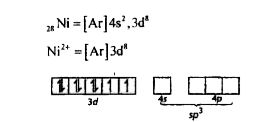



Topper's Solved these Questions
COORDINATION COMPOUNDS
BRILLIANT PUBLICATION|Exercise LEVEL III (Single Correct Answer Type )|10 VideosCOORDINATION COMPOUNDS
BRILLIANT PUBLICATION|Exercise LEVEL III (Multiple Correct Answer Type)|12 VideosCOORDINATION COMPOUNDS
BRILLIANT PUBLICATION|Exercise LEVEL I |55 VideosCO-ORDINATION COMPOUNDS AND ORGANOMETALLICS
BRILLIANT PUBLICATION|Exercise Level-II (Assertion- Reason)|4 VideosD & F BLOCK ELEMENTS
BRILLIANT PUBLICATION|Exercise Level -II|38 Videos
Similar Questions
Explore conceptually related problems
BRILLIANT PUBLICATION-COORDINATION COMPOUNDS -LEVEL II
- In which of the following pairs both the complex show optical isomeris...
Text Solution
|
- Which of the following facts about the complex [Cr(NH3)6] Cl3 is wrong...
Text Solution
|
- Nickel (Z = 28) combines with a uninegative monodentate ligand X^(-) t...
Text Solution
|
- i) K(2) [Fe(H2O)6] ii) K(3)[Cr(CN)6] iii) K(3) [Fe(CN)6] iv) K2 [Ni(CN...
Text Solution
|
- Red precipitate is obtained when ethanol solution of dimethylglyoxime ...
Text Solution
|
- An excess of AgNO3 is added to 100 mL of a 0.01 M solution of dichloro...
Text Solution
|
- Consider the following complex ions P, Q and R: P=[FeF6]^(3-), Q=[V(...
Text Solution
|
- The correct structure of ethylenediamineteraacetic acid (EDTA) is
Text Solution
|
- For the given complex [CoCl2 (en)(NH3)2]^(+), the number of geometrica...
Text Solution
|
- [Co(NH(3))(4)(NO(2))(2)]Cl exhibits :
Text Solution
|
- Cobalt(III) chloride forms several octahedral complexes with ammonia. ...
Text Solution
|
- The d-electron.configurations of Mn^(2+), Fe^(2+),Co^(3+) and Ni^(2+)...
Text Solution
|
- Crystal field splitting energy (CFSE) for the complex [Cr(H2O)6]^(2+) ...
Text Solution
|
- Amongst Ni (CO)4, [Ni(CN)4]^(2-) and [NiCl4]^(2-)
Text Solution
|
- Which of the following complexes are not correctly matched with the hy...
Text Solution
|
- Among [Ni(CO)4], [NiCl4]^(2-), [Co(NH3)4 Cl2] Cl, Na3 [CoF6], Na2O2 an...
Text Solution
|
- Which of these statements about [Co(CN)6]^(3-) is true?
Text Solution
|
- [NiCl2 {P(C2H5)2(C6H5)}2] exhibits temperature dependent magnetic beha...
Text Solution
|
- The octahedral complex of a metal ion , M^(3+), with four monodentate ...
Text Solution
|
- If the length of CO bond in carbon monoxide is. 1.128 Å, then what is ...
Text Solution
|