

Home
Class 12
PHYSICS
A ray parallel to principal axis is inci...

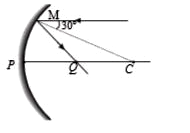
A ray parallel to principal axis is incident at `30^(@)` from normal on concave mirror having radius of curvature R. The point on principal axis where rays are focussed is Q such that PQ is

A

`(R )/(2)`

B

`(R )/(sqrt(3))`

C

`(2sqrt(R )-R )/(sqrt(2))`

D

`R(1-(1)/(sqrt(3)))`

Text Solution

Verified by Experts

The correct Answer is:
D
Promotional Banner

Topper's Solved these Questions

  • QUESTION-PAPERS-2014

    BITSAT GUIDE|Exercise PHYSICS|40 Videos
  • QUESTION-PAPERS-2016

    BITSAT GUIDE|Exercise PHYSICS|40 Videos

Similar Questions

Explore conceptually related problems

A point object at 15 cm from a concave mirror of radius of curvature 20 cm is made to oscillate along the principal axis with amplitude 2 mm. The amplitude of its image will be

A light ray parallel to the principal axis is incident (as shown in the figure) on a thin planoconvex lens with radius of curvature of its curved part equal to 10 cm. Assuming that the refractive index of the material of the lens is 4//3 and medium on both sides of the lens is air, find the distance of the point from the lens where this ray meets the principal axis. Find your answer in the form (X)/(7)cm and fill value of X .

Rays parallel to principal axis, incident on the spherical mirror at different heights from principal axis are focused at different points. And due to this reason we cannot define unique focus. This is known as spherical aberration. Angle of incidence theta shown in figure depends on the height of ray above principal axis. Focal length of spherical mirror can be easily written in terms of angle theta shown in figure as follows : f = R- (R)/(2)sec theta Here R is radius of curvature of mirror. The light rays which are very close to principal axis are known as paraxial rays and rays far away from principal axis are called marginal rays. What will be the focal length for ray which is incident at an angle 60^(@) ?

Rays parallel to principal axis, incident on the spherical mirror at different heights from principal axis are focused at different points. And due to this reason we cannot define unique focus. This is known as spherical aberration. Angle of incidence theta shown in figure depends on the height of ray above principal axis. Focal length of spherical mirror can be easily written in terms of angle theta shown in figure as follows : f = R- (R)/(2)sec theta Here R is radius of curvature of mirror. The light rays which are very close to principal axis are known as paraxial rays and rays far away from principal axis are called marginal rays. Let f_(P) and fm represent the focal length corresponding to paraxial rays and marginal rays respectively then

Rays parallel to principal axis, incident on the spherical mirror at different heights from principal axis are focused at different points. And due to this reason we cannot define unique focus. This is known as spherical aberration. Angle of incidence theta shown in figure depends on the height of ray above principal axis. Focal length of spherical mirror can be easily written in terms of angle theta shown in figure as follows : f = R- (R)/(2)sec theta Here R is radius of curvature of mirror. The light rays which are very close to principal axis are known as paraxial rays and rays far away from principal axis are called marginal rays. For paraxial rays focal length is approximately

A point object on the principal axis at a distance 15cm in front of a concave mirror of radius of curvature 20cm has velocity 2mm//s perpendicular to the principal axis. The magnitude of velocuty of image at that instant will be

A point object on the principal axis at a distance 1.5cm in front of a concave mirror of radius of curvature 20cm has velocity ,2mm/s perpendicular to , the principal axis.The velocity of image at that instant will be

A point object on the principal axis at a distance 1.5 cm in front of concave mirror of radius of curvature 20 cm has velocity 2mm/s is perpendicular to the principal axis. The velocity of image at that instant will be

BITSAT GUIDE-QUESTION-PAPERS-2015-PHYSICS
  1. Two tuning forks with natural frequencies of 340 Hz each move relative...

    Text Solution

    |

  2. The displacement of a particle is given at time t, by: x=A sin (-2 o...

    Text Solution

    |

  3. A ray parallel to principal axis is incident at 30^(@) from normal on ...

    Text Solution

    |

  4. A solid sphere of radius R has a charge Q distributed in its volume wi...

    Text Solution

    |

  5. A charged particle is moving in a uniform magnetic field and losses 4%...

    Text Solution

    |

  6. Calculate the wavelength of light used in an interference experiment f...

    Text Solution

    |

  7. The masses of the block A and B are m and M Between A and B there is a...

    Text Solution

    |

  8. An elastic spring of unstretched length L and spring constant K is str...

    Text Solution

    |

  9. A body is thrown vertically upwards from A. The top of a tower . It re...

    Text Solution

    |

  10. 0.5 mole of an ideal gas at constant temperature 27^(@)C kept inside a...

    Text Solution

    |

  11. A conducting square loop is placed in a magnetic field B with its plan...

    Text Solution

    |

  12. A beam of light has three lambda, 4144 "Å", 4972 "Å" "and"6216 "Å" wit...

    Text Solution

    |

  13. A square gate of size 1mxx1m is hinged at its mid point. A fluid of de...

    Text Solution

    |

  14. When 0.50 Å X-ray strike a material , the photoelectron from the K she...

    Text Solution

    |

  15. In a CE transistor amplifier, the audio signal voltage across the coll...

    Text Solution

    |

  16. At the corners of an equilateral tringle of side a =1 m, three point c...

    Text Solution

    |

  17. A vessel of volume 20 L contains a mixture o hydrogen and helium at te...

    Text Solution

    |

  18. The resistance of a wire is R. It is bent at the middle by 180^@ and b...

    Text Solution

    |

  19. In YDSE, light of wavelength lamda = 5000 Å is used, which emerges in ...

    Text Solution

    |

  20. The position of a projectile launched from the origin at t = 0 is giv...

    Text Solution

    |