

Home
Class 12
PHYSICS
A bar magnet M is dropped so that it fal...

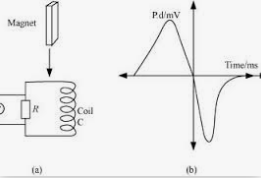
A bar magnet M is dropped so that it falls vertically through the coil C. (Show in the figure). The graph obtained for voltage produced across the coil versus time is shown in the figure Why is the negative peak longer than the positive peak?

Promotional Banner

Topper's Solved these Questions

  • ELECTROMAGNETIC INDUCTION

    MODERN PUBLICATION|Exercise EXERCISE|146 Videos
  • ELECTRICAL MEASUREMENTS

    MODERN PUBLICATION|Exercise EXERCISE|44 Videos
  • ELECTROMAGNETIC WAVES

    MODERN PUBLICATION|Exercise EXERCISE|66 Videos

Similar Questions

Explore conceptually related problems

A small coil is positionaed so that its axis lies along the axis of a large bar agnet, as shown in the figure. The coil has a cross-sectional area of 0.40 cm^2 and contains 150 turns of wire. The average magnetic flux density B through the coil aries with the distance x between the face of the magnet and the plane of the coil as shown in the figure. The coil is 5.0 cm from the face of the magnet to determine the magnetic flux density in the coil.

A cylindrical bar magnet is kept along the axis of a circular coil and near it as shown in the figure. Will there by an y iduced e.m.f. at the terminal of the coil, when the magnet is rotated about an axis perpendicular to the length of the magnet?

A copper ring is held horizontally and a bar magnetic is dropped through the ring with its length along the axis of the ring (shown in the figure) will the acceleration of the falling magnet be equal to , greater than or less than that due to gravity?

The existence of negatively charged particle in an atom was shown by J.J. Thomson as a result of the studies of the passage of electricity through gases at extremely low pressure known as discharge tube experiments. When a high voltage of the order of 10,000 volts or more was impressed across the electrodes, some sort of invisible rays moved from the negative electrode to the positive electrode these rays are called as cathode rays. Cathode rays travel in straight path in absence of electrical and magnetic field . Cathode rays consist of material part and charged particles? Cathode rays produce X-rays and light is emitted when they strike on ZnS screen. Cathode rays penetrate through thin sheets of aluminium and other metals . They affect the photogenic plate and passes heating effect when they strike on metal foil. The raito of charge to mass i.e charge/mass is same for all the cathode rays irrespective of the gas used in the tube. The existence of positively charged particle in an atom was shown be E. Goldstein. He repeated the same discharge tube experiments by using a perforated cathode. It was observed that when a high potential difference was applied between the electrodes, not only cathode rays were produced but also a new type of rays were produced simultaneoulsy from anode moving towards cathode and passes through the holes or canal of the cathode. These termed as canal rays or anode rays. These rays travel in straight lines and consists of positively charged particles. These rays have kinetic energy and produces heating effect also. The e/m ratio of these rays is smaller than that of electrons. Unlike cathode rays, their e/m value is dependent upon the nature of the gas taken in the tube. These rays produced flashes of light on ZnS screen and can pass throughs thin metal foils. They can produce physical and chemical changes and are capable to produce ionisation in gases. For cathode rays the value of e/m:

The existence of negatively charged particle in an atom was shown by J.J. Thomson as a result of the studies of the passage of electricity through gases at extremely low pressure known as discharge tube experiments. When a high voltage of the order of 10,000 volts or more was impressed across the electrodes, some sort of invisible rays moved from the negative electrode to the positive electrode these rays are called as cathode rays. Cathode rays travel in straight path in absence of electrical and magnetic field . Cathode rays consist of material part and charged particles? Cathode rays produce X-rays and light is emitted when they strike on ZnS screen. Cathode rays penetrate through thin sheets of aluminium and other metals . They affect the photogenic plate and passes heating effect when they strike on metal foil. The raito of charge to mass i.e charge/mass is same for all the cathode rays irrespective of the gas used in the tube. The existence of positively charged particle in an atom was shown be E. Goldstein. He repeated the same discharge tube experiments by using a perforated cathode. It was observed that when a high potential difference was applied between the electrodes, not only cathode rays were produced but also a new type of rays were produced simultaneoulsy from anode moving towards cathode and passes through the holes or canal of the cathode. These termed as canal rays or anode rays. These rays travel in straight lines and consists of positively charged particles. These rays have kinetic energy and produces heating effect also. The e/m ratio of these rays is smaller than that of electrons. Unlike cathode rays, their e/m value is dependent upon the nature of the gas taken in the tube. These rays produced flashes of light on ZnS screen and can pass throughs thin metal foils. They can produce physical and chemical changes and are capable to produce ionisation in gases. Which is not true with respect to cathode rays?

The existence of negatively charged particle in an atom was shown by J.J. Thomson as a result of the studies of the passage of electricity through gases at extremely low pressure known as discharge tube experiments. When a high voltage of the order of 10,000 volts or more was impressed across the electrodes, some sort of invisible rays moved from the negative electrode to the positive electrode these rays are called as cathode rays. Cathode rays travel in straight path in absence of electrical and magnetic field . Cathode rays consist of material part and charged particles? Cathode rays produce X-rays and light is emitted when they strike on ZnS screen. Cathode rays penetrate through thin sheets of aluminium and other metals . They affect the photogenic plate and passes heating effect when they strike on metal foil. The raito of charge to mass i.e charge/mass is same for all the cathode rays irrespective of the gas used in the tube. The existence of positively charged particle in an atom was shown be E. Goldstein. He repeated the same discharge tube experiments by using a perforated cathode. It was observed that when a high potential difference was applied between the electrodes, not only cathode rays were produced but also a new type of rays were produced simultaneoulsy from anode moving towards cathode and passes through the holes or canal of the cathode. These termed as canal rays or anode rays. These rays travel in straight lines and consists of positively charged particles. These rays have kinetic energy and produces heating effect also. The e/m ratio of these rays is smaller than that of electrons. Unlike cathode rays, their e/m value is dependent upon the nature of the gas taken in the tube. These rays produced flashes of light on ZnS screen and can pass throughs thin metal foils. They can produce physical and chemical changes and are capable to produce ionisation in gases. Select the incorrect statement.

A small retangular coil ABCD contains 140 turns of wire. The sides AB and BC of the coil are of length 4.5 and 2.8 cm respectively, as shown in the figure The coil is held between the poles of a large magnet so that the coil can rotate about an axis thorugh its centre. The magnet produces a uniform magnetic field of flux density B between its poles. When the current in the coil is 170 mA, the maximum torque produced in the coil is 2.1 xx 10^-3 N m . For the coil in the position shown in the figure. calculate the magnitude of the force on (i) side AB of the coil and (ii) side BC of the coil.

A small retangular coil ABCD contains 140 turns of wire. The sides AB and BC of the coil are of length 4.5 and 2.8 cm respectively, as shown in the figure The coil is held between the poles of a large magnet so that the coil can rotate about an axis thorugh its centre. The magnet produces a uniform magnetic field of flux density B between its poles. When the current in the coil is 170 mA, the maximum torque produced in the coil is 2.1 xx 10^-3 N m . For the coil in the position for maximum torque, state whether the plane of the coil is parallel to, or normal to , the direction of the magnetic field.

A small retangular coil ABCD contains 140 turns of wire. The sides AB and BC of the coil are of length 4.5 and 2.8 cm respectively, as shown in the figure The coil is held between the poles of a large magnet so that the coil can rotate about an axis thorugh its centre. The magnet produces a uniform magnetic field of flux density B between its poles. When the current in the coil is 170 mA, the maximum torque produced in the coil is 2.1 xx 10^-3 N m . The current in the coil in (a) is switched off and the coil s positioned as shown in the figure. The coil is then turned thorugh an angle of 90^@ in a time of 0.14 s. Calculate the average e.m.f. induced in the coil.

A small retangular coil ABCD contains 140 turns of wire. The sides AB and BC of the coil are of length 4.5 and 2.8 cm respectively, as shown in the figure The coil is held between the poles of a large magnet so that the coil can rotate about an axis thorugh its centre. The magnet produces a uniform magnetic field of flux density B between its poles. When the current in the coil is 170 mA, the maximum torque produced in the coil is 2.1 xx 10^-3 N m . Use your answer to show that the magnetic flux density B between the poles of the magnet is 70 mT.

MODERN PUBLICATION-ELECTROMAGNETIC INDUCTION-EXERCISE
  1. A bar magnet M is dropped so that it falls vertically through the coil...

    Text Solution

    |

  2. Explain the concept of magnetic flux linked with a surface.

    Text Solution

    |

  3. What is electromagnetic induction ? State its laws.

    Text Solution

    |

  4. What is electromagnetic induction ? State its laws.

    Text Solution

    |

  5. What is electro-magnetic induction?

    Text Solution

    |

  6. What is electromagnetic induction ? State its laws.

    Text Solution

    |

  7. State Lenz’s law of electromagnetic induction.

    Text Solution

    |

  8. State and explain Faraday’s law of electromagnetic induction.

    Text Solution

    |

  9. State and explain Faraday’s law of electromagnetic induction.

    Text Solution

    |

  10. Is Lenz's law in accordance with the law of conservation of energy?

    Text Solution

    |

  11. State Lenz’s law.Give one example to illustrate it.

    Text Solution

    |

  12. Show that Lenz's law obeys the law of conservation of energy.

    Text Solution

    |

  13. State Lenz’s law of electromagnetic induction.

    Text Solution

    |

  14. Will an induced current be always produced whenever there is change of...

    Text Solution

    |

  15. Derive an expression for induced e.m.f. developed in a conductor of le...

    Text Solution

    |

  16. Derivea expression for inducede.m.f. whenacoilrotates in a uniform mag...

    Text Solution

    |

  17. Derive an expression for induced current, when a coductor of length l ...

    Text Solution

    |

  18. A straight conductor 1 meter long moves a right angles to both, its le...

    Text Solution

    |

  19. What is electromagnetic induction ? State its Faraday's laws. Find an ...

    Text Solution

    |

  20. What is electromagnetic induction ? State its Faraday's laws. Find an ...

    Text Solution

    |

  21. A rectangular conductor LMNO is placed in a uniform magnetic field vec...

    Text Solution

    |