Home
Class 11
PHYSICS
The coefficient of static friction betw...

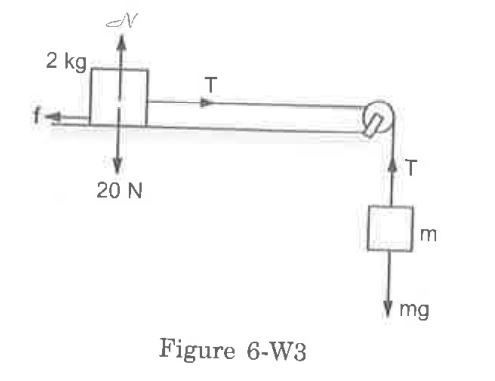
The coefficient of static friction between the block of 2 kg and the table shown in figurwe is `mu_s=0.2` What should be the maximum value of m so tht the blocks do not move? Take `g=10 m/s^2.` The string and the pulley are light and smooth.

Text Solution

Verified by Experts

Consider the equilibrium of the block of mass m. The forces on this block are
a. mg downward by the earth and
T upward by the string.
hence `T-mg=0 or, T=mg`…….i
Now consider the equilibrium of the 2 kg block. The forces on this block are
a. T towards rightby the string,
b. f towards left (friction)by the table,
c. 20 N downward (weight) by the earth and
d. N upward (normal force) by the table
For vertical equilibrium of this block,
N=20N...........ii
A m is the largest mass which can be used without moving the system, the friction is limiting
Thus, `f=mu_sN` ...........iii
For horizontal equilibrium of the 2 kg block
f=T
Using equations i, iii and iv
`mu_sN=mg`
or `02xx20N=mg`
or, `m=(02xx20)/10kg=04kg`
Promotional Banner

Topper's Solved these Questions

Similar Questions

Explore conceptually related problems

The coefficient of static friction between a block of mass m and an incline is mu_s=0.3 , a. What can be the maximum angle theta of the incline with the horizontal so that the block does not slip on the plane? b. If the incline makes an angle theta/2 with the horizontal, find the frictional force on the block.

The coefficient of static friction between the two blocks shown in figure is mu and the table is smooth. What maximum horizontal forced F can be applied to he block of mass M so that the block move together?

A 100 kg block is started with a speed of 2.0 m s^(-1) on a long, rough belt kept fixed in a horizontal position. The coefficient of kinetic friction between the block and the belt is 0.20. (a) calculate the change in the internal energy of the block-belt system as the block comes to a stop on the belt. (b) consider the situation from a frame of reference moving at 2.0 m s^(-1) along the initial velocity of the block. as seen from this frame, the block is gently put on a moving belt and in due time the block starts moving with the belt at 2.0 m s^(-1) , calculate the increase in the kinetic energy of the block as it stops slipping past the belt. (c ) find the work done in this frame by the external force holding the belt.

Consider an object of mass 2 kg resting on the floor. The coefficient of static friction between the object and the floor is mu_8 = 0.8. What force must be applied on the object to move it?

In the previous problem, suppose m_2=2.0kg and m_3=3.0 kg . What should be the mass m so that it remains at rest?

A block of mass m slips on a rough horizontal table under the action of horiozontal force applied to it. The coefficient of friction between the block and the table is mu . The table does not move on the floor. Find the total frictional force aplied by the floor on the legs of the table. Do you need the friction coefficient between the table and the floor or the mass of the table ?

The friction coefficient between the horizontal surfce and ech of the blocks shown in figure is 0.20. The collision between the blocks is perfectly elastic. Find the separation between the two blocks when they come to rest. Take g=10 m/s^2 .

A constant force F=m_2g/s is applied on the block of mass m_1 as shown in figure. The string and the pulley are light and the surface of the table is smooth. Find the acceleration of m_1
