Home
Class 11
PHYSICS
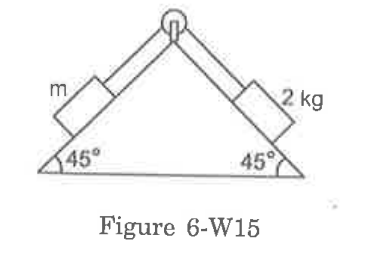
figure shows two blocks connected by a l...

figure shows two blocks connected by a light string placed on the two inclined parts of a triangular structure. The coefficients of static and inetic friction are 0.28 and 0.25 respectively at each of the surface. a.Find the minimum and maximum values of m for which the system remains at rest, b. Find the acceleration of either block if m is given the minimu value calculated in teh first part and is gentluy pushed up the incline for a short while.

Text Solution

Verified by Experts

a. Take the 2 kg block as the system. The forces on this block are shown in ure with `M=2` kg. It is assumed that m has its minimum value so that the 2 kg block has a tendency to slip down.As the block is in equilibrium, the resutant force shoud be zero.


Taking coponents `_|_` to the incline
`N=Mg cos 45^0=Mg /sqrt2`.
Taking components || to the incline
`T+f=Mg sin 45^0 = Mg /sqrt2`. or ` T=Mgsqrt2-f`
As it is a case of limiting equilibrium.
`f=mu_2N`
or `T=Mg/sqrt2-mu_s Mg/sqrt2=Mg/sqrt(1-mu_2)`............i
Now consider the other block as the system. the forces acting on this block are shown in ure.
Taking components `_|_` to the incline,
`N'=mg cos 45^0+f'=mg/sqrt2+f'`
As it is the case of limiting equilirium
`f'=mu_sN'=mu_s mg/sqrt2`
Thus, `T=mg/sqrt2(1+mu_s)`
From i. and ii
`m(1+mu_s)=M(1-mu_s)`
or `m=(1-mu_s)/(1+mu_s) M=(1-0.28)/(1+0.28)xx 2 kg`
when maximum possible value of m is suplied the directions of friction are reversed becauyse m hs the tendency to sip down and 2 kg block to slip up. Thus, themaximum value of m can be obtained from iii by utting `mu=-0.28. Thus the maximum value of m is `brgt `m=(1+0.28)/(1-0.28)xx2 kg
`32/9kg`
b. If `m=9/8 kg ` and the system is gently pushed, kinetic friction will operate. Thus,
`f=mu_k Mg/sqrt2 and f'(mu_kmg)/sqrt2
where `mu_k=0.25`. If the acceleration is a Newton's second law for M gives ure.
`Mg sin 45^0-T-f=Ma`
or, `Mg/sqrt2-T-(mu_kMg)/sqrt2Ma`............iv
Applying Newton'ssecond law m ure.
`T-mg sin 45^0 -f' =Ma`
`T-Mg/sqrt2-(mu_kmkg)/sqrt2=Ma`a...........v
Adding iv and v
`Mg/sqrt2(1-mu_k)mg/sqrt2(1+mu_k)=(M+m)a`
or, `a=(M(1-mu_k)-m(1+mu_k))/(sqrt(2(M+m)) g`
`=(2xx0.75-9/8xx1.25)/(sqrt2(2+9/8))g`
`=031 m/s^2`.
Promotional Banner

Topper's Solved these Questions

Similar Questions

Explore conceptually related problems

Find the acceleration of the blocks A and B in the this situations shown in figure.

find the acceleration of the block of mass M in the situation shown in figure. All the surfaces are frictionless and the pulleys and the string are light.

The surface over which blocks are placed in smooth. What is the acceleration of each block in the given diagram ?

A block of mass m slides down the plane inclined at an angle 60^@ with an acceleration g/2. Find the co-efficient of kinetic friction.

The pulleys in figure are identical, each having a radius R and moment of inertia I. Find the acceleration of the block M.

Find the maximum value of M//m in the situation shown in figure so that the system remains at rest. Friction coefficient at both the contacts mu . Discuss the situation when tanthetagtmu

