Home
Class 11
PHYSICS
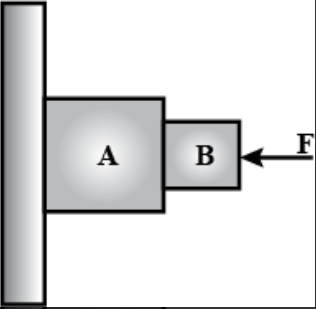
Consider the situation shown in figure. ...

Consider the situation shown in figure. The wall is smooth but the surfces of A and B in contact are rough. The friction on B due to A in equilibrium.

A

is upward

B

is downward

C

is zero

D

the system cannot remain in equilibrium

Text Solution

Verified by Experts

The correct Answer is:

D
Promotional Banner

Topper's Solved these Questions

Similar Questions

Explore conceptually related problems

Consider the situation shown in figure. The straight wire is fixed but the loop can move under magnetic force. The loop will

Suppose all the surfaces in the previous problem are rough. The direction of friction on B due to A

Consider the situation shown in figure.The switch is closed at t=0 when the capacitor C_(1) as a function of time t .

Consider the situation shown in figure. All the surfaces are frictions and the string and the pulley are light. Find the magnitude of the acceleration of the two blocks.

Consider the situation shown in figure. The horizontal surface below the bigger block is smooth. The coefficient of friction between the blocks is mu . Find the minimum and the maximum force F that can be applied in order to keep the smaller block at rest with respect to the bigger block.

Consider4 the situation shown in figure. Bothe the pulleys and the string are light and all the surfaces are friction less. a. Find the acceleration of the mass M. b. Find the tension in the string c. Calculate the force exerted by the clamp on the pulley A in the figure.

Consider the situation shown in figure. The force F is equal to the (m_2g)/2 . If the area of cross section of the string is A and its Young modulus Y, find the strain developed in it. The string is light and there is no friction anywhere.

Consider the situation shown in figure. The wire which has a mass of 4.00 g oscillates in its second harmonic and sets the air column in the tube into vibrations in its fundamental mode. Assuming that the speed of sound in air is 40 m s^-1 , find the tension in the wire. .

Consider the situation shown in figure. Initially the spring is unstretched when the system is released from rest. Assuming no friction in the puley, find the maximum eleongation of the spring.

Consider the situation shown in figure. Find the maximum angle theta for which the light suffers total internal reflection at the vertical surface.
