Home
Class 11
PHYSICS
A car is going at a speed of 21.6 km/hr ...

A car is going at a speed of 21.6 km/hr when it encounters a 12.8 m long slope of angle `30^0` figure. `1/(2sqrt3)`. Shwo tht no matter how hard the driver applies the brakes, tehcar will reach the bottim with a speed greater than 36 km/hr. Take `g=10 m/s^2`

Text Solution

Verified by Experts
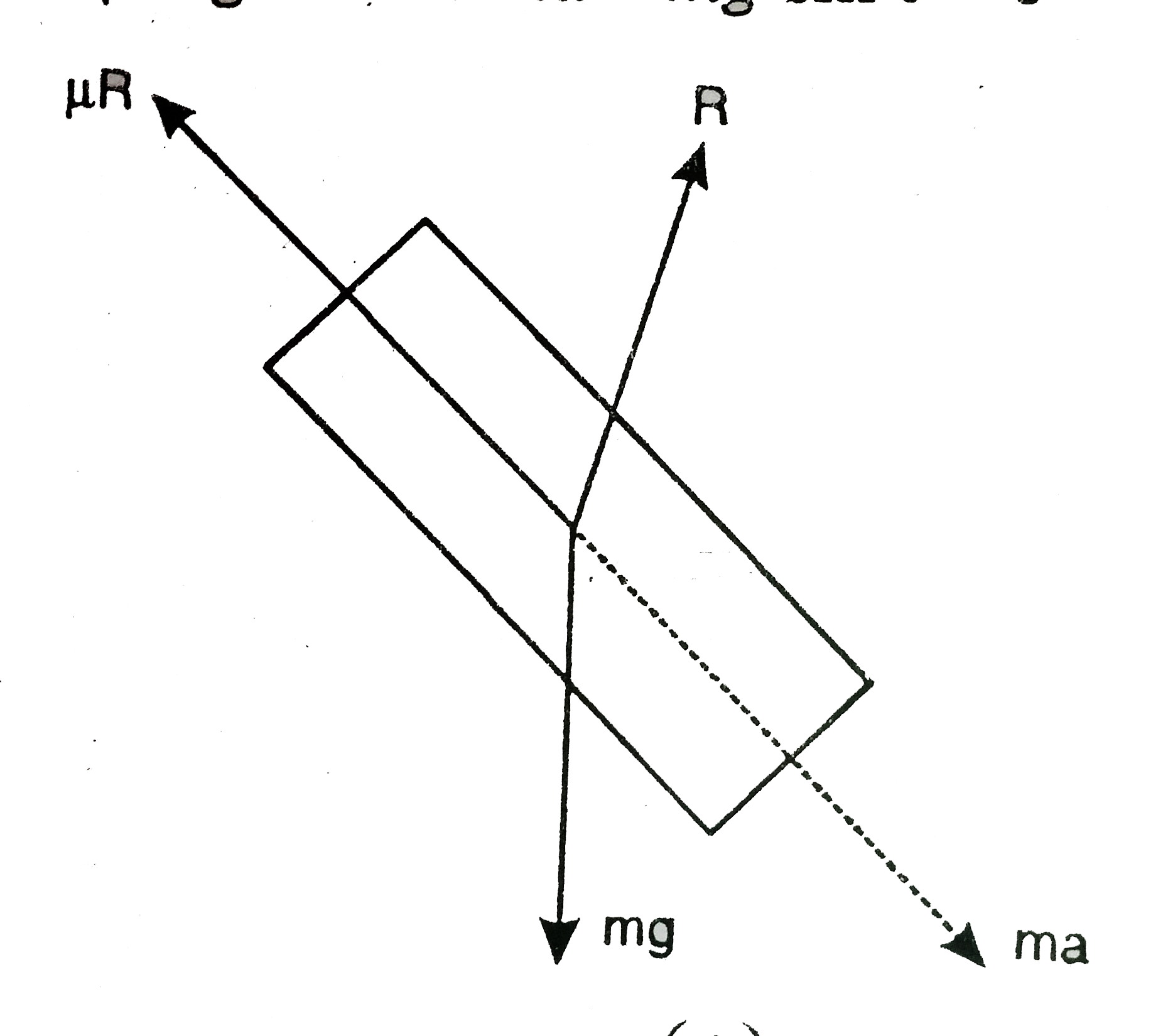
Hardest brake indicates that maximum force of friction is developed between car's tyre and road.
Maximum frictioN/Al force `=muR`
From the free body diagram,
`R-mgcostheta=0`
`rarr R=mg costheta`……..i
`and muR+ma-mgsintheta=0` ………ii
`rarr mu mg cos theta+ma-mg sin theta=0`

`rarr mg cos theta +a-10xx(1/2)=0`
`rarr a=5-[1-2sqrt3]xx10(sqrt3/2)`
`=5-2.5=2.5m/s^2`
`S=12.8 m/s^2 `
`u=6 m/s, velocity at the end of incline
`v=sqrt(u^2+2as)`
`=sqsrt(6^2+2(2.5)(12.8))`
`=sqrt(36+64)
`=10 m/s=36 km/hr
Hence, the harder the driver applies the brakes,m the lower will be the velocity of the cr when it reaches the ground i.e. at `36 km/hr`.
Promotional Banner

Topper's Solved these Questions

Similar Questions

Explore conceptually related problems

Figure shows as rod of length 20 cm pivoted near an end and which is made to rotate in a horizontal plane with a constant angular speed. A ball ofmass m is spuspended by a string angular also of length 20 cm from the other end of the rod. If the angle theta made by the stirng with the vertical is 30^0 . find the anglular speed of the rotation. Take g=10 m/s^2

A car moving with a speed of 40 km/hr comes to rest at a distance of 2 m after applying brakes. If the same car is moving with a speed of 80 km/hr, what is the minimum stopping distance?

A ball is thrown at a speed of 40 m/s at an angle of 60^0 with the horizontal. Find a. the maximum height reached and b. the range of te ball. Take g=10 m/s^2 .

A simple pendulum is suspended from the ceiling of a car taking a turn of radius 10 m at a speed of 36 km/h. Find the angle made by the string of the pendulum with the vertical if this angle does not change during the turn. Take g=10 m/s^2 .

A ball is thrown from a field with a speed of 12.0 m/s at an angle of 45^0 with the horizontal. At what distance will it hit the field again ? Take g=10.0 m/s^2

The pulley shown in figure has a radius of 20 cm and moment of inertial 0.2 kg-m^2. The string going over it is attached at one end to a vertical sprign of spring constant 50 N/m fixed from below and supports a 1 kg mas at other end. The system is released from rest with the spring at its natural length. Find the speed of the block when it has desceds through 10 cm. Take g=10 m/s^2 .

A car moving at a speed of 36 km/hr is taking a turn on a circular road of radius 50 m. A small wooden plate is kept on the seat with its plane perpendicular to the radius of the circular road figure. A small bock of mass 100 g is kept on the seat which rests against the plate. The friction coefficient between the block and the plate is mu=0.58. a. Find the normal contact force exerted by the plate on the block. b. The plate is slowly turned so that the angle between the normal to the plate and the radius of the road slowly increases Find the angle at which the block will just start sliding on the plate.

A bullet of mass 50g if fired from below into the bob of mass 450g of a long simple pendulum as shown in Fig. The bullet remains inside the bob and the bob rises through a height of 1.8m. Find the speed of the bullet.Take g=10 m/s^2

A heavy particle is usspended by a 1.5 m long string . It is given a horizontal velocityof sqrt(57) m/s. a. Find the angle made by the string with the upward vertical, when it becomes slack. B. Find the speed of the particle at this instant. c.Find the maximum height reached by the particle over the point of suspension. Take g=10 m/s^2

A man can swim in still water ast a speed of 3 km/h. He wants to cross a river that flows at 2 km/h and reach the point directly oposite to his starting point. A. In which diretionshoeld he try to swim (that is, find the angle his body makes wilth the river flow)? b. How much time will he take to cross the river if the river is 500 m wide?

HC VERMA-FRICTION-Exercises
  1. If the tension in the string in the figure. Is 16 N and the accelerati...

    Text Solution

    |

  2. The friction coefficient between the table and the block shown in figu...

    Text Solution

    |

  3. In the section 3.7.3 (Banking of road) we have not included the fricti...

    Text Solution

    |

  4. The friction coefficient bettween an athelete's shoes and the ground i...

    Text Solution

    |

  5. A car is going at a speed of 21.6 km/hr when it encounters a 12.8 m lo...

    Text Solution

    |

  6. A car starts from rest on a half kilometer long bridge. The coefficiet...

    Text Solution

    |

  7. Figure shows tow blocks in contact sliding down an inclined surface of...

    Text Solution

    |

  8. Two masses M1 and M2 are connected by a light rod and the system is sl...

    Text Solution

    |

  9. A block of mass M is kept on as rough horizontal surface. The coeffici...

    Text Solution

    |

  10. The friction coeficient bettween the board and the floor shownin filgu...

    Text Solution

    |

  11. A horizontal force of 3.2 N is applied on a 3.7kg block, which rests o...

    Text Solution

    |

  12. Find the accelerations a1,a2,a3 of the three blocks shown in figure if...

    Text Solution

    |

  13. The friction coefficient between the two blocks shown in figure is mu ...

    Text Solution

    |

  14. Suppose the entire system of the previous question is kept inside an e...

    Text Solution

    |

  15. Consider the situation shown in figure. Suppose a small electric field...

    Text Solution

    |

  16. A block of mass m slips on a rough horizontal table under the action o...

    Text Solution

    |

  17. Find the acceleration of the block of mass M in the situation of figur...

    Text Solution

    |

  18. A block of mass 2 kg is pushed against a rough vertical wall with a fo...

    Text Solution

    |

  19. A person (40 kg) is managing to be at rest between two verticle walls ...

    Text Solution

    |

  20. Figure shows a small block of mass m kept at the left end of a larger ...

    Text Solution

    |

