Home
Class 11
PHYSICS
A car starts from rest on a half kilomet...

A car starts from rest on a half kilometer long bridge. The coefficiet of friction between the tyre and the road is 1.0. Show that one cannot drive thrugh the bridge in less than 10 s.

Text Solution

Verified by Experts
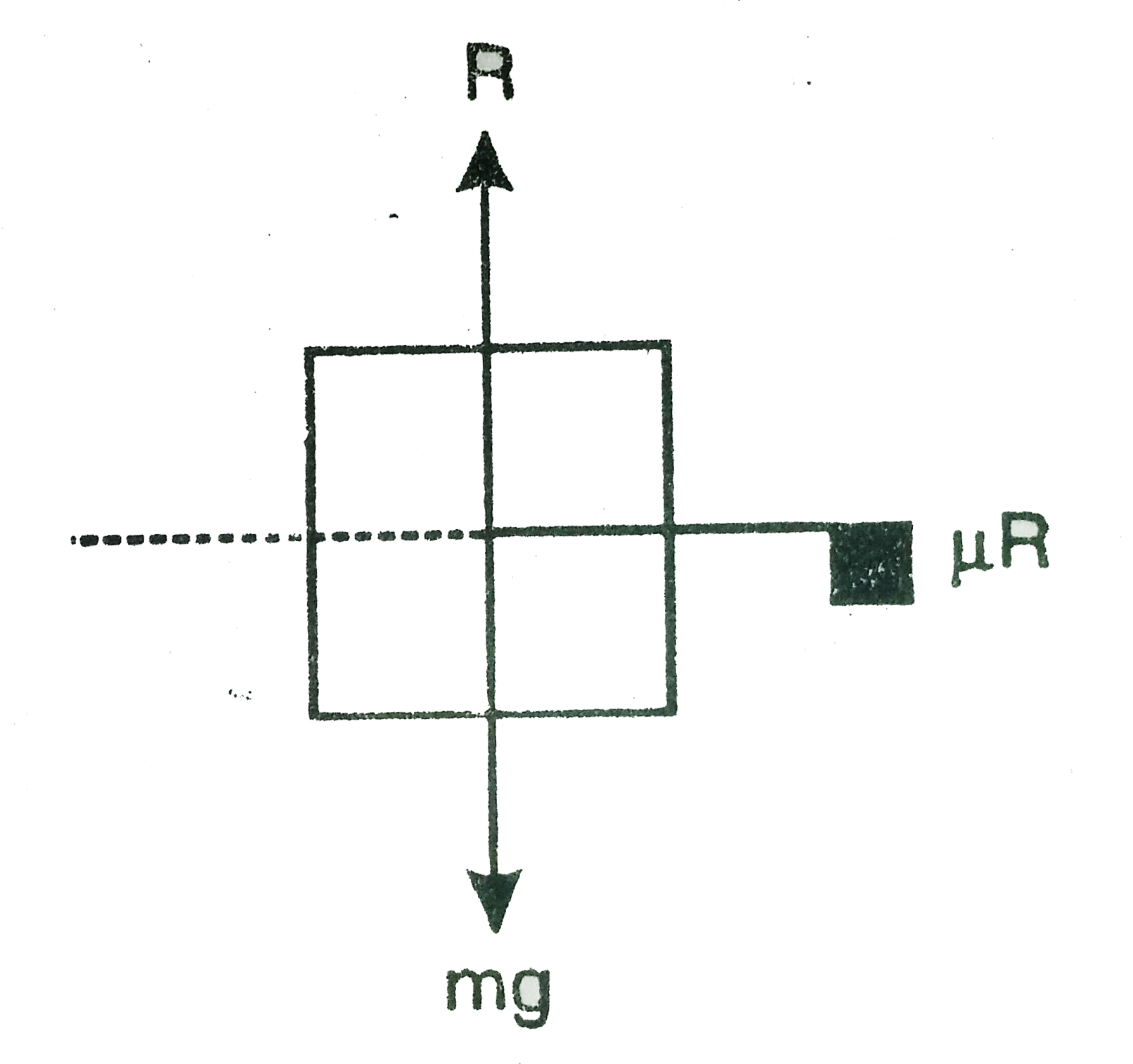
Let a maximum acceleratin is produced in car
`ma-mu R`
(for more accelerations the tyres will slip)
`rarr ma =mu mg`
`rarr a=mu g=1xx10=10 m/s^2` Force crossing of the bridge in minimum time, it has to travel with maximum acceeleration.
u=0, S=500m, a=10m/s
`From S=ut+1/2 at^2`
`500=0+(1/2)10t^2`
`rarr t=sqrt100=10sec`

If acceleration is less than `10 m/s^2` timewill be more than 10 sec. So one can't drive throughthe bridge in less than 10 s.
Promotional Banner

Topper's Solved these Questions

Similar Questions

Explore conceptually related problems

A car has to move on a level turn of radius 45 m. If the coefficient of static friction between the tyre and the road is mu_s=2.0, find the maximum speed the car can take without skidding.

The rear side of a truck is open and a box of 40 kg mass is placed 5 m away from the open end as shown in Fig. The coefficient of friction between the box and the surface below it is 0.15. On a straight road, the truck starts from rest and accelerates with 2 m s^(-2) . At what distance from the starting point does the box fall off the truck? (Ignore the size of the box).

Two bodies A and B of masses 5 kg and 10 kg in contact with each other rest on a table against a rigid wall . The coefficient of friction between the bodies and the table is 0.15. A force of 200 N is applied horizontally to A. What are (a) the reaction of the partition (b) the action-reaction forces between A and B ? What happens when the wall is removed? Does the answer to (b) change, when the bodies are in motion? Ignore the difference between mu_s and mu_k

A 100 kg block is started with a speed of 2.0 m s^(-1) on a long, rough belt kept fixed in a horizontal position. The coefficient of kinetic friction between the block and the belt is 0.20. (a) calculate the change in the internal energy of the block-belt system as the block comes to a stop on the belt. (b) consider the situation from a frame of reference moving at 2.0 m s^(-1) along the initial velocity of the block. as seen from this frame, the block is gently put on a moving belt and in due time the block starts moving with the belt at 2.0 m s^(-1) , calculate the increase in the kinetic energy of the block as it stops slipping past the belt. (c ) find the work done in this frame by the external force holding the belt.

In the section 3.7.3 (Banking of road) we have not included the friction exerted by the road on the car. Suppose the coefficient of static friction between the car tyre and the surface of the road is mu_s , calculate the minimum speed with which the car can take safe turn? When the car takes turn in the banked road, the following three forces act on the car. (1) The gravitational force mg acting downwards (2) The normal force N acting perpendicular to the surface of the road (3) The static frictional force f acting on the car along the surface.

A body of mass 2kg is resting on a rough horizontal surface. A force of 20N is now applied to it for 10s, parallel to the surface. If the coefficient of kinetic friction between the surfaces of contact is 0.2. Calculate change in kinetic energy of the object in 10s. (Take g=10ms^(-2) ).

A body of mass 2kg is resting on a rough horizontal surface. A force of 20N is now applied to it for 10s, parallel to the surface. If the coefficient of kinetic friction between the surfaces of contact is 0.2. Calculate Work done by the applied force in 10s

In a rotor, a hollow vertical cylindrical structure rotates about its axis and a person rests against the inner wall. At a particular speed of the rotor, the floor below the person is removed and the person hangs resting against the wall without any floor. If the radius of the rotor is 2m and the coefficient of static friction between the wall and the person is 0.2, find the minimum speed at which the floor may be removed Take g=10 m/s^2 .

HC VERMA-FRICTION-Exercises
  1. If the tension in the string in the figure. Is 16 N and the accelerati...

    Text Solution

    |

  2. The friction coefficient between the table and the block shown in figu...

    Text Solution

    |

  3. In the section 3.7.3 (Banking of road) we have not included the fricti...

    Text Solution

    |

  4. The friction coefficient bettween an athelete's shoes and the ground i...

    Text Solution

    |

  5. A car is going at a speed of 21.6 km/hr when it encounters a 12.8 m lo...

    Text Solution

    |

  6. A car starts from rest on a half kilometer long bridge. The coefficiet...

    Text Solution

    |

  7. Figure shows tow blocks in contact sliding down an inclined surface of...

    Text Solution

    |

  8. Two masses M1 and M2 are connected by a light rod and the system is sl...

    Text Solution

    |

  9. A block of mass M is kept on as rough horizontal surface. The coeffici...

    Text Solution

    |

  10. The friction coeficient bettween the board and the floor shownin filgu...

    Text Solution

    |

  11. A horizontal force of 3.2 N is applied on a 3.7kg block, which rests o...

    Text Solution

    |

  12. Find the accelerations a1,a2,a3 of the three blocks shown in figure if...

    Text Solution

    |

  13. The friction coefficient between the two blocks shown in figure is mu ...

    Text Solution

    |

  14. Suppose the entire system of the previous question is kept inside an e...

    Text Solution

    |

  15. Consider the situation shown in figure. Suppose a small electric field...

    Text Solution

    |

  16. A block of mass m slips on a rough horizontal table under the action o...

    Text Solution

    |

  17. Find the acceleration of the block of mass M in the situation of figur...

    Text Solution

    |

  18. A block of mass 2 kg is pushed against a rough vertical wall with a fo...

    Text Solution

    |

  19. A person (40 kg) is managing to be at rest between two verticle walls ...

    Text Solution

    |

  20. Figure shows a small block of mass m kept at the left end of a larger ...

    Text Solution

    |

