Home
Class 11
PHYSICS
Find the accelerations a1,a2,a3 of the t...

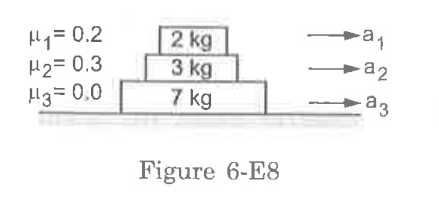
Find the accelerations `a_1,a_2,a_3` of the three blocks shown in figure if a horizontal force of 10 N is applied on a. 2 kg block, b. 3 kg block, c. 7 kg block. Take `g=10 m/s^2`.

Text Solution

Verified by Experts
Given
`mu_1=0.2 mu_2=0.3 mu_3=0.4`

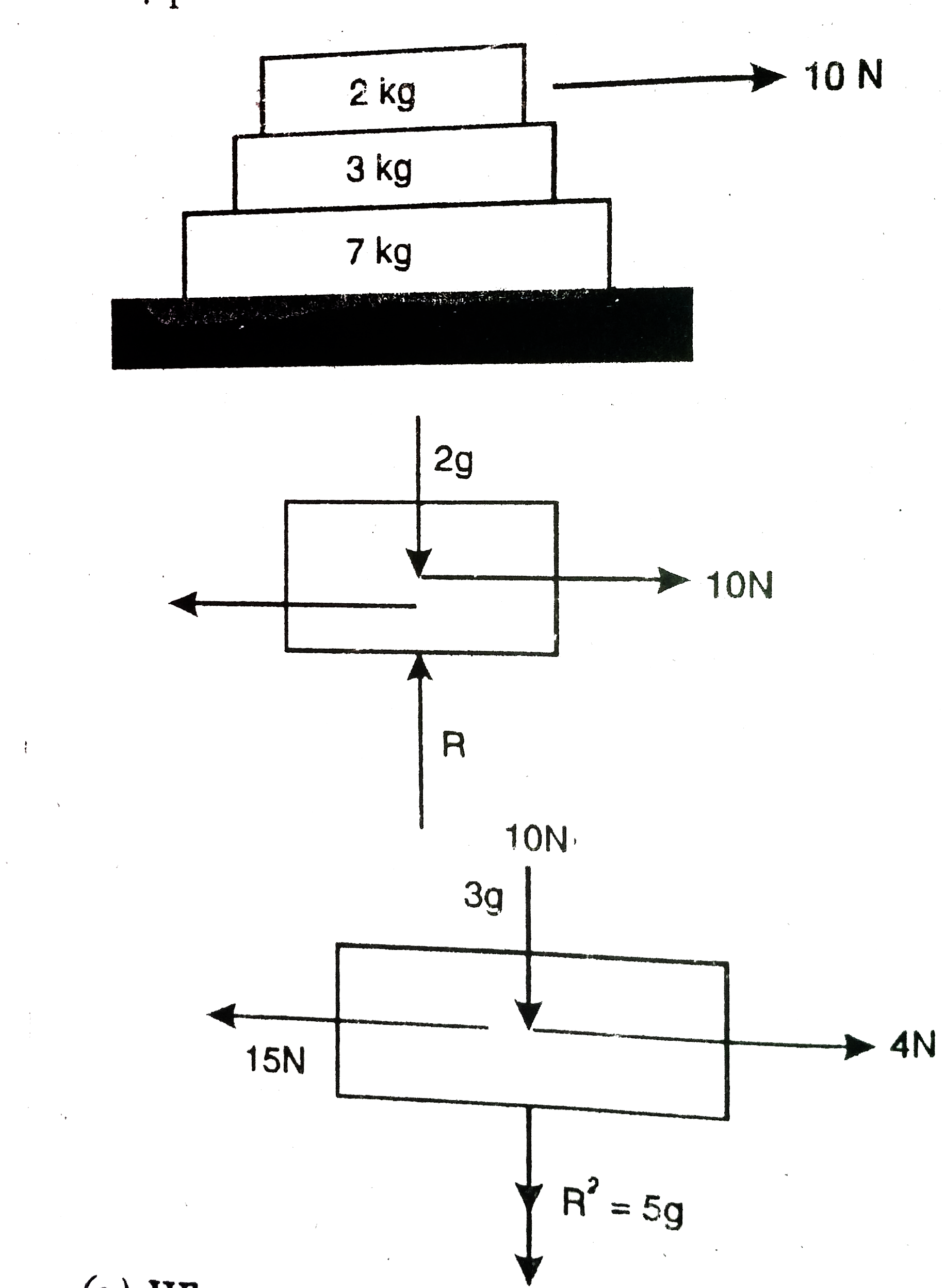
a. Whenthe 10N force is aplie don 2 kg blcok, it experiences maximum frictioN/Al froce.
`muR_1=muxx2g=(0.2)xx20`
`=4N from the 3 kg blocl So, the 2 kg block experience a net froce `=10-4=6N`
So,` a_1=6/2=3m/s^2`
But for the 3 kg block, ure the frictioN/Al force from 2 kg block (4N) becomes the driving force and the maximum frictioN/Al foce between 3 kg and 7 kg blocks
`mu_2=RP_2=(0.3)xx5 kg`
=15N
S, the 3 kg block cannot move relative to the 7 kg block, the 3 kg blcok and the 7 kg block bothwill have same acceleration`(a_2=a_3)` which will be due to the 4N force because there is no friction from the floor.
`a_2=a_3=4/10=0.4m/s^2`
b. When the 10 N force is appied to the 3 Kg block, it canexperience maximum frictioN/Al force of 15+4=19N fromthke 2 kg block and 7 kg blcok.
So, it can not move with respect to them. As tehfloor is frictionless, al the three bodies will move together.
`:. a_1=a_2=a_3=10/12=(5/6)m/s^2.
Promotional Banner

Topper's Solved these Questions

Similar Questions

Explore conceptually related problems

A block of mass 2.5 kg is kept on a rough horizontal surface. It is found that the block does not slide if a horizontal force less than 15 N is applied to it. Also it is found that it takes 5 seconds to slide through the first 10 m if a horizontal force of 15 N is applied and the block is gently pushed to start the motion. Taking g=10 m/s^2 , calculate the coefficient of static and kinetic friction between the block and the surface.

The coefficient of static friction between the two blocks shown in figure is mu and the table is smooth. What maximum horizontal forced F can be applied to he block of mass M so that the block move together?

The coefficient of static friction between the block of 2 kg and the table shown in figurwe is mu_s=0.2 What should be the maximum value of m so tht the blocks do not move? Take g=10 m/s^2. The string and the pulley are light and smooth.

The friction coefficient between the horizontal surfce and ech of the blocks shown in figure is 0.20. The collision between the blocks is perfectly elastic. Find the separation between the two blocks when they come to rest. Take g=10 m/s^2 .

A small block B is placed on another block A of mass 5 kg and length 20 cm. Initially, the block B is near the right end of block A. A constant horizontal force of 10 N is applied to the block A. All the surfaces are assumed frictionless. Find the time elapsed before the block B separates from A.

Find the acceleration of the block of mass M in the situation of figure. The coefficient of friction between the two blocks is mu_1 and that between the bigger block and the ground is mu_2 .

A block of mass 2 kg is pushed against a rough vertical wall with a force is 40 N. Coefficient of static friction being 0.5. Another horizontal force is 15 N, is applied on the block in a direction parallel to the wall. Will the block move? If yes in which direction? If no, find the frictional force exerted by the wall on the block.

Three blocks A, B and C of mass 4 kg , 2kg and 1kg respectively , are in contact on frictionless surface as shown .If a force appliedon 14N is applied on the 4 kg block then the contact force between A and B is :

Find the ratio of the weights, as measured by a spring balance, of a 1 kg block of iron and a 1kg block of wood. Density of iron =7800 kg m^-3 density of wood =800 kg m^-3 and density of air =1.293 kgm^-3 .

HC VERMA-FRICTION-Exercises
  1. If the tension in the string in the figure. Is 16 N and the accelerati...

    Text Solution

    |

  2. The friction coefficient between the table and the block shown in figu...

    Text Solution

    |

  3. In the section 3.7.3 (Banking of road) we have not included the fricti...

    Text Solution

    |

  4. The friction coefficient bettween an athelete's shoes and the ground i...

    Text Solution

    |

  5. A car is going at a speed of 21.6 km/hr when it encounters a 12.8 m lo...

    Text Solution

    |

  6. A car starts from rest on a half kilometer long bridge. The coefficiet...

    Text Solution

    |

  7. Figure shows tow blocks in contact sliding down an inclined surface of...

    Text Solution

    |

  8. Two masses M1 and M2 are connected by a light rod and the system is sl...

    Text Solution

    |

  9. A block of mass M is kept on as rough horizontal surface. The coeffici...

    Text Solution

    |

  10. The friction coeficient bettween the board and the floor shownin filgu...

    Text Solution

    |

  11. A horizontal force of 3.2 N is applied on a 3.7kg block, which rests o...

    Text Solution

    |

  12. Find the accelerations a1,a2,a3 of the three blocks shown in figure if...

    Text Solution

    |

  13. The friction coefficient between the two blocks shown in figure is mu ...

    Text Solution

    |

  14. Suppose the entire system of the previous question is kept inside an e...

    Text Solution

    |

  15. Consider the situation shown in figure. Suppose a small electric field...

    Text Solution

    |

  16. A block of mass m slips on a rough horizontal table under the action o...

    Text Solution

    |

  17. Find the acceleration of the block of mass M in the situation of figur...

    Text Solution

    |

  18. A block of mass 2 kg is pushed against a rough vertical wall with a fo...

    Text Solution

    |

  19. A person (40 kg) is managing to be at rest between two verticle walls ...

    Text Solution

    |

  20. Figure shows a small block of mass m kept at the left end of a larger ...

    Text Solution

    |

