Home
Class 11
PHYSICS
The friction coefficient between the two...

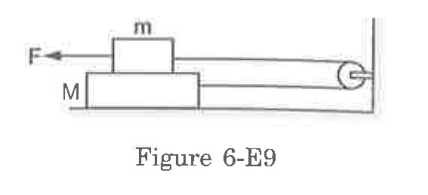
The friction coefficient between the two blocks shown in figure is `mu` but the floor is smooth. A. What maximum horizontal force F can be applied without disturbing the equilibrium of the systme? b.suppose the horizontal force applied is double of that found in part a. Findthe accelerations of the two masses.

Text Solution

Verified by Experts

Both upper block andlower block will have acceleration `2m/s^2`

`R_1=mg F=mu R_1-T=0`
`rarr T-muR_1=0`
`and `F--mu mg =T` …..ii
`rarr T=mu mg`
Putting `T=mu mg`
`F=mu mg +mu mg = 2mu mg`
b. `2F=T-mumg -ma`
=0.........i
`T-ma-mu mg =0 [:.R=mg]`
`rarr T=ma+mumg`
Putting value of T in i. we have
`2F-Mamu mg +mu mg-ma=0`
Putting `F=2mumg`
2(2mumg)-2mumg=a(M+m)`
`rarr4mu mg-2mumg=a(M+m)`
`rarr a=(2mu mg)/(M+m)`
Both blocks move with this acceleration a in opposite direction.
Promotional Banner

Topper's Solved these Questions

Similar Questions

Explore conceptually related problems

The coefficient of static friction between the two blocks shown in figure is mu and the table is smooth. What maximum horizontal forced F can be applied to he block of mass M so that the block move together?

The friction coefficient between the horizontal surfce and ech of the blocks shown in figure is 0.20. The collision between the blocks is perfectly elastic. Find the separation between the two blocks when they come to rest. Take g=10 m/s^2 .

A block is mass m moves on as horizontal circle against the wall of a cylindrical room of radius R. The floor of the room on which the block moves is smooth but the friction coefficient between the wall and the block is mu . The block is given an initial speed v_0 . As a function of the speed v write a. the normal force by the wall on the block. b. the frictional force by the wall and c. the tangential acceleration of the block. d. Integrate the tangential acceleration ((dv)/(dt)=v(dv)/(ds)) to obtain the speed of the block after one revoluton.

A constant force F=m_2g/s is applied on the block of mass m_1 as shown in figure. The string and the pulley are light and the surface of the table is smooth. Find the acceleration of m_1

A block of mass m slips on a rough horizontal table under the action of horiozontal force applied to it. The coefficient of friction between the block and the table is mu . The table does not move on the floor. Find the total frictional force aplied by the floor on the legs of the table. Do you need the friction coefficient between the table and the floor or the mass of the table ?

A block of mass m is kept on a horizontal ruler . The friction coefficient between the ruler and the block is mu . The ruler is fixed at one end the block is at a distance L from the fixed end . The ruler is rotated about the fixed end in the horizontal plane through the fixed end a. What can the maximum angular speed be for which the block does not slip? b. If the angular speed of the ruler is uniform increase from zero at an angular acceleration a at angular speed will the block slip?

Consider the situation shown in figure. Suppose a small electric field E exists in the space in the vertically upward direction and the upper block carries a positive charge Q on its top surface. The friction coefficient between the two blocks is mu but teh floor is smooth. what maximum horizontal force F can be applied without disturbing the equilibrium?

A horizontal force of 3.2 N is applied on a 3.7kg block, which rests on a horizontal surface. If the co-efficient of friction is 0.6, find the acceleration produced in the block ?

A block of mass M is pulled on a smooth horizontal table by a string making an angle theta with the horizontal as shown in figure. If the acceleration of the block is a , find the force applied by the string and by the table N on the block.

A block is placed on a rough floor and a horizontal force F is applied on it. The force of friction f by the floor on the block is measured for different values of F and a graph is plotted between them.

HC VERMA-FRICTION-Exercises
  1. If the tension in the string in the figure. Is 16 N and the accelerati...

    Text Solution

    |

  2. The friction coefficient between the table and the block shown in figu...

    Text Solution

    |

  3. In the section 3.7.3 (Banking of road) we have not included the fricti...

    Text Solution

    |

  4. The friction coefficient bettween an athelete's shoes and the ground i...

    Text Solution

    |

  5. A car is going at a speed of 21.6 km/hr when it encounters a 12.8 m lo...

    Text Solution

    |

  6. A car starts from rest on a half kilometer long bridge. The coefficiet...

    Text Solution

    |

  7. Figure shows tow blocks in contact sliding down an inclined surface of...

    Text Solution

    |

  8. Two masses M1 and M2 are connected by a light rod and the system is sl...

    Text Solution

    |

  9. A block of mass M is kept on as rough horizontal surface. The coeffici...

    Text Solution

    |

  10. The friction coeficient bettween the board and the floor shownin filgu...

    Text Solution

    |

  11. A horizontal force of 3.2 N is applied on a 3.7kg block, which rests o...

    Text Solution

    |

  12. Find the accelerations a1,a2,a3 of the three blocks shown in figure if...

    Text Solution

    |

  13. The friction coefficient between the two blocks shown in figure is mu ...

    Text Solution

    |

  14. Suppose the entire system of the previous question is kept inside an e...

    Text Solution

    |

  15. Consider the situation shown in figure. Suppose a small electric field...

    Text Solution

    |

  16. A block of mass m slips on a rough horizontal table under the action o...

    Text Solution

    |

  17. Find the acceleration of the block of mass M in the situation of figur...

    Text Solution

    |

  18. A block of mass 2 kg is pushed against a rough vertical wall with a fo...

    Text Solution

    |

  19. A person (40 kg) is managing to be at rest between two verticle walls ...

    Text Solution

    |

  20. Figure shows a small block of mass m kept at the left end of a larger ...

    Text Solution

    |

