Home
Class 11
PHYSICS
Consider the situation shown in figure. ...

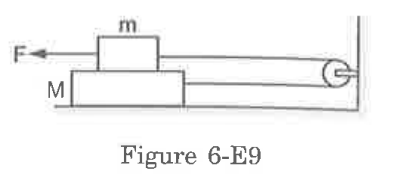
Consider the situation shown in figure. Suppose a small electric field E exists in the space in the vertically upward direction and the upper block carries a positive charge Q on its top surface. The friction coefficient between the two blocks is `mu` but teh floor is smooth. what maximum horizontal force F can be applied without disturbing the equilibrium?

Text Solution

Verified by Experts
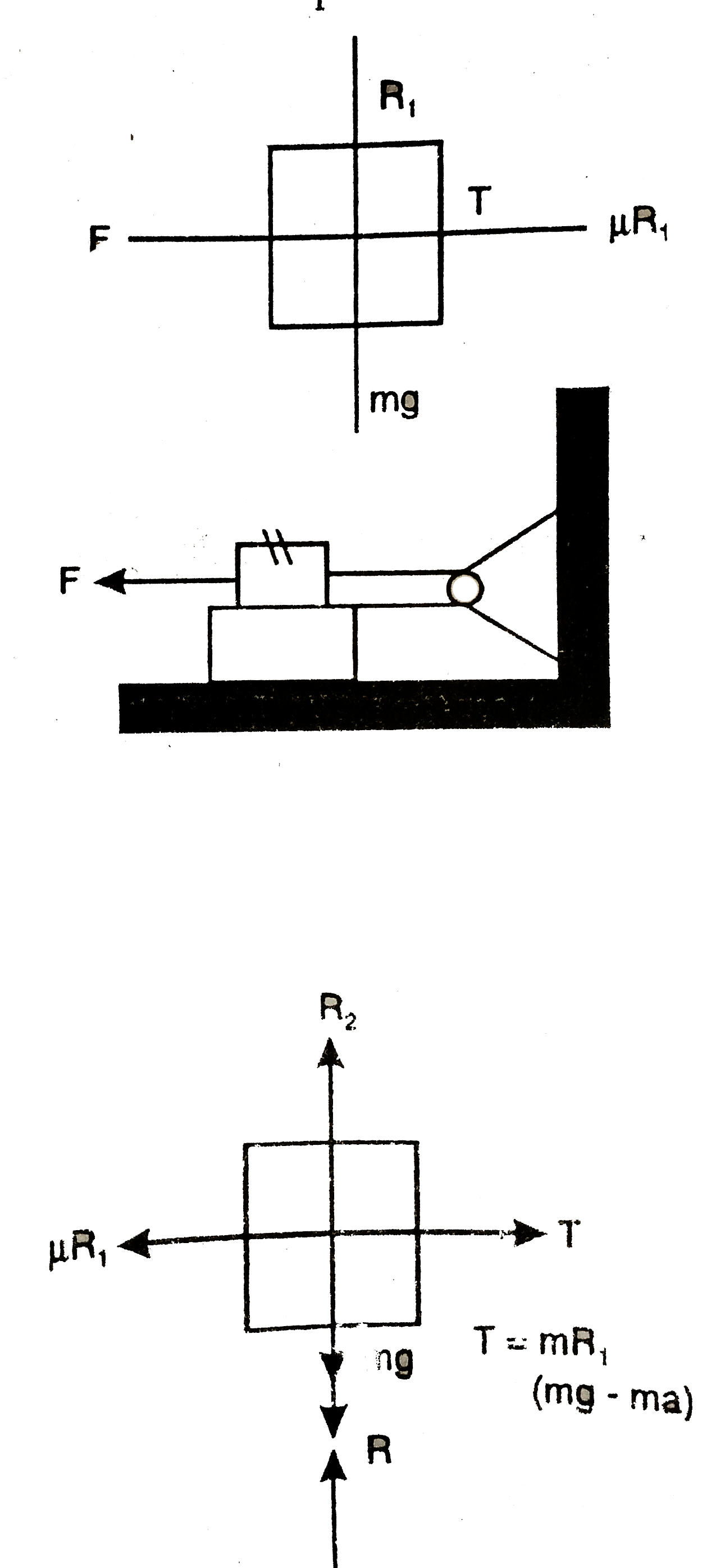
`R_1+QE=mg=0`
`rarr R_1=mg-QE`…………i

`F-T=muR_1`
From equation i.

`rarr T-mumg+muQE`
=0 …………ii
`T-muR_1=0`
`rarr T=muR_1`
=mu(mg-QE)`……iii
From equation ii
`F-mumg+muQE-mumg+muQE=0`
`rarr F-2mumg+2muQE=0`
`rarr F=2mumg-2muQE`
`rarr F=2mu(mg-QE)`
Maximum horizontal force that can be applied is `2mu(mg-QE)`.
Promotional Banner

Topper's Solved these Questions

Similar Questions

Explore conceptually related problems

The coefficient of static friction between the two blocks shown in figure is mu and the table is smooth. What maximum horizontal forced F can be applied to he block of mass M so that the block move together?

The friction coefficient between the two blocks shown in figure is mu but the floor is smooth. A. What maximum horizontal force F can be applied without disturbing the equilibrium of the systme? b.suppose the horizontal force applied is double of that found in part a. Findthe accelerations of the two masses.

Consider the situation shown in figure. The horizontal surface below the bigger block is smooth. The coefficient of friction between the blocks is mu . Find the minimum and the maximum force F that can be applied in order to keep the smaller block at rest with respect to the bigger block.

A hemispherical bowl of radius R is rotated about its axis of symmetry which is kept vertical.A small block is kept in the bowl at a position where the radius makes an angle theta with the vertical. The block rotates with the bowl without any slipping. The friction coefficient between the block and the bowl surface is mu . Find the range of the angular speed for which the block will not slip.

Two metal strips, each of length, each of length l, are clamped parallel to each other on a horizontal floor with a separation b between them. A wire of mass m line on them perpendicularly as shown in figure. A vertically upward magnetic field of strenght B exists in the space. The matal strips are smooth but the cofficient of freiction between the wire and the floor is mu . A current i is established when the switch S is closed at the instant t=0 . Discuss the motion of the wire after the switch is closed. How far away from the strips will the wire reach?

A straight wire of length l can slide on two parallel plastic rails kept in a horizontal plane with a separation d. The coefficient of friction between the wire and the rails is mu . If the wire carries a current I, what minimum magnetic field should exist in the space in order to slide the wire on the rails.

A block of mass m and positive charge q is placed on an insulated frictionless inclined plane as shown in the figure. A uniform electric field E is applied parallel to the inclined surface such that the block is at rest. Calculate the magnitude of the electric field E.

A small block of mass m is kept on a bigger block of mass M which is attached to a vertical spring of spring constant k as shown in the figure. The system oscilates verticaly. a.Find the resultant force on the smaller block when it is displaced through a distance x above its equilibrium position. b. find the normal force on the smaller blok at this position. When is this force smallest smaller block at this position. When is this force smallest in magnitude? c. What can be the maximum amplitude with which the two blocks may oscillate together?

Figure shows a metal rod PQ resting on the smooth rails AB and positioned between the poles of a permanent magnet. The rails, the rod and the magnetic field are in three mutually perpendicular directions. A galvonometer G connects the rails through a switch K. Length of rod = 15 cm, B = 0.50 T, resistance of the closed loop containing the rod = 9.0mOmega . Assume the field to be uniform. a. Suppose K is open and the rod is moved with a speed of 12cms^(-1) in the direction shown. Give the polarity and magnitude of the induced emf. b. Is there an excess charge built up at the ends of the rods when K is open? What if K is closed? c. With K open and the rod moving uniformly, there is no net force on the electrons in the rod PQ eventhough they do experience magnetic force due to the motion of the rod. Explain. d. What is the retarding force on the rod when K is closed? e. How much power is required (by an external agent) to keep the rod moving at the same speed (=12cms^(-1)) when K is closed? How much power is required when K is open? f. How much power is dissipated as heat in the closed circuit? What is the source of this power? g. What is the induced emf in the moving rod if the magnetic field is parallel to the rails instead of being perpendicular?

HC VERMA-FRICTION-Exercises
  1. If the tension in the string in the figure. Is 16 N and the accelerati...

    Text Solution

    |

  2. The friction coefficient between the table and the block shown in figu...

    Text Solution

    |

  3. In the section 3.7.3 (Banking of road) we have not included the fricti...

    Text Solution

    |

  4. The friction coefficient bettween an athelete's shoes and the ground i...

    Text Solution

    |

  5. A car is going at a speed of 21.6 km/hr when it encounters a 12.8 m lo...

    Text Solution

    |

  6. A car starts from rest on a half kilometer long bridge. The coefficiet...

    Text Solution

    |

  7. Figure shows tow blocks in contact sliding down an inclined surface of...

    Text Solution

    |

  8. Two masses M1 and M2 are connected by a light rod and the system is sl...

    Text Solution

    |

  9. A block of mass M is kept on as rough horizontal surface. The coeffici...

    Text Solution

    |

  10. The friction coeficient bettween the board and the floor shownin filgu...

    Text Solution

    |

  11. A horizontal force of 3.2 N is applied on a 3.7kg block, which rests o...

    Text Solution

    |

  12. Find the accelerations a1,a2,a3 of the three blocks shown in figure if...

    Text Solution

    |

  13. The friction coefficient between the two blocks shown in figure is mu ...

    Text Solution

    |

  14. Suppose the entire system of the previous question is kept inside an e...

    Text Solution

    |

  15. Consider the situation shown in figure. Suppose a small electric field...

    Text Solution

    |

  16. A block of mass m slips on a rough horizontal table under the action o...

    Text Solution

    |

  17. Find the acceleration of the block of mass M in the situation of figur...

    Text Solution

    |

  18. A block of mass 2 kg is pushed against a rough vertical wall with a fo...

    Text Solution

    |

  19. A person (40 kg) is managing to be at rest between two verticle walls ...

    Text Solution

    |

  20. Figure shows a small block of mass m kept at the left end of a larger ...

    Text Solution

    |

