Home
Class 11
PHYSICS
The track shown in figure is frictionles...

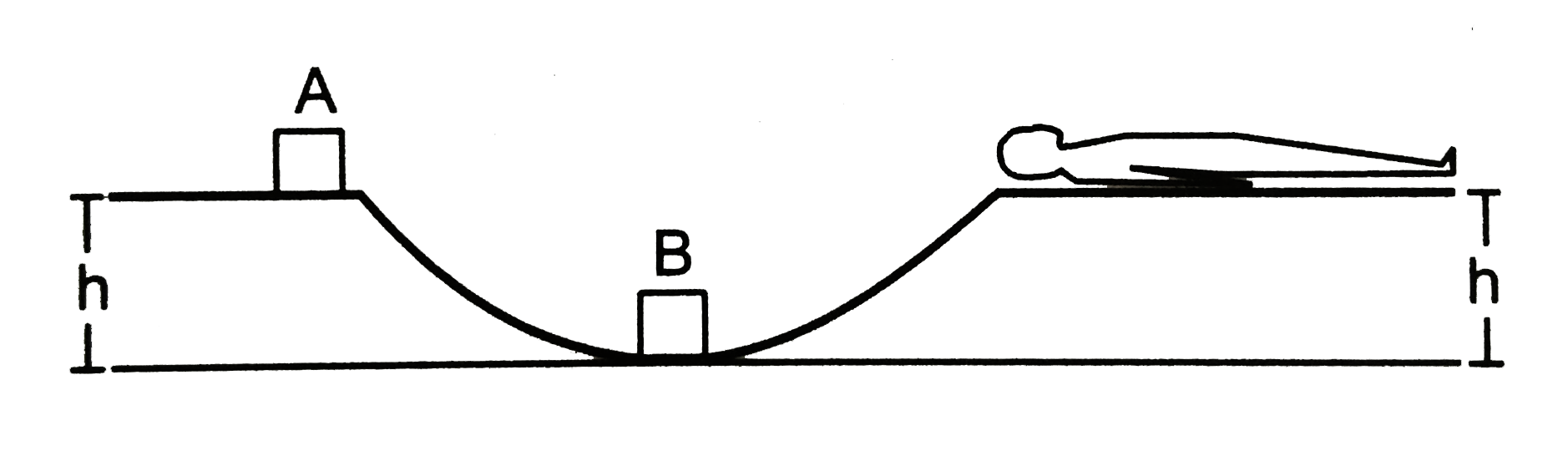
The track shown in figure is frictionless. The block B of mass 2 m is lying at rest and the block A of mass m is placed along the track with some speed. The collision between A and B is perfectly elastic. With what velocity should the block A be started to get the sleeping man awakened ?

Text Solution

Verified by Experts

The correct Answer is:

A, B

Let the velocity of `A=mu_1`
Let the fiN/Al velocity when reachign at B become collision `=v_1`
`:.(1/2)m_1^2-(1/2)mv_1^2=mgh`
`rarr v_1^2-v_1^2=2gh`
`rarr v_1=sqrt(2gh+u_1^2)`……..i
When the block B reached at the upper man's hed, the velocity of B is just zero.
`:. (1/2)x2mxx(0)^2-(1/2)xx2mxxv^2=mgh`
rarr `v=sqrt(2gh)`
`:. Before collison velocity of u_A=v_1` ltbr. `u_B=0`
After collision velocity fo v_A=V(say)`
`v_B=sqrt(2gh)`
since it is an elastic collision the momentum and K be conserved
`:.mxxv_1+2mxx0=mxxv+2m+sqrt(2gh)`
`rarr v_1-v=2sqrt(2gh)`
Also `(1/2)xxmxxv_1^2+(1/2)xx2m(sqrt(2gh)^2)`
`rarr v_1^2-v^2=2xxsqrt(2gh)xx2msqrt(2gh)`
Dividing i and ii
`((v_1+v)(v_1-v))/(v_1+v)=(2xxsqrt(2gh)xsqrt(2gh))/(2xxsqrt(2gh))`
`rarr v_1+v=sqrt(2gh)`
dividing i and iii
`2v_1=3sqrt(2gh)`
`rarr v_1=(3/2)sqrt(2gh)`
`But v_1=sqrt(2gh+u^2)`
`=(3/2)sqrt(2gh)`
rarr 2gh+u^2=(9/4)(2gh)`
`u=sqrt(2.5gh)`
So the block will travel with a velocity greater than `sqrt(2.5gh)` i.e., man must awake.
Promotional Banner

Topper's Solved these Questions

  • CENTRE OF MASS, LINEAR MOMENTUM, COLLISION

    HC VERMA|Exercise Objective -2|11 Videos
  • CALORIMETRY

    HC VERMA|Exercise Exercises|18 Videos
  • CIRCULAR MOTION

    HC VERMA|Exercise Exercises|30 Videos

Similar Questions

Explore conceptually related problems

The block of mass m_1 shown in figure is fastened to the spring and the block of mass m_2 is placed as against it. Find the compression of the spring in the equilibrium position.

All the surfaces shown in figure are assumed to be frictionless. The block of mass m slides on the prism which in turn slides backward on the horizontal surface. Find the acceleration of the smaller block with respect to the prism.

A block of mass m moving at speed upsilon collides with another block of mass 2 m at rest. The lighter block comes to rest after the collision. Find the coefficient of restitution.

Describe the motion of the mass m shown in figure. The walls and the block are elastic.

The friction coefficient between the horizontal surfce and ech of the blocks shown in figure is 0.20. The collision between the blocks is perfectly elastic. Find the separation between the two blocks when they come to rest. Take g=10 m/s^2 .

A block of mas m is placed on a triangular block of mas m, which in tunis placed on a horizontal surface as shown in figure. Assuming frictionless surfaces find the velocity of the triangular block when the smaller block reaches the bottom end.

Two concave mirrors of equal radii of curvature R are fixed on a stand facing opposite directions. The whole system has a mass m and is kept on a frictionless horizonal table. Two blocks A and B, each of mass m, are placed on the two side of the stand. At t=0, the separation between A and the mirrors is 2R and also the separation between B and the mirrors is 2R. The block B moves towards the mirror at a speed v. All collisions which take place are elastic. Taking the original position of the mirrors stand system to be x=0 and X -axis along AB, find the position of the image of A and B at t= a.) R/(upsilon) , b.) (3R)/(upsilon) c.) (5R)/(upsilon)

A man of mass m is standing on a platform of mass M kept on smooth ice. If the man starts moving on the platform with a speed v relative to the platform with what velocity relative to the ice does the platform recoil?

The elevator shown in figure is descending with an acceleration of 2m/s^2 . The mass of the block A is 0.5 kg. What force is exerted by the block A on the block B?

A block of mass m slides down a smooth vertical circular track. During the motion, the block is in

HC VERMA-CENTRE OF MASS, LINEAR MOMENTUM, COLLISION-Exercises
  1. The coefficient of restitution (e ) for a material is as follows

    Text Solution

    |

  2. An ideal spring of spring constant k, is suspended from the ceiling of...

    Text Solution

    |

  3. A bullet of mass 25 g is fired horizontally into a ballistic pendulum ...

    Text Solution

    |

  4. A bullet of mass 10g moving horizontally with a velocity of 400 ms^-1s...

    Text Solution

    |

  5. Two masses m1 and m2 re connected by a spring of spring constant k and...

    Text Solution

    |

  6. Two blocks of masses m1 and m2 are connected by a spring of spring con...

    Text Solution

    |

  7. Cionsider the situation of the previous problem. Suppose each of tbe b...

    Text Solution

    |

  8. Consider the situation of the previous problem. The force on the centr...

    Text Solution

    |

  9. A ball of mass 1 kg moving with a speed of 10 ms^(-1) rebounds after ...

    Text Solution

    |

  10. The track shown in figure is frictionless. The block B of mass 2 m is ...

    Text Solution

    |

  11. A bullet of mass 10g moving horizontally at a speed of 50 7 ​ m/s s...

    Text Solution

    |

  12. Two balls having masses m and 2m are fasrtened to two light strings of...

    Text Solution

    |

  13. A uniform chain of mass M and length L is held verticallyi in such a w...

    Text Solution

    |

  14. The blocks shown in figure have equal masses. The surface of A is smoo...

    Text Solution

    |

  15. The friction coefficient between the horizontal surfce and ech of the ...

    Text Solution

    |

  16. A block of mas m is placed on a triangular block of mas m, which in tu...

    Text Solution

    |

  17. Figure shows a small body of mass m placed over a larger mass M whose ...

    Text Solution

    |

  18. A small block of superdennse material has a mass of 3xx10^24 kg. It i...

    Text Solution

    |

  19. A body of mass m makes an elastic collision with another identical bod...

    Text Solution

    |

  20. A small particle travelling with a velocity v collides elastically wit...

    Text Solution

    |
