Home
Class 11
PHYSICS
Two balls having masses m and 2m are fas...

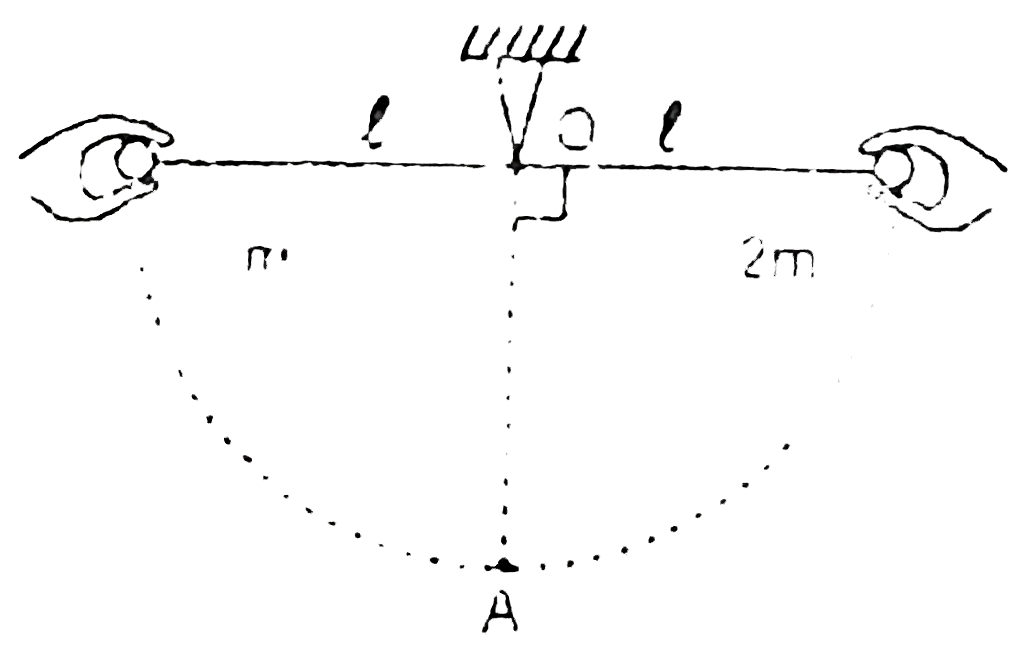
Two balls having masses m and 2m are fasrtened to two light strings of same length (figure). The other ends of the strings are fixed at O. The strings are kept in the same horizontal line and the system is released from rest. The collision between the balls is elastic. Point A is the lowest point at which either ball can reach

The speed of ball of mass 2m just after collision (for the first time) is over

Text Solution

Verified by Experts

Let the velocilty of m reaching at lower end
`=v_1`
From work energy principle
`:.(1/2)xxmv_1^2-(1/2)xxm(0)^2=mgl`
`rarr v_1=sqrt(2gl)`
similarly velocity of heavy block will be ltbr. `v_2=sqt(2gl)`
`:. V_1=v_2=u(say)`
Let fiN/A,l velocity of m and 2m are `v_1 and v_2` respectively.
According to law of conservation of momenum
`rarr mxxu-2mu=mv_1+2mv_2`
`rarr v_1+2v_2=-u`
`Again v_1-v-2=[(u-v)]=-2u`
Substracting
`3v_2=u`
`rarr v_2=u/3=sqrt(2gl)/3`
substituting in ii ltbr. `v_1-v_2=-2u`
`rarr v_1=-2u+v_2`
`=-2u+(u/3)`
`=(-5)/3u=(-5)/3xxsqrt(2gl)`
`(sqrt(50gl))/3`
b. putting the work energy principle
(1/2)xx2mxx(0)^2-(1/2)xx2mxx(v_2)^2`
`=-2mxxgxxh`
`[hrarr` height reached by heavy ball]`
`rarr h=(L/9)`
similarly
`(1/2)xxmx(0)^2-(1/2)xxmv_1^2=mxxgxxh_2`
[height reached by small ball] ltbr. `(1/2)xx(50gL)/9 gxxh_2`
`h_2=(0.25L)/9`
some `h_2` is more than 2L the velocity at highest point will not be zero.
Promotional Banner

Topper's Solved these Questions

  • CENTRE OF MASS, LINEAR MOMENTUM, COLLISION

    HC VERMA|Exercise Objective -2|11 Videos
  • CALORIMETRY

    HC VERMA|Exercise Exercises|18 Videos
  • CIRCULAR MOTION

    HC VERMA|Exercise Exercises|30 Videos

Similar Questions

Explore conceptually related problems

The mass of the part of the string below A in figure is m. Find the tension of the string at the lower end and at A.

A particle is fastened at the end of a string and whirled in a vertical circle with the other end of the string being fixed. The motion of the particle is

A stone of mass m tied to a string of length l is rotated in a circle with the other end of the string as the centre. The speed of the stone is v. If the string breaks, the stone will move

A standing wave is produced on a string on a string clamped at one end and free at the other. The length of the string

Two bodies of masses m_1 and m_2 are connected by a light string going over a smooth lilght pulley at the end of an incline. The m_1 lies on the incline m_2 hangs vertically. The system is t rest. Find the angle of the incline and the fore exerted by the incline on the body of mass m_1.

Two pith balls carrying equal charges are suspended from a common point by strings of equal length, the equilibrium separation between them is r.Now the strings are rigidly clamped at half the height.The equilibrium separation between the balls now become:

Two blocks of equal mass m are tied to each other through light string. One of the blocks is pulled along the line joining them with a constant force F. Find the tension in the string joining the blocks.

Two small balls A and B each of mass m, are joined rigidly to the ends of a light rod of length L figure. The system translates on a frictionless horizontal surface with a velocity v_0 in a direction perpendicular to the rod. A particle P of mass kept at rest on the surface sticks to the ball A as the ball collides with it . Find a. the linear speeds of the balls A and B after the collision, b. the velocity of the centre of mass C of the system A+B+P and c. the angular speed of the system about C after the collision.

A 2.00 m-long rope, having a mass of 80 g, is fixed at one end and is tied to a light string at the other end. The tension in the string is 256 N. (a) Find the frequencies of the fundamental and the first two overtones. (b) Find the wavelength in the fundamental and the first two overtones.

A body of mass m is suspended by two strings making angles alpha and beta with the horizontal. Find the tensions in the strings.

HC VERMA-CENTRE OF MASS, LINEAR MOMENTUM, COLLISION-Exercises
  1. The coefficient of restitution (e ) for a material is as follows

    Text Solution

    |

  2. An ideal spring of spring constant k, is suspended from the ceiling of...

    Text Solution

    |

  3. A bullet of mass 25 g is fired horizontally into a ballistic pendulum ...

    Text Solution

    |

  4. A bullet of mass 10g moving horizontally with a velocity of 400 ms^-1s...

    Text Solution

    |

  5. Two masses m1 and m2 re connected by a spring of spring constant k and...

    Text Solution

    |

  6. Two blocks of masses m1 and m2 are connected by a spring of spring con...

    Text Solution

    |

  7. Cionsider the situation of the previous problem. Suppose each of tbe b...

    Text Solution

    |

  8. Consider the situation of the previous problem. The force on the centr...

    Text Solution

    |

  9. A ball of mass 1 kg moving with a speed of 10 ms^(-1) rebounds after ...

    Text Solution

    |

  10. The track shown in figure is frictionless. The block B of mass 2 m is ...

    Text Solution

    |

  11. A bullet of mass 10g moving horizontally at a speed of 50 7 ​ m/s s...

    Text Solution

    |

  12. Two balls having masses m and 2m are fasrtened to two light strings of...

    Text Solution

    |

  13. A uniform chain of mass M and length L is held verticallyi in such a w...

    Text Solution

    |

  14. The blocks shown in figure have equal masses. The surface of A is smoo...

    Text Solution

    |

  15. The friction coefficient between the horizontal surfce and ech of the ...

    Text Solution

    |

  16. A block of mas m is placed on a triangular block of mas m, which in tu...

    Text Solution

    |

  17. Figure shows a small body of mass m placed over a larger mass M whose ...

    Text Solution

    |

  18. A small block of superdennse material has a mass of 3xx10^24 kg. It i...

    Text Solution

    |

  19. A body of mass m makes an elastic collision with another identical bod...

    Text Solution

    |

  20. A small particle travelling with a velocity v collides elastically wit...

    Text Solution

    |
