Home
Class 11
PHYSICS
A block of mas m is placed on a triangul...

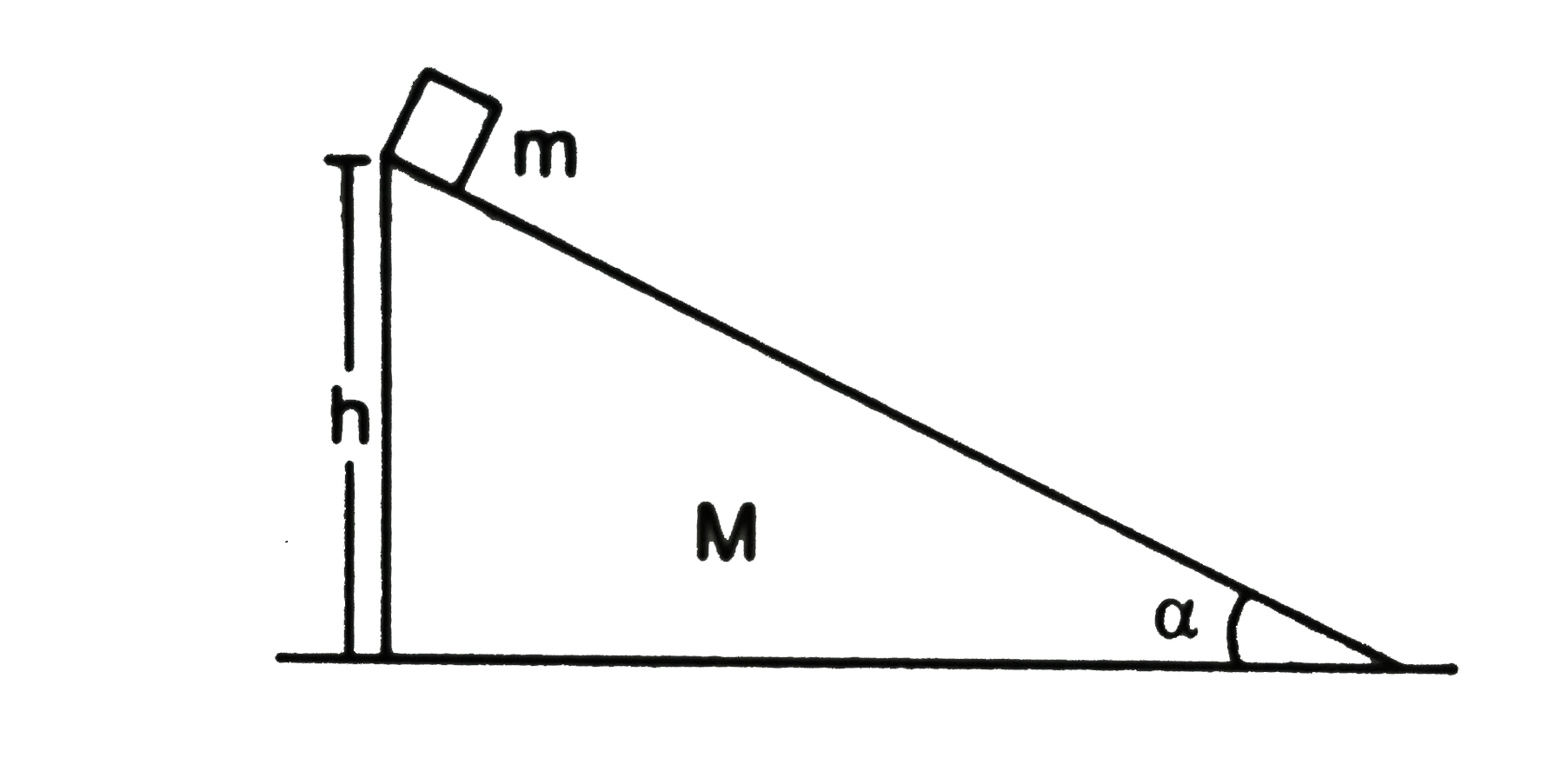
A block of mas m is placed on a triangular block of mas m, which in tunis placed on a horizontal surface as shown in figure. Assuming frictionless surfaces find the velocity of the triangular block when the smaller block reaches the bottom end.

Text Solution

Verified by Experts

The correct Answer is:

A, B, C

The block m will slide down the inclined pklane of mass M with aceleration `a_1=g sin alpha` (relative) to the inclined plane.
The horizontal component of `a_1` will be `a_x=g sin alpha cos alpha, for which the blcok M will accelerate towards left, let teh acceleration be `a_2.`
According to the concept of centre of mass, (in the horizontl direcrtion exterN/Al force is zero)
`ma_x=(M+m)a_2`
`rarr a_2=(ma_x)/(M+m)`
`=(mgsiN/Alpha cosalpha)/(M+m)`......i ltbr.gt so the absolute (resulstant) acceleration of m on the block M along the direction of the incline will be
`a=gsiN/Alpha-a_2cosalpha`
`=gsiN/Alpha- (mgsiN/Alphacos^2alpha)/(M+m)`
`=gsiN/Alpha[1-(mcos^2alpha)/(M+m)]`
`=g sin alpha[(M+m-mcos^2alpha)/(M+m)]`
So, `a=g siN/Alpha [(M+msin^2alpha)/(M+m)]`...ii
Let the time taken by the block m to reach the bottom end be t
`Now, S=ut+(1/2)at^2`
`rarrh/(siN/Alpha)=(1/2)at^2`
`rarr t=(sqrt(2h)/(a siN/Alpha))`
So, the velocity of the bigger block after time t will be
`v_m=u=a_2t`
`=(mgsiN/Alphacosalpha)/(M+m)`
(sqrt(2h)/(alphasiN/Alpha))`
`=[(2m^2g^2hsin^2alphacos^2alpha)/((M+m)^2a siN/Alpha)]^(1/2)`
now substituting the value of a from equtioin ii we get
` V_m=[(2m^2g^2hsin^2alpha)/((M+m)^2siN/Alpha)xx(cos^2alpha)/(gsiN/Alpha)((M+m))/((M+msin^2alpha))]`
or ` V_m=[(2m^2ghcos^2alpha)/((M+m)(M+msin^2alpha)]^(1/2)`
Promotional Banner

Topper's Solved these Questions

  • CENTRE OF MASS, LINEAR MOMENTUM, COLLISION

    HC VERMA|Exercise Objective -2|11 Videos
  • CALORIMETRY

    HC VERMA|Exercise Exercises|18 Videos
  • CIRCULAR MOTION

    HC VERMA|Exercise Exercises|30 Videos

Similar Questions

Explore conceptually related problems

Figure shows a small block of mass m which is started with a speed v on the horizontal part of the bigger block of mas m placed on a horizontal floor. The curved part of the surface shown is semicircular. All the surfaces are frictionless. Find the speed of the bigger block when the smaller block reaches the point A of the surface.

A block of mass M is placed on the top of a bigger block of mass 10 M as shown in figure. All the surfaces are frictionless. The system is released from rest, then the distance moved by the bigger block at the instant the smaller block reaches the ground :

A small block of mass m is kept on a bigger block of mass M which is attached to a vertical spring of spring constant k as shown in the figure. The system oscilates verticaly. a.Find the resultant force on the smaller block when it is displaced through a distance x above its equilibrium position. b. find the normal force on the smaller blok at this position. When is this force smallest smaller block at this position. When is this force smallest in magnitude? c. What can be the maximum amplitude with which the two blocks may oscillate together?

A block of mass m slides along a frictionless surface as shown in the figure. If it is releases from rest from A what is its speed at B?

A block of mass M is pulled on a smooth horizontal table by a string making an angle theta with the horizontal as shown in figure. If the acceleration of the block is a , find the force applied by the string and by the table N on the block.

A horizontal force of 3.2 N is applied on a 3.7kg block, which rests on a horizontal surface. If the co-efficient of friction is 0.6, find the acceleration produced in the block ?

Three blocks of masses m_1, m_2 and m_3 are connected as shown in the figure. All the surfaces are frictionless and the string and the pulleys are light. Find the acceleration of m_1

A block of mass m is kept on a horizontal table. If the static friction coefficient is mu ., find the frictional force acting on the block.

A block of mass m is pulled along a horizontal surface by a rope. The tension in the rope will be same at all the points

find the acceleration of the block of mass M in the situation shown in figure. All the surfaces are frictionless and the pulleys and the string are light.

HC VERMA-CENTRE OF MASS, LINEAR MOMENTUM, COLLISION-Exercises
  1. The coefficient of restitution (e ) for a material is as follows

    Text Solution

    |

  2. An ideal spring of spring constant k, is suspended from the ceiling of...

    Text Solution

    |

  3. A bullet of mass 25 g is fired horizontally into a ballistic pendulum ...

    Text Solution

    |

  4. A bullet of mass 10g moving horizontally with a velocity of 400 ms^-1s...

    Text Solution

    |

  5. Two masses m1 and m2 re connected by a spring of spring constant k and...

    Text Solution

    |

  6. Two blocks of masses m1 and m2 are connected by a spring of spring con...

    Text Solution

    |

  7. Cionsider the situation of the previous problem. Suppose each of tbe b...

    Text Solution

    |

  8. Consider the situation of the previous problem. The force on the centr...

    Text Solution

    |

  9. A ball of mass 1 kg moving with a speed of 10 ms^(-1) rebounds after ...

    Text Solution

    |

  10. The track shown in figure is frictionless. The block B of mass 2 m is ...

    Text Solution

    |

  11. A bullet of mass 10g moving horizontally at a speed of 50 7 ​ m/s s...

    Text Solution

    |

  12. Two balls having masses m and 2m are fasrtened to two light strings of...

    Text Solution

    |

  13. A uniform chain of mass M and length L is held verticallyi in such a w...

    Text Solution

    |

  14. The blocks shown in figure have equal masses. The surface of A is smoo...

    Text Solution

    |

  15. The friction coefficient between the horizontal surfce and ech of the ...

    Text Solution

    |

  16. A block of mas m is placed on a triangular block of mas m, which in tu...

    Text Solution

    |

  17. Figure shows a small body of mass m placed over a larger mass M whose ...

    Text Solution

    |

  18. A small block of superdennse material has a mass of 3xx10^24 kg. It i...

    Text Solution

    |

  19. A body of mass m makes an elastic collision with another identical bod...

    Text Solution

    |

  20. A small particle travelling with a velocity v collides elastically wit...

    Text Solution

    |
