Home
Class 11
PHYSICS
A small particle travelling with a veloc...

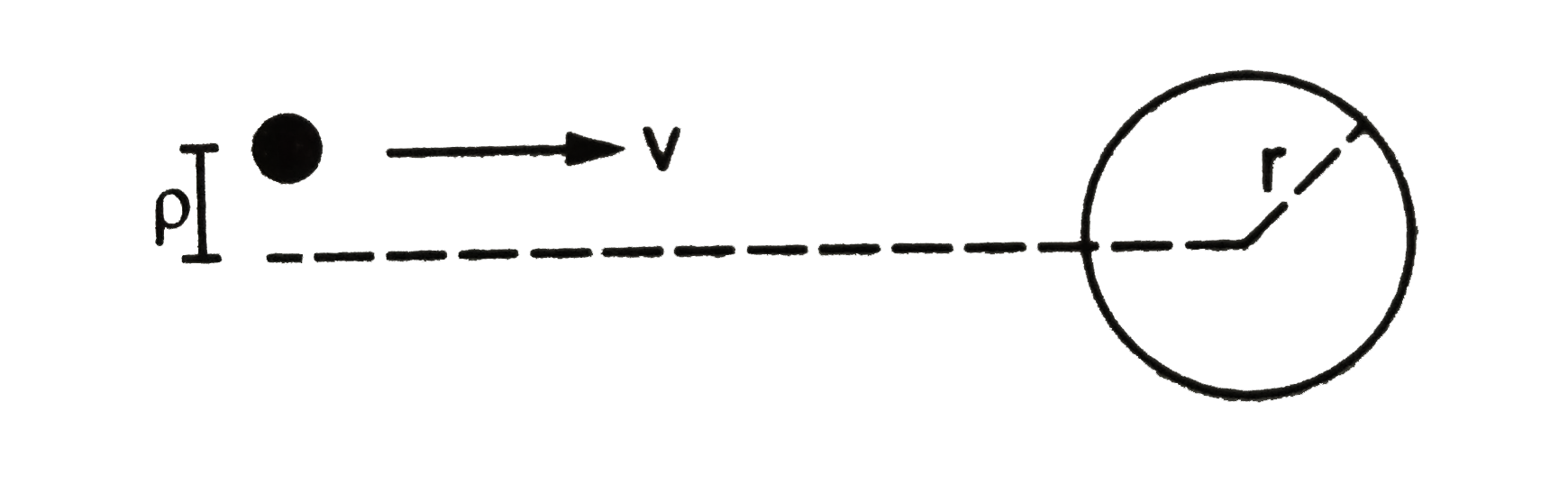
A small particle travelling with a velocity v collides elastically with a spbereical body of equal masss and of radius r initially kept at rest. The centre of this spherical body is located a distnce `rho(ltr)` away from the direction of motion of the particle figure. Find the final velocities of the two particles.

Text Solution

Verified by Experts

The correct Answer is:

A, B, C, D

Let the mass of both the particle and the spherical body m the particle velocity v has two components `v cosalpha` normal to the sphere and `v sin alpha` tangential to the sphere.
After the collision, they will exchanged their velocity . So, the spherical body wil have a velocity `vcosalpha` and the particle wl not have any component of velocity in this direction.
[The collision will be due to the component `v cos alpha` in the normal direction
but, the tantential velocity, of the particke `vsiN/Alpha` will be uN/Affected]
So, velocity of the sphere `=v cos alpha`
`=v/r sqrt(r^2-p^2)`
and velocity of the particle `=vsiN/Alpha`
`(vp)/r`.
Promotional Banner

Topper's Solved these Questions

  • CENTRE OF MASS, LINEAR MOMENTUM, COLLISION

    HC VERMA|Exercise Objective -2|11 Videos
  • CALORIMETRY

    HC VERMA|Exercise Exercises|18 Videos
  • CIRCULAR MOTION

    HC VERMA|Exercise Exercises|30 Videos

Similar Questions

Explore conceptually related problems

A small particle of mass on is projected with an initial velocity v at an angle 8 with x axis in X-Y plane as shown in Figure. Find the angular momentum of the particle.

A body is in pure rotation. The linear speed 'v' of a particle, the distance 'r' of the particle from the axis and the angular velocity omega of the body are related as omega=v/r . Thus

a solid sphere of mass m and radius r is placed inside a hollow thin spherical shell of mass M and radius R as shown in figure. A particle of mass m is placed on the line joining the two centers as a distance x from the point of contact of the sphere and the shell. Find the magnitude of the resultant gravitational force on this particle due to the sphere and the shell if a). rltxlt2r , b). 2rltxlt2R and c). xgt2R .

Two small balls A and B each of mass m, are joined rigidly to the ends of a light rod of length L figure. The system translates on a frictionless horizontal surface with a velocity v_0 in a direction perpendicular to the rod. A particle P of mass kept at rest on the surface sticks to the ball A as the ball collides with it . Find a. the linear speeds of the balls A and B after the collision, b. the velocity of the centre of mass C of the system A+B+P and c. the angular speed of the system about C after the collision.

The sphere shown in figure lies on a rough plane when a particle of mass m travelling at a speed v_0 collides and sticks with it. If the line of motion of the particle is at a distance h above the plane, find a. the linear speed o the combined system just after the collision b. the angular speed of the system about the centre of the sphere just the collision c. the value of h for which the sphere starts pure rolling on the plane Assume that the mass M of the sphere is large compared to the mass of the particle so that the centre of mass of the combined system is not appreciably shifted from the centre of the sphere.

A smooth sphere of radius R is made to translate line with a constant acceleration a=g. A particle kept on the top of the sphere is released from there at zero velocity with respect to the sphere. Find the speed of the particle with respect to the sphere as a function of angle θ as it slides down.

Separation of Motion of a system of particles into motion of the centre of mass and motion about the centre of mass : (a) Show p=p_(i)'+m_(i)V where pi is the momentum of the ith particle (of mass m_(i) ) and p'_(i)=m_(i)v'_(i) . Note v'_(i) is the velocity of the ith particle relative to the centre of mass. Also, prove using the definition of the centre of mass sump'_(i)=O (b) Show K=K'+1//2MV^(2) where K is the total kinetic energy of the system of particles, K′ is the total kinetic energy of the system when the particle velocities are taken with respect to the centre of mass and MV^(2)//2 is the kinetic energy of the translation of the system as a whole (i.e. of the centre of mass motion of the system). The result has been used in Sec. 7.14. (c ) Show L=L'+RxxMV where L'=sumr'_(i)xxp'_(i) is the angular momentum of the system about the centre of mass with velocities taken relative to the centre of mass. Remember – r'_(i)=r_(i)-R , rest of the notation is the standard notation used in the chapter. Note ′ L and MR × V can be said to be angular momenta, respectively, about and of the centre of mass of the system of particles. (d) Show (dL')/(dt)=sumr'_(i)xx(dp')/(dt) Further, show that (dL')/(dt)=tau'_(ext) where tau'_(ext) is the sum of all external torques acting on the system about the centre of mass.

A magnetic field that varies in magnitude from point to point but has a constant direction (east to west) is set up in a chamber. A charged particle enters the chamber and travels undeflected along a straight path with constant speed. What can you say about the initial velocity of the particle? A charged particle enters an environment of a strong and non-uniform magnetic field varying from point to point both in magnitude and direction, and comes out of It following a complicated trajectory. Would its final speed equal the initial speed if it suffered no collisions with the environment? An electron travelling west to east enters a chamber baving a uniform electrostatic field in north to south direction. Specify the direction in which a uniform magnetic field should be set up to prevent the electron from deflecting from its straight line path.

A particle of mass m is kept on the top of a smooth sphere of radius R. It is given a sharp impulse which imparts it a horizontal speed v. a. find the normal force between the sphere and the particle just after the impulse. B. What should be the minimum value of v for which the particle does not slip on the sphere? c. Assuming the velocity v to be half the minimum calculated in part, d. find the angle made by the radius through the particle with the vertical when it leaves the sphere.

HC VERMA-CENTRE OF MASS, LINEAR MOMENTUM, COLLISION-Exercises
  1. The coefficient of restitution (e ) for a material is as follows

    Text Solution

    |

  2. An ideal spring of spring constant k, is suspended from the ceiling of...

    Text Solution

    |

  3. A bullet of mass 25 g is fired horizontally into a ballistic pendulum ...

    Text Solution

    |

  4. A bullet of mass 10g moving horizontally with a velocity of 400 ms^-1s...

    Text Solution

    |

  5. Two masses m1 and m2 re connected by a spring of spring constant k and...

    Text Solution

    |

  6. Two blocks of masses m1 and m2 are connected by a spring of spring con...

    Text Solution

    |

  7. Cionsider the situation of the previous problem. Suppose each of tbe b...

    Text Solution

    |

  8. Consider the situation of the previous problem. The force on the centr...

    Text Solution

    |

  9. A ball of mass 1 kg moving with a speed of 10 ms^(-1) rebounds after ...

    Text Solution

    |

  10. The track shown in figure is frictionless. The block B of mass 2 m is ...

    Text Solution

    |

  11. A bullet of mass 10g moving horizontally at a speed of 50 7 ​ m/s s...

    Text Solution

    |

  12. Two balls having masses m and 2m are fasrtened to two light strings of...

    Text Solution

    |

  13. A uniform chain of mass M and length L is held verticallyi in such a w...

    Text Solution

    |

  14. The blocks shown in figure have equal masses. The surface of A is smoo...

    Text Solution

    |

  15. The friction coefficient between the horizontal surfce and ech of the ...

    Text Solution

    |

  16. A block of mas m is placed on a triangular block of mas m, which in tu...

    Text Solution

    |

  17. Figure shows a small body of mass m placed over a larger mass M whose ...

    Text Solution

    |

  18. A small block of superdennse material has a mass of 3xx10^24 kg. It i...

    Text Solution

    |

  19. A body of mass m makes an elastic collision with another identical bod...

    Text Solution

    |

  20. A small particle travelling with a velocity v collides elastically wit...

    Text Solution

    |
