Home
Class 12
PHYSICS
A compound microscope consists of an obj...

A compound microscope consists of an objective lens of focal length 2.0 cm and an eyepiece of focal length 6.25 cm separated by a distance of 15 cm. How far from the objective should an object be placed in order to obtain the final image at (a) the least distance of distinct vision (25cm), and (b) at infinity? What is the magnifying power of the microscope in each case ?

Text Solution

Verified by Experts
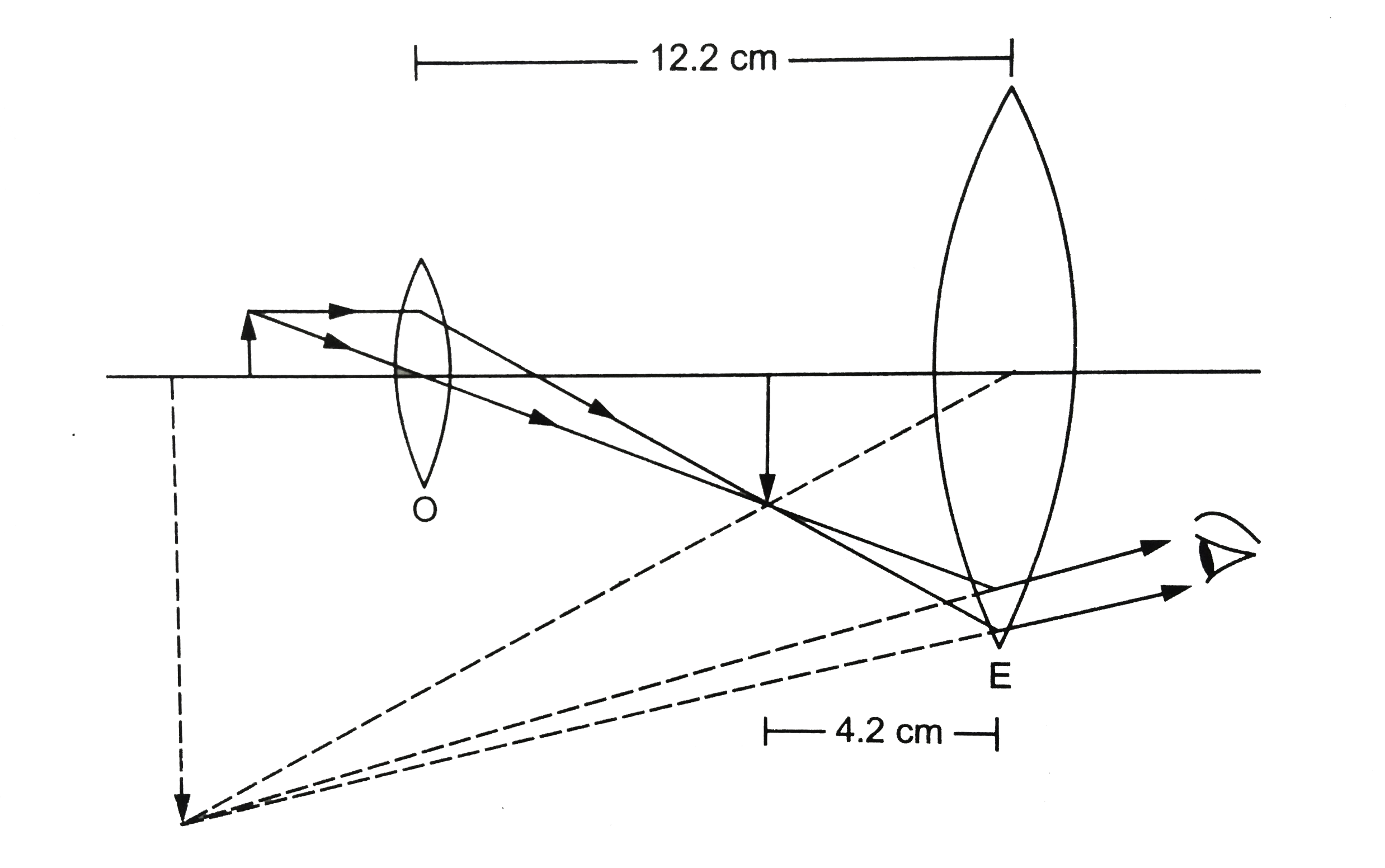
a. For the eyepiece `v_e=-25cm nd f_e=+5cm`
Using `1/v_e-1/u_e=1/f_e`
`1/u_e=1/v_e-1/f_e`
`-1/(25cm_-1/(5cm)`
or `u_e=25/6cm=-4.17=-4.2cm`
As the objective is 12.2 cm away from the eyepiece the image formed by the objective is 12.2 cm-4.2 cm =8.0 cm away from it. for the objective
`v=+8.0 cm, f_0=+1.0cm`
Using `1/v-1/u=1/f_0`
`1/u=1/v-1/f_0`
`=1/(8.0cm)-1/(1.0cm)`
or `u=-8.0/7.0cm=-1.1cm.`
b. The angular magnification is
`m=v/u(1+D/f_e)`
`=(+8.0cm)/(-1.1cm)(1+(25cm)/(5cm))=-44`.
Promotional Banner

Topper's Solved these Questions

  • OPTICAL INSTRUMENTS

    HC VERMA|Exercise Question for short Answer|12 Videos
  • OPTICAL INSTRUMENTS

    HC VERMA|Exercise Objective -1|11 Videos
  • OPTICAL INSTRUMENTS

    HC VERMA|Exercise Exercises|23 Videos
  • MAGNETIC PROPERTIES OF MATTER

    HC VERMA|Exercise Exercise|9 Videos
  • PERMANENT MAGNETS

    HC VERMA|Exercise Exercise|25 Videos

Similar Questions

Explore conceptually related problems

A compound microscope has an objective of focal length 1 cm and an eyepiece of focal length 2.5 cm. An object has to be placed at a distance of 1.2 cm away from the objective for normal adjustment. a.Find the angular magnification. b.Find the length of the microscope tube.

A small telescope has an objective lens of focal length 140 cm and eyepiece of focal length 5.0 cm. What is the magnifying power of the telescope for viewing distant objects when (a) the telescope is in normal adjustment and (b) the final image is formed at least distance of distinct vision ?

A diverging lens of focal length 20 cm and a converging mirror of focal length 10 cm are placed coaxially at a separation of 5 cm. Where should an object be placed so that a real image is formed at the object itself ?

A small telescope has an objective lens of focal length 144 cm and eyepiece of focal length 6.0 cm. What is the magnifying power of the telescope ? What is the separation between the objective and the eyepiece?

A diverging lens of focal length 20 cm and a converging lens of focal length 30 cm are placed 15 cm apart with their principal axes coinciding. Where should an object be placed on the principal axis so that its image formed at infinity ?

A small telescope has an objective lens of focal length 140 cm and eyepiece of focal length 5.0 cm. What is the megniftying power of the telescope for viewing distant objects when (a) the telescope is in normal adjustment (i.e, when the final image is at infinity ) (b) the final image is formed at the least distance of distinct vision (25cm) ?

An amateur astronomer wishes to estimate roughly the size of the Sun using his crude telescope consisting of an objective lens of focal length 200 cm and an eyepiece of focal length 10 cm. By adjusting the distance of the eyepiece from the objective, he obtains an image of the Sun on a screen 40 cm behind the eyepiece. the diameter of the sun's image is measured to be 6.0 cm. What is his estimate of the Sun's size given that the average Earth-sun distance is 1.5 xx 10^(11) m ?

A concave lens of focal length 20 cm is placed at a distance of 35 cm from an object. Find the position of the image and its magnification.

What focal length should the reading spectacles have for a person for whom the least distance of distinct vision is 50 cm?

The focal length of the objective of an astronomical telescope is 75 cm and that of the eyepiece is 5 cm . If the final image is formed at the least distance of distanct of distinct vision from the eye, calculate the magnifying power of the telescope.

