Home
Class 11
PHYSICS
Suppose the bent part of the frame of th...

Suppose the bent part of the frame of the previous problem has a thermal conductivity of `780s^(-1)m^(-1).^(@)C^(-1)` whereas it is `390Js^(-1)m^(-1).^(@)C^(-1)` for the straight the bent part to the rate of heat flow through the straight part.

Text Solution

Verified by Experts

The correct Answer is:
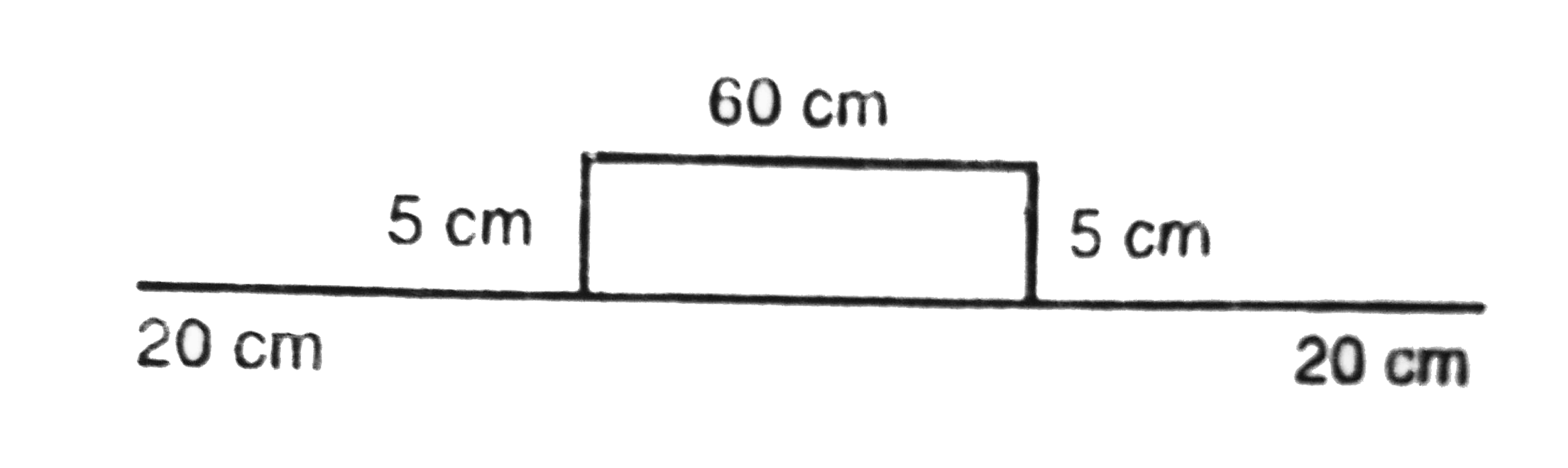
A, B

`(Q/t)_(Bent)=(780xxAxx100)/70`
`(Q/t)_(Straight)=(390xxAxx100)/70`
`((Q/t)_(Bent))/((Q/t)_(Straight))=(780xxAxx100)/70`
`xx60/(390xxAxx100)=12/7`
Promotional Banner

Topper's Solved these Questions

  • HEAT TRANSFER

    HC VERMA|Exercise OBJECTIVE II|6 Videos
  • HEAT AND TEMPERATURE

    HC VERMA|Exercise Exercise|34 Videos
  • INTRODUCTION TO PHYSICS

    HC VERMA|Exercise Exercises|19 Videos

Similar Questions

Explore conceptually related problems

Two parallel plates A and B are joined together to form a compound plate . The thicknesses of the plate are 4.0cm and 2.5cm respectively and the area of cross section is 100cm^(2) for each plate. The thermal conductivities are K_(A)=200Wm^(-1) C^(-1) for plate A and K_(B)=400Wm^(-1) C^(-1) for the plate B. The outer surface of the plate A is maintained at 100^(@)C and the outer surface of the plate B is maintained at 0^(@)C . Find (a) the rate of heat flow through any cross section, (b) the temperature at the interface and (c) the equivalent thermal conductivity of the compound plate.

A liquid-nitrogen container is made of a 1-cm thick styrofoam sheet having thermal conductivity 0.025Js^(-1)m^(-1)C^(-1) . Liquid nitrogen at 80K is kept in it. A total area of 0.80m^(2) is in contact with the liquid nitrogen. The atmospheric temperature is 300K . Calculate the rate of heat flow from the atmosphere to the liquid nitrogen.

Suppose the smaller pulley of the previous problem has its radius 5.0 cm and moment of inertia 0.10 kg-m^2. Find the tension in the part of the string joiningk the pulleys.

Suppose the bob of the previous problem has a speed of 1.4 m/s when the string makes an angle of 0.20 radian with the vertical. Find the tension at this instant. You can use costheta=1-theta^2/2 and sintheta=theta for small theta .

A metal rod of cross sectional area 1.0cm^(2) is being heated at one end. At one time , the temperature gradient is 5.0^(@)C cm^(-1) at cross section A and is 2.5^(@)Ccm^(-1) at cross section B. calculate the rate at which the temperature is increasing in the part AB of the rod. The heat capacity of the part AB =0.40J^(@)C^(-1) , thermal conductivity of the material of the rod. K=200Wm^(-1)C^(-1) . Neglect any loss of heat to the atmosphere.

A pitcher with 1-mm thick porous walls contain 10kg of water. ,Water comes to its outer surface and evaporates at the rate of 0.1gs^(-1) . The surface area of the pitcher (one side) =200cm^(2) . The room temperature =42^(@)C , latent heat of vaporization =2.27xx10^(6)Jkg^(-1) , and the thermal conductivity of the porous walls =0.80js^(-1)m^(-1)C^(-1) . Calculate the temperature of water in the pitcher when it attains a constant value.

The heat is flowing through two cylindrical rods of same material. The diameters of the rods are in the ratio 1:2 and their lengths are in the ratio 2:1. If the temperature difference between their ends is the same, the ratio of rate of flow of heat through them will be

Suppose the tube in the previous problem is kept verticla with B upward. Water enters through B at the rate of 1cm^3s^-1 . Repeat parts a, b, and c. Note that the speed decreases as the water falls down.

Three rods of lengths 20cm each and area of cross section 1cm^(2) are joined to from a triangle ABC. The conductivities of the rods are k_(AB)=50Js^(-1)m^(-1)C^(-1) , k_(BC)=200Js^(-1)m^(-1)C^(-1) , and k_(AC)=400Js^(-1)m^(-1)C^(-1) . The junction A,B and C are maintained at 40^(@)C , 80^(@)C and 80^(@)C respectively. Find the rate of heat flowing through the rods AB, AC and BC .

HC VERMA-HEAT TRANSFER-EXERCIESE
  1. Figure shows an aluminium rod joined to a copper rod. Each of the rods...

    Text Solution

    |

  2. Conside the situation shown in figure. The frame is made of the same m...

    Text Solution

    |

  3. Suppose the bent part of the frame of the previous problem has a therm...

    Text Solution

    |

  4. A room has s window fitted with a single 1.0mxx2.0m glass of thickness...

    Text Solution

    |

  5. The two rods show in figure have identical geometrical dimension.. The...

    Text Solution

    |

  6. The three rods shown in figure have identica dimensions. Heat flows fr...

    Text Solution

    |

  7. Four identical rods AB, CD, CF and DE are joined as shown in figure. T...

    Text Solution

    |

  8. Seven rods A, B, C, D, E, F and G are joined as shown in figure. All t...

    Text Solution

    |

  9. Find the rate of heat flow through a cross section of the rod shown in...

    Text Solution

    |

  10. A rod of negligible heat capacity has length 20cm, area of cross secti...

    Text Solution

    |

  11. Find the volume of a sphere of radius a.

    Text Solution

    |

  12. The specific heat capacity of water is cal//g^(@)C

    Text Solution

    |

  13. Two objects of masses m(1) and m(2) fall from the heights h(1) and h(2...

    Text Solution

    |

  14. A gas is enclosed in a cylindrical vessel fitted with a frictionless p...

    Text Solution

    |

  15. Assume that the total surface area of a human body is 1.6m^(2) and tha...

    Text Solution

    |

  16. Calculate the amount of heat radiated per second by a body of surface ...

    Text Solution

    |

  17. A solid sphere and a hollow sphere of the same material and of equal r...

    Text Solution

    |

  18. A 100W bulb has tungsten filament of total length 1.0m and radius 4xx1...

    Text Solution

    |

  19. A spherical ball of surface area 20cm^(2) absorbs any radiation that f...

    Text Solution

    |

  20. A spherical tungsten pieces of radius 1.0cm is suspended in an evacuat...

    Text Solution

    |

