Home
Class 11
PHYSICS
Four identical rods AB, CD, CF and DE ar...

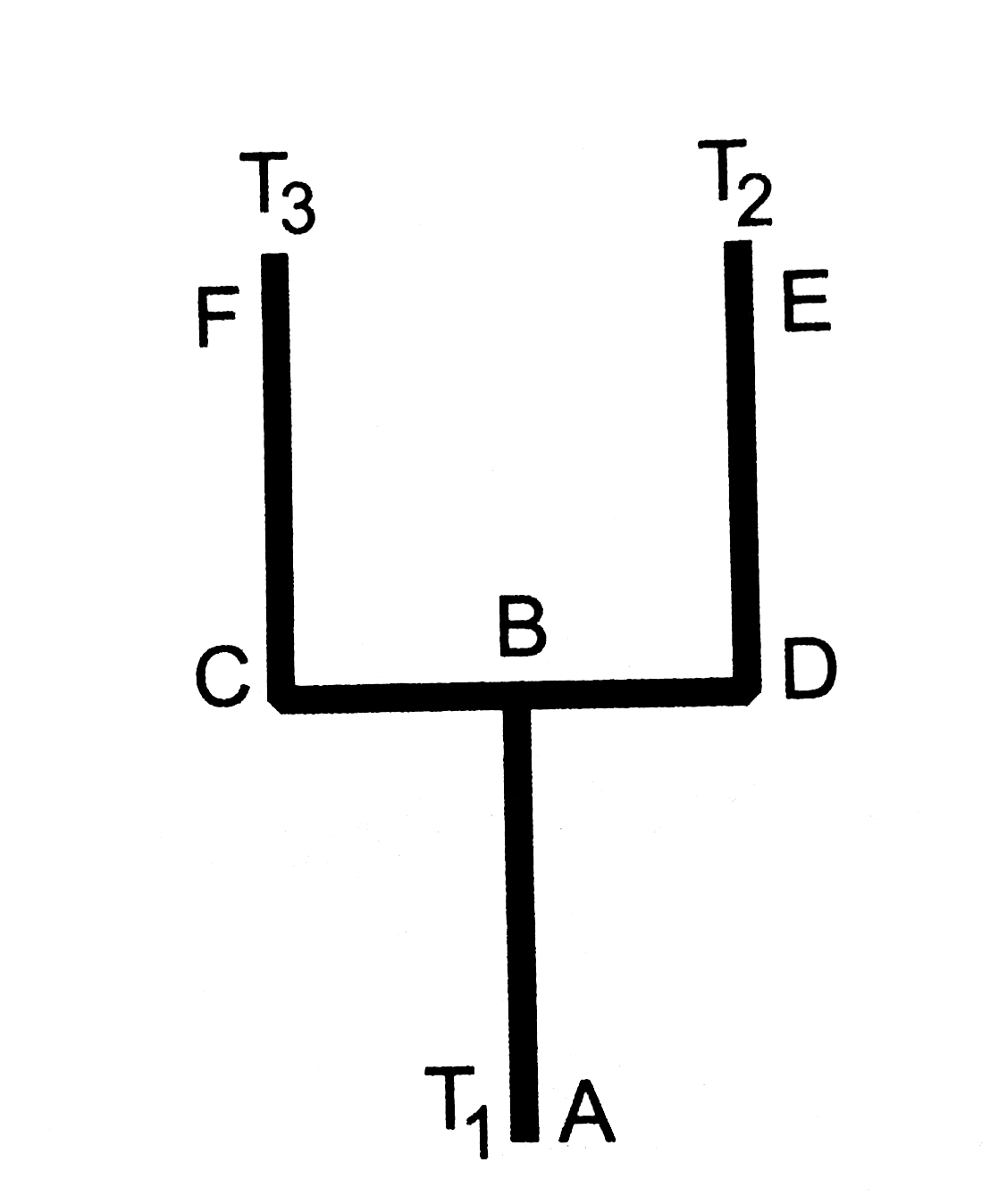
Four identical rods AB, CD, CF and DE are joined as shown in figure. The length, cross-sectional area and thermal conductivity of each rod are l, A and K respectively. The ends A, E and F are maintained at temperature `T_(1)` , `T_(2)` and `T_(3)` respectively. Assuming no loss of heat to the atmosphere, find the temperature at B.

Text Solution

Verified by Experts

The correct Answer is:
A, B, C

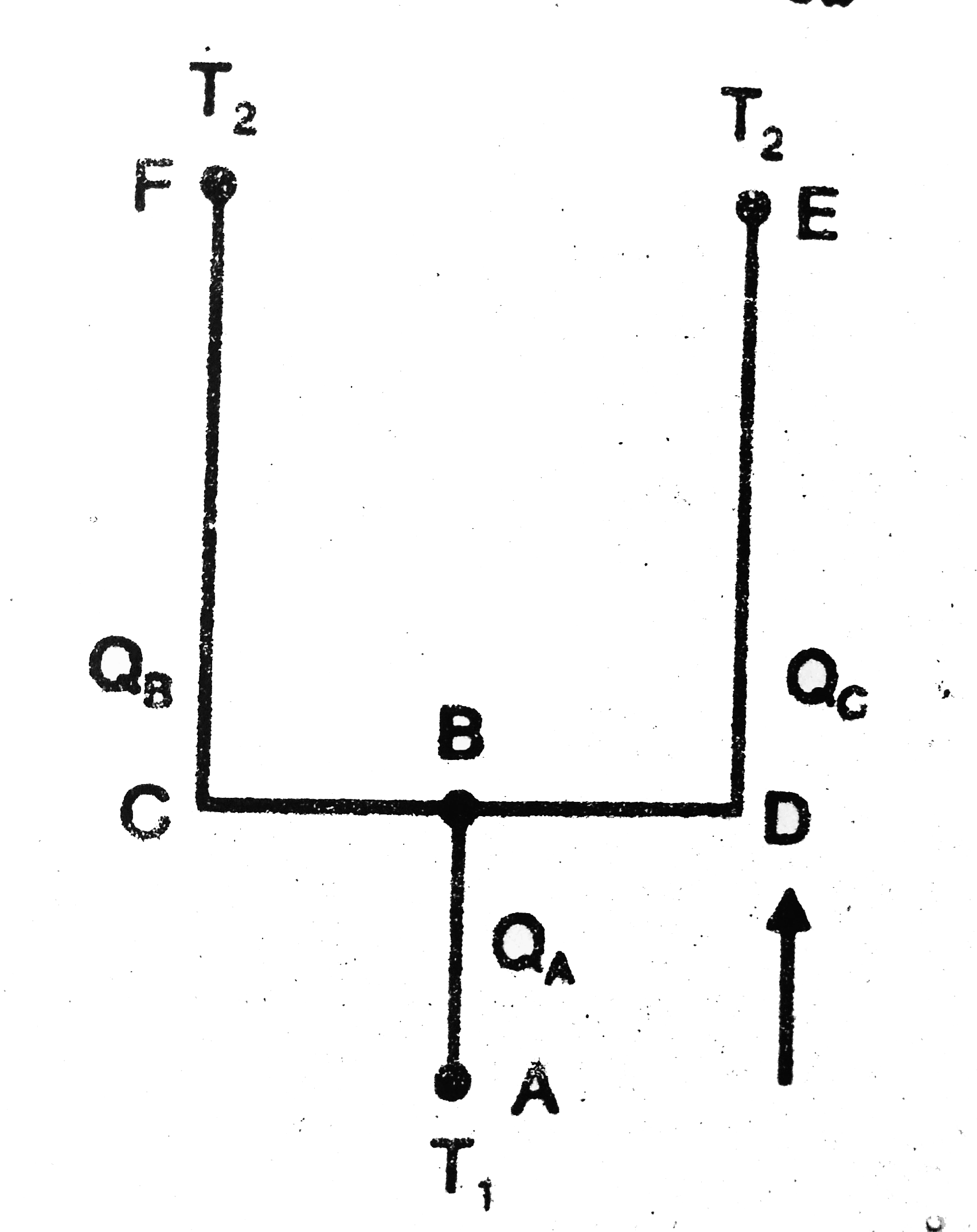
Let the tempareture at B be T
`(Q_A/t)=(Q_B/t)+(Q_C/t)`
`implies(KA(T-T_1))/l=(KA(T-T_2))/(l+l//2)+(KA(T-T_3))/(3l//2)`
`(T-T_1))/l=(T-T_2))/(l+l//2)+(T-T_3))/(3l//2)`
`implies T-T_1=(2/3)(2T-T_2-T_3)`
`implies3T=3T_1=4T-2(T_2+T_3)`
`implies-7=+3T_1-2(T_2+T_3)`
`impliesT=(-3T+2(T_2+T_3))/7`
Promotional Banner

Topper's Solved these Questions

  • HEAT TRANSFER

    HC VERMA|Exercise OBJECTIVE II|6 Videos
  • HEAT AND TEMPERATURE

    HC VERMA|Exercise Exercise|34 Videos
  • INTRODUCTION TO PHYSICS

    HC VERMA|Exercise Exercises|19 Videos

Similar Questions

Explore conceptually related problems

Seven rods A, B, C, D, E, F and G are joined as shown in figure. All the rods have equal cross-sectional area A and length l. The thermal conductivities of the rods are K_(A)=K_(C)=K_(0) , K_(B)=K_(D)=2K_(0) , K_(E)=3K_(0) , K_(F)=4K_(0) and K_(G)=5K_(0) . The rod E is kept at a constant temperature T_(1) and the rod G is kept at a constant temperature T_(2) (T_(2)gtT_(1)) . (a) Show that the rod F has a uniform temperature T=(T_(1)+2T_(2))//3 . (b) Find the rate of heat flowing from the source which maintains the temperature T_(2) .

Two rods of same length and cross section are joined along the length. Thermal conductivities of first and second rod are K_1 and K_2 . The temperature of the free ends of the first and second rods are maintained at θ_1 and θ_2 respectively. The temperature of the common junction is

A rod CD of thermal resistance 5.0KW^(-1) is joined at the middle of an identical rod AB as shown in figure. The ends A, B and D are maintained at 100^(@)C , 0^(@)C and 25^(@)C respectively. Find the heat current in CD.

A hollow tube has a length l, inner radius R_(1) and outer radius R_(2) . The material has a thermal conductivity K. Find the heat flowing through the walls of the tube if (a) the flat ends are maintained at temperature T_(1) and T_(2) (T_(2)gtT_(1)) (b) the inside of the tube is maintained at temperature T_(1) and the outside is maintained at T_(2) .

Find the rate of heat flow through a cross section of the rod shown in figure (theta_(2)gttheta_(1)) . Thermal conductivity of the material of the rod is K.

A rod of negligible heat capacity has length 20cm, area of cross section 1.0cm^(2) and thermal conductivity 200Wm^(-1)C^(-1) . The temperature of one end is maintained at 0^(@)C and that of the other end is slowly and linearly varied from 0^(@)C to 60^(@)C in 10 minutes. Assuming no loss of heat through the sides, find the total heat transmitted through the rod in these 10 minutes.

Two identical uniform rods AB and CD, each of length L are jointed to form a T-shaped frame as shown in figure. Locate the centre of mass of the frame. The centre of mass of a uniform rod is at the middle point of the rod.

The two ends of a rod of length L and a uniform cross-sectional area are kept at two temperatures T_1 and T_2 (T_1>T_2) . The rate of heat transfer , dQ/dt through the rod in a steady state is given by:

A semicircular rods is joined at its end to a straight rod of the same material and the same cross-sectional area. The straight rod forms a diameter of the other rod. The junctions are maintained at different temperatures. Find the ratio of the heat transferred through a cross section of the straight rod in a given time.

The ends of two rods of different materials with their thermal conductivities, radii of cross sections and lengths all in the ratio 1 : 2 are maintained at the same temperature difference, if the rate of flow of heat in the larger rod is 4 cal/ sec, the rate of flow of heat in the shorter rod will be

HC VERMA-HEAT TRANSFER-EXERCIESE
  1. The two rods show in figure have identical geometrical dimension.. The...

    Text Solution

    |

  2. The three rods shown in figure have identica dimensions. Heat flows fr...

    Text Solution

    |

  3. Four identical rods AB, CD, CF and DE are joined as shown in figure. T...

    Text Solution

    |

  4. Seven rods A, B, C, D, E, F and G are joined as shown in figure. All t...

    Text Solution

    |

  5. Find the rate of heat flow through a cross section of the rod shown in...

    Text Solution

    |

  6. A rod of negligible heat capacity has length 20cm, area of cross secti...

    Text Solution

    |

  7. Find the volume of a sphere of radius a.

    Text Solution

    |

  8. The specific heat capacity of water is cal//g^(@)C

    Text Solution

    |

  9. Two objects of masses m(1) and m(2) fall from the heights h(1) and h(2...

    Text Solution

    |

  10. A gas is enclosed in a cylindrical vessel fitted with a frictionless p...

    Text Solution

    |

  11. Assume that the total surface area of a human body is 1.6m^(2) and tha...

    Text Solution

    |

  12. Calculate the amount of heat radiated per second by a body of surface ...

    Text Solution

    |

  13. A solid sphere and a hollow sphere of the same material and of equal r...

    Text Solution

    |

  14. A 100W bulb has tungsten filament of total length 1.0m and radius 4xx1...

    Text Solution

    |

  15. A spherical ball of surface area 20cm^(2) absorbs any radiation that f...

    Text Solution

    |

  16. A spherical tungsten pieces of radius 1.0cm is suspended in an evacuat...

    Text Solution

    |

  17. A cubical block of mass 1.0kg and edge 5.0cm is heated to 227^(@)C . I...

    Text Solution

    |

  18. A copper sphere is suspended in an evacuated chamber maintained at 300...

    Text Solution

    |

  19. A spherical ball A of surface area 20cm^(2) is kept at the centre of a...

    Text Solution

    |

  20. A cylindrical rod of length 50cm and cross sectional area 1cm^(2) is f...

    Text Solution

    |

