Home
Class 12
PHYSICS
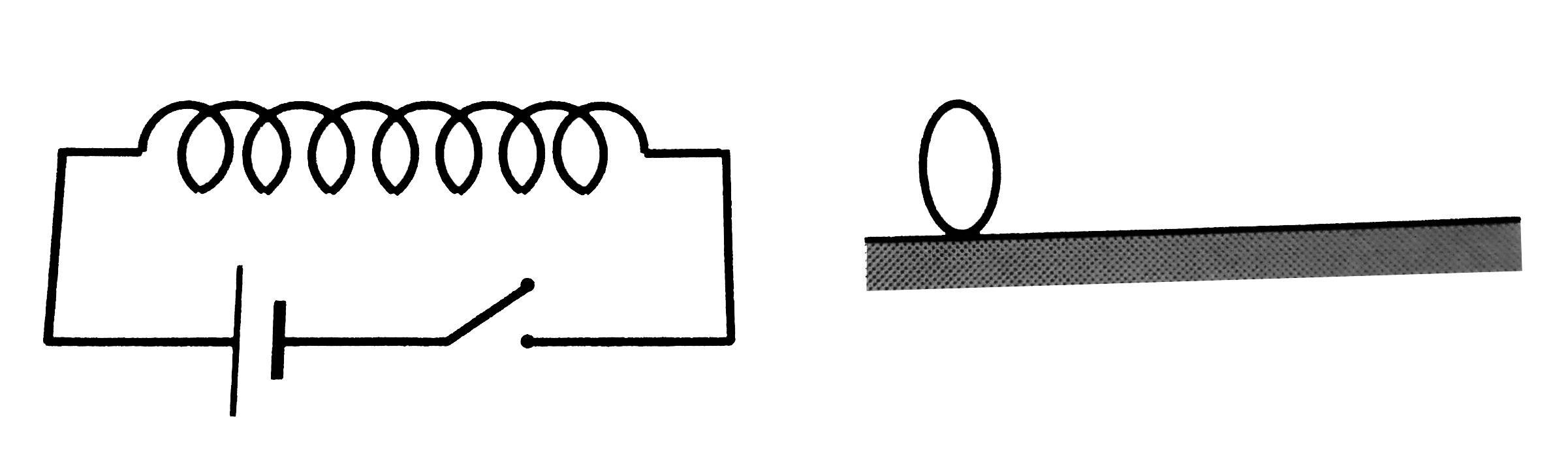
shows a horizontal solenoid connected to...

shows a horizontal solenoid connected to a battery and a switch. A coper ring is placed on a frictionless track, the axis of the ring being along the axis of the solenoid. As the switch is closed, the ring will

A

remain stationary

B

move towards the solenoid

C

move away form the solenoid

D

move towards the solenoid or away from it depending on which terminal (positive or negative) of the battery is connected to the left end of the solenoid.

Text Solution

Verified by Experts

The correct Answer is:

C
Promotional Banner

Topper's Solved these Questions

  • ELECTROMAGNETIC INDUCTION

    HC VERMA|Exercise Objective 2|10 Videos
  • ELECTROMAGNETIC INDUCTION

    HC VERMA|Exercise EXERCISE|98 Videos
  • ELECTROMAGNETIC INDUCTION

    HC VERMA|Exercise Questions for short answer|10 Videos
  • ELECTRIC FIELD AND POTENTIAL

    HC VERMA|Exercise Exercises|75 Videos
  • ELECTROMAGNETIC WAVES

    HC VERMA|Exercise Exercise|9 Videos

Similar Questions

Explore conceptually related problems

A closed surface S is constructed around a conducting wire connected to a battery and a switch (figure 30-Q6). As the switch is closed, the free electrons in the wire start moving along the wire. In any time interval, the number of electrons entering the closed surface S is equal to the number of electrons leaving it. On closing the switch, the flux of the electric field through the closed surface

A long straight conductor carrying a current lies along the axis of a ring. The conductor will exert a force on the ring, if the ring

A thin circular ring of mass M and radius R is rotating in a horizontal plane about an axis vertical to its plane with a constant angular velocity omega . If two objects each of mass m be attached gently to the opposite ends of a diameter of the ring, the ring will then rotate with an angular velocity:

A bar magnet is moved along the axis of a copper ring placed far away from the magnet. Looking from the side of the magnet, an anticlockwise current is found to be induced in the ring. Which of the following may be true?

A metal rign of mass m and radius R is placed on a smooth horizontal table and is set rotating abut its own axis in such a way that each part of the ring moves with a speed v. Find the tension in the ring.

A solenoid with large number of turns is in a closed circuit and a short bar magnet is dropped through each with its length along the axis. State the acceleration of the falling magnet when it is : a. Well above A b. At the end A c. At the middle d. At the end B e. Far away, down, from B

Positive charge Q is distributed uniformly over a circular ring of radius R. A particle having a mass m and a negative charge q, is placed on its axis at a distance x from the centre. Find the force on the particle. Assuming x is very less than R, find the time period of oscillation of the particle if it is released from there.

Figure shows a metal rod PQ resting on the smooth rails AB and positioned between the poles of a permanent magnet. The rails, the rod and the magnetic field are in three mutually perpendicular directions. A galvonometer G connects the rails through a switch K. Length of rod = 15 cm, B = 0.50 T, resistance of the closed loop containing the rod = 9.0mOmega . Assume the field to be uniform. a. Suppose K is open and the rod is moved with a speed of 12cms^(-1) in the direction shown. Give the polarity and magnitude of the induced emf. b. Is there an excess charge built up at the ends of the rods when K is open? What if K is closed? c. With K open and the rod moving uniformly, there is no net force on the electrons in the rod PQ eventhough they do experience magnetic force due to the motion of the rod. Explain. d. What is the retarding force on the rod when K is closed? e. How much power is required (by an external agent) to keep the rod moving at the same speed (=12cms^(-1)) when K is closed? How much power is required when K is open? f. How much power is dissipated as heat in the closed circuit? What is the source of this power? g. What is the induced emf in the moving rod if the magnetic field is parallel to the rails instead of being perpendicular?
