Home
Class 12
PHYSICS
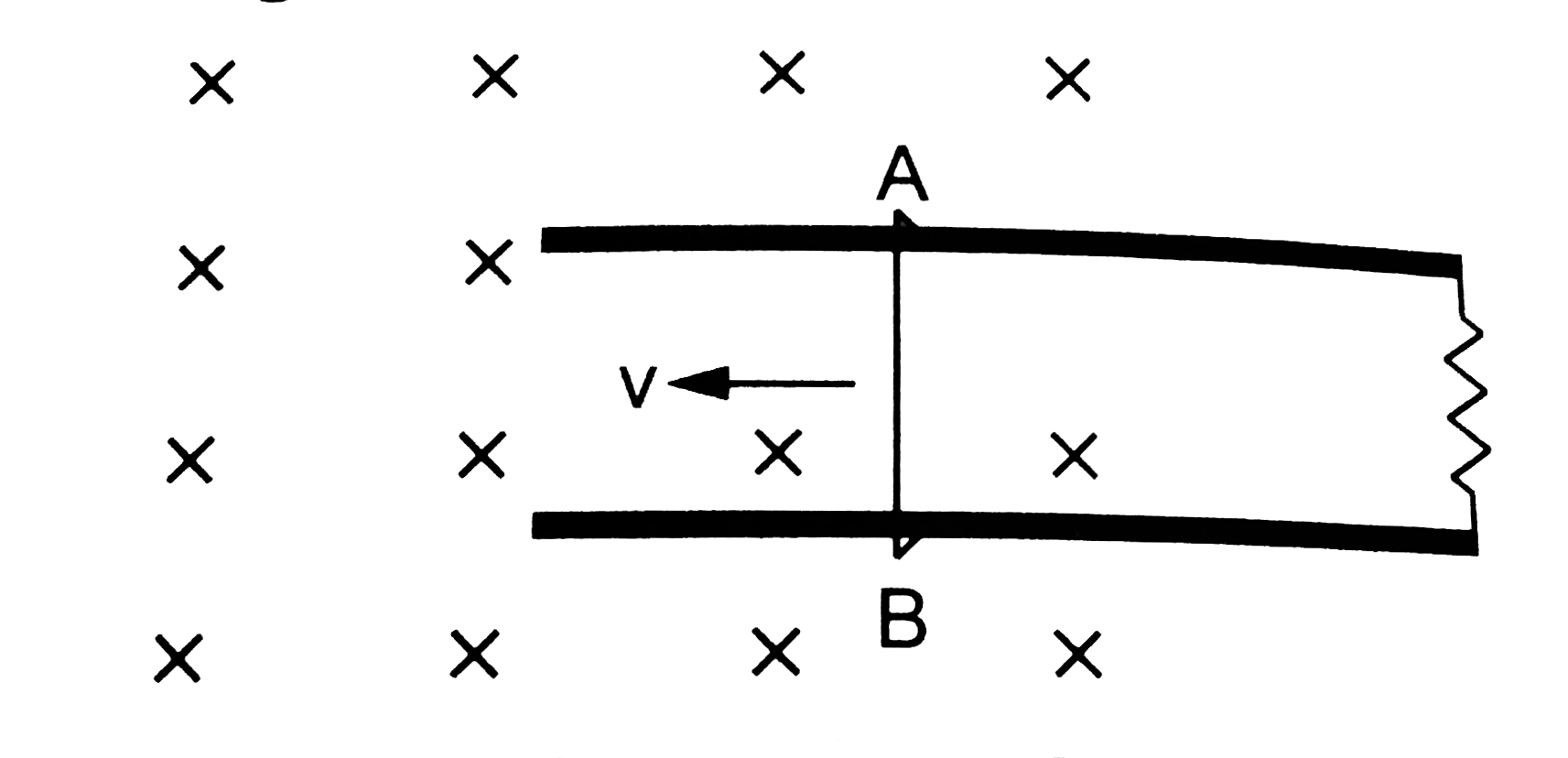
Consider the situation shown in . The wi...

Consider the situation shown in . The wire AB is slid on the fixed rails rails with a constant velocity. If the wire AB is replaced by a semicircular wire, the magnitude of the induced current will

A

increase

B

remain the same

C

decrease

D

increase or decrease depending on whether the semi-circle bulges towards the resistance or away form it.

Text Solution

Verified by Experts

The correct Answer is:

B
Promotional Banner

Topper's Solved these Questions

  • ELECTROMAGNETIC INDUCTION

    HC VERMA|Exercise Objective 2|10 Videos
  • ELECTROMAGNETIC INDUCTION

    HC VERMA|Exercise EXERCISE|98 Videos
  • ELECTROMAGNETIC INDUCTION

    HC VERMA|Exercise Questions for short answer|10 Videos
  • ELECTRIC FIELD AND POTENTIAL

    HC VERMA|Exercise Exercises|75 Videos
  • ELECTROMAGNETIC WAVES

    HC VERMA|Exercise Exercise|9 Videos

Similar Questions

Explore conceptually related problems

Consider the situation shown in figure. The straight wire is fixed but the loop can move under magnetic force. The loop will

Consider the situation shown in . The wire PQ has a negligible resistance and is made to slide on the three rails with a constant speed of 5 cm s^(-1) . Find the current in the 10 Omega resistor when the switch S is thrown to (a) the middle rail (b) the bottom rail.

A conducting wire ab of length l, resistance r and mass m starts sliding at t = 0 down a smooth, vertical, thick pair of connected rails as shown in . A uniform magnetic field B exists in the space in a diraction perpendicular to the plane of the rails. (a) Write the induced emf in the loop at an instant t when the speed of the wire is v. (b) what would be the magnitude and direction of the induced current in the wire? (c) Find the downward acceleration of the wire at this instant. (d) After sufficient time, the wire starts moving with a constant velocity. Find this velocity v_m. (e) Find the velocity of the wire as a function of time. (f) Find the displacement of the wire as a functong of time. (g) Show that the rate of heat developed inte wire is equal to the rate at which the gravitational potential energy is decreased after steady state is reached.

The current generator I _g , shown in . Sends a constant current I throught the curcuti. The wire cd is fixed and ab is made ot slide on the smooth, thick rails with a constant velocity v towards right. Each of these wire has resistance r. Find the current through the wire cd.

Consider the situation shown in . The wire PQ has mass m, resistance r and can slide on the smooth, horizontal parallel rails separted by a distance l. The resistance of the rails is negligible. A uniform magnetic field B exists in the rectangualr region and a resistance R connects the rails outsided the field region At t= 0, the wire PQ is puched towards right with a speed v_0 . find (a) the current in the loop at an instant when the speed of the wire PQ is v, (b) the acceleration of the wire at this instatn, (c ) the velocity v as a function of x and (d) the maximum distance the wire will move.

Consider the situation shown in figure. The wires P1Q1 and P2Q2 are made to slide on the rails with the same speed 5cm/sec . Find the electric current in the 19Ω resistor if (a) both the wires move towards right and (b) if P 1Q1 moves towards left but P2Q2 moves towards right.

Shows a wire of length l which can slide on a U- shaped rail of negligible resistance. The resistance of the wire is R. The wire is pulled ot the right with a constant speed v. Draw an equivalent circuit diagram representing the induced emf by a battery. Find the current in the wire usingj this diagram.

A straight metal wire crosses a magnetic field of flux 4 m Wb in a time 0.4 s. Find the magnitude of the emf induced in the wire.

Consider the situation shown in the figure of the previous problem. Suppose the wire connecting O and C has zero resistance but circular loop has a resistance R uniformly distributed along its length. The rod OA is made to rotate with a uniform angular speed omega as shown in the figure. Find the current in the rod when ltAOC = 90^@ .
