Home
Class 12
PHYSICS
A conducting square loop of side l and r...

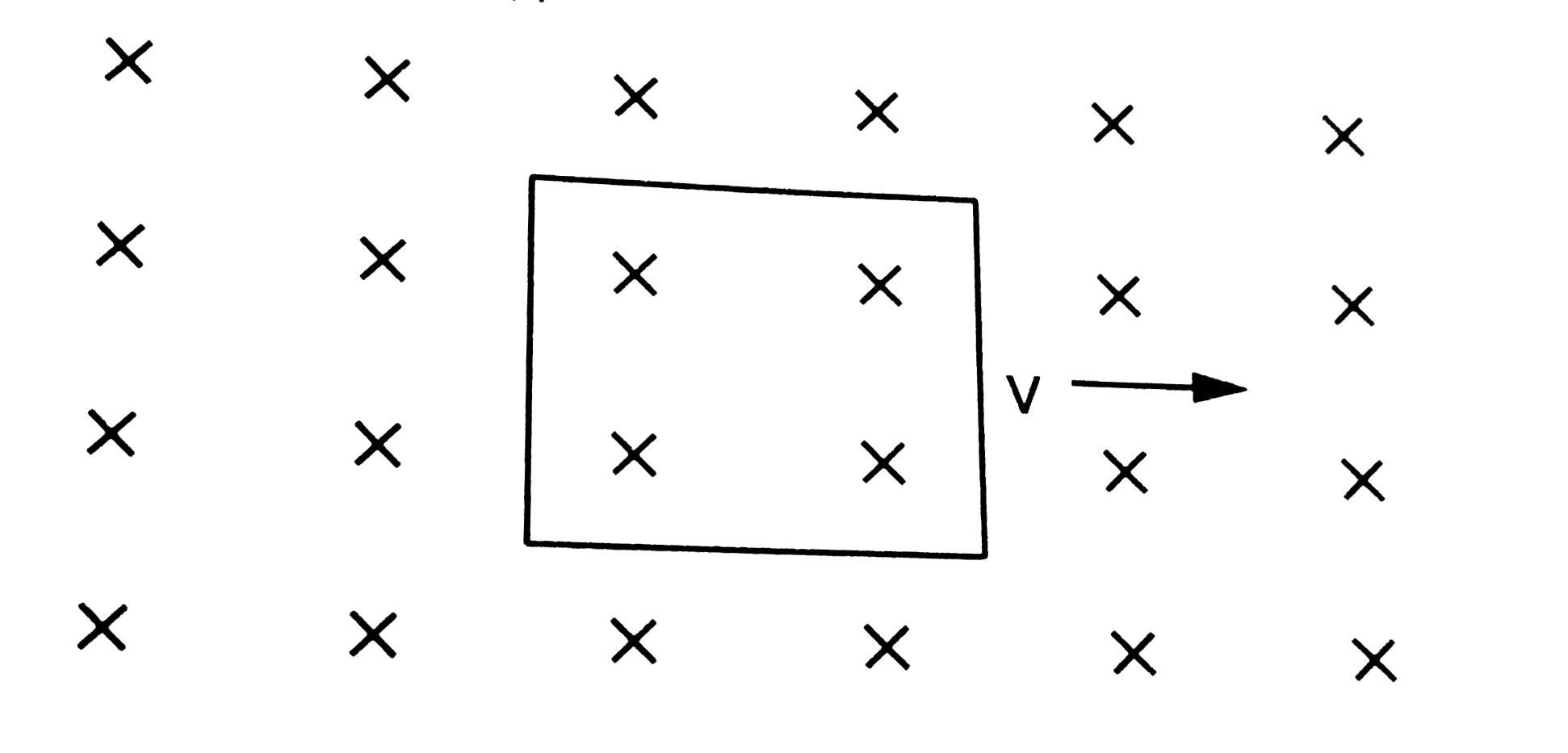
A conducting square loop of side l and resistance R moves in its plane with a uniform velocity v perpendicular ot one of its sides. A uniform and constant magnetic field B exists along the perpendicualr ot the plane of the loop as shown in . The current induced in the loop is

A

Blv/R clockwise

B

Blv/R anticlockwise

C

2 Blv/R anticlockwise

D

zero.

Text Solution

Verified by Experts

The correct Answer is:

D
Promotional Banner

Topper's Solved these Questions

  • ELECTROMAGNETIC INDUCTION

    HC VERMA|Exercise Objective 2|10 Videos
  • ELECTROMAGNETIC INDUCTION

    HC VERMA|Exercise EXERCISE|98 Videos
  • ELECTROMAGNETIC INDUCTION

    HC VERMA|Exercise Questions for short answer|10 Videos
  • ELECTRIC FIELD AND POTENTIAL

    HC VERMA|Exercise Exercises|75 Videos
  • ELECTROMAGNETIC WAVES

    HC VERMA|Exercise Exercise|9 Videos

Similar Questions

Explore conceptually related problems

A square loop of side 10 cm and resistance 1 Omega is moved towards right with a constant velocity V_0 as shown in . The left arm of the loop is in a uniform magnetic field of 2 T. the field is perpendicular ot the plane of the drawing and is going into it. the loop is connected to a network of resistors each of value 3 Omega with what speed should the loop be moved so that a steady curfrent of 1 mA flows in the loop.

A 20 cm long conducting rod is set into pure translation with a uniform velocity of 10cm s ^(-1) perpendicular to its length. A uniform magnetic field of magnitude 0.10 T exists in a direction perpendicular to the plane of motion. Find emf developed in the rod.

A copper wire bent in the shape of a semicircle of radius r translates in its plane with a constant velocity v. A uniform magnetic field B exists in the direction perpendicular to the plane of the wire. Find the emf induced between the ends of the wire if (a) the velocity is perpendicular ot the diameter joining free ends, (b) the velocity is parallel to this diameter.

A square loop of edge a having n turns Is rotated with a uniform angular velocity omega about one of its diagonals which is kept fixed in a horizontal position . A uniform magnetic field B exists in the vertical direction. Find the emf induced in the coil.

A rod of length l rotates with a uniform angular velocity omega about its perpendicular bisector. A uniform magnetic field B exists parallel to the axis of rotation. The potential difference between the two ends of the rod is

A conducting wire ab of length l, resistance r and mass m starts sliding at t = 0 down a smooth, vertical, thick pair of connected rails as shown in . A uniform magnetic field B exists in the space in a diraction perpendicular to the plane of the rails. (a) Write the induced emf in the loop at an instant t when the speed of the wire is v. (b) what would be the magnitude and direction of the induced current in the wire? (c) Find the downward acceleration of the wire at this instant. (d) After sufficient time, the wire starts moving with a constant velocity. Find this velocity v_m. (e) Find the velocity of the wire as a function of time. (f) Find the displacement of the wire as a functong of time. (g) Show that the rate of heat developed inte wire is equal to the rate at which the gravitational potential energy is decreased after steady state is reached.

A rectangular loop of wire is moved within the region of a uniform magnetic field acting perpendicular to its plane. What is the direction and magnitude of current induced in it ?

A current loop of arbitrary shape lies in a uniform magnetic field B. show that the net magnetic force acting on the loop is zero.

A conductlng circular loop is placed in a uniform magnetic field 0.04 T with its plane perpendicular to the magnetic field. The radius of the loop starts shrinking at 2 mm//s . The induced emf in the loop when the radius is 2 cm is:

A circular loop of area 1cm^2 , carrying a current of 10 A , is placed in a magnetic field of 0.1 T perpendicular to the plane of the loop. The torque on the loop due to the magnetic field is
