Home
Class 12
PHYSICS
A conducting wire ab of length l, resist...

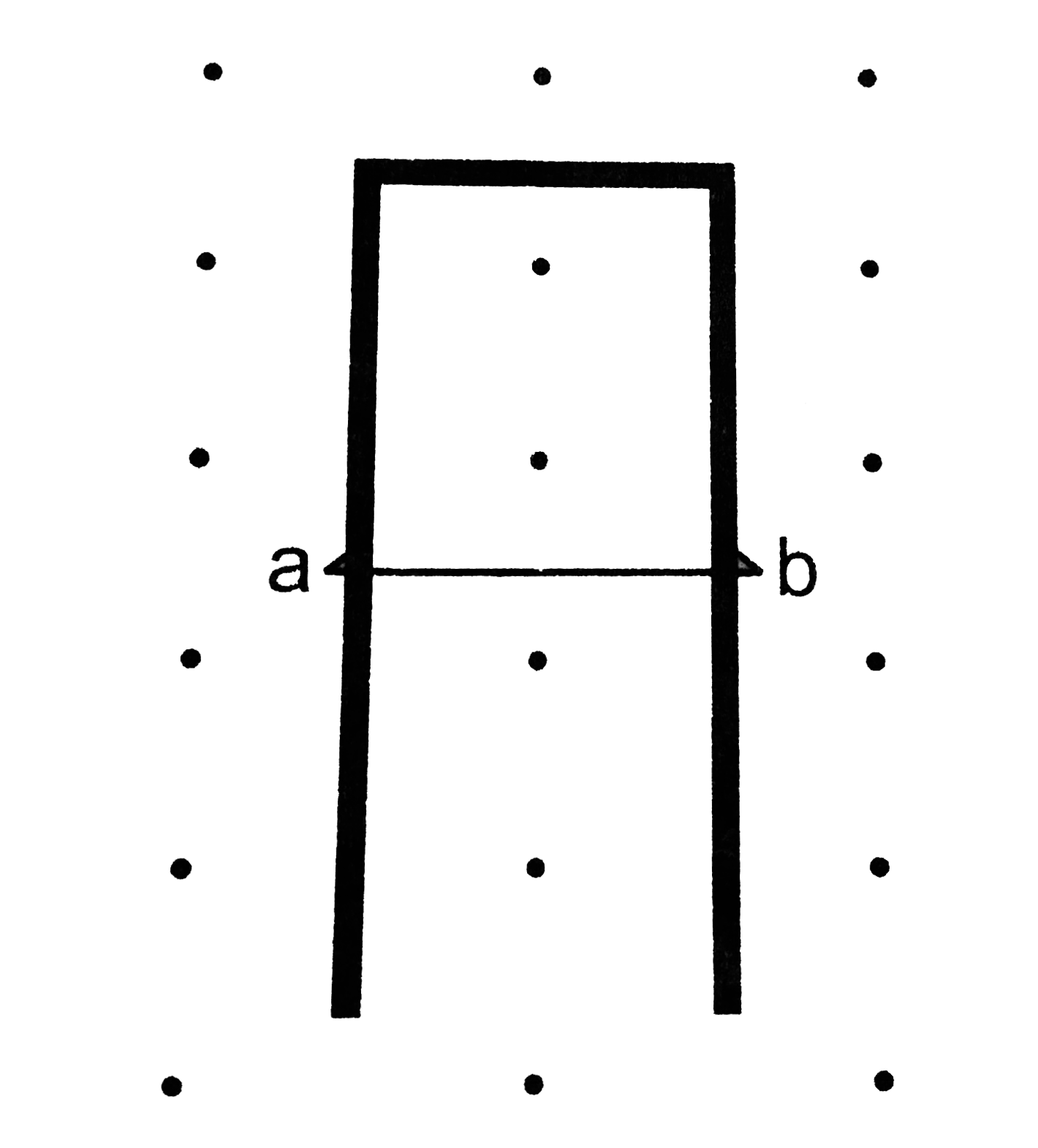
A conducting wire ab of length l, resistance r and mass m starts sliding at t = 0 down a smooth, vertical, thick pair of connected rails as shown in . A uniform magnetic field B exists in the space in a diraction perpendicular to the plane of the rails. (a) Write the induced emf in the loop at an instant t when the speed of the wire is v. (b) what would be the magnitude and direction of the induced current in the wire? (c) Find the downward acceleration of the wire at this instant. (d) After sufficient time, the wire starts moving with a constant velocity. Find this velocity `v_m. (e) Find the velocity of the wire as a function of time. (f) Find the displacement of the wire as a functong of time. (g) Show that the rate of heat developed inte wire is equal to the rate at which the gravitational potential energy is decreased after steady state is reached.

Text Solution

Verified by Experts

(a) when the speed the speed of wire is v
emf developed =Blv`
`(b) Induced current is the wire =(Blv)/R`
`(from b to a )`
`(c ) Downwards acceleration of the wire`
`=(mg-F)/m due to the current `
`=(ilB)/(m)=g=(B^2l^2v)/(Rm)`
`(d) let the start moving with constant velocity then acceleration =0`
`(B^2l^2v_m)/(Rm)=g`
` implies V_m=(GrM)/(B^2l^2)`
`(e) since (dv)/(dt)=a`
`implies (dv)/(dt)=((mg-B^2l^2v//R)/m) implies (dv)/((mg-B^2l^2v//R)/(m))=dt`
`int_(0)^(v)(m dv)/(mg-(B^2l^2v/R)/(m))=int_(0)^(v)dt`
`implies (m)/((B^2l^2v)/(R))[log (mg-((B^2l^2v)/(R))]_(0)^(v)=t`
` implies(-mR)/(B^2l^2)[log (mg-(B^2l^2v)/(R))-log(mg)]=t`
implies log[mg-((B^2l^2v)/(R))/(mg)]=(-t B^2l^2)/(mr)`
`=log[1-(B^2l^2v)/(Rmg)]=(-t B^2l^2)/(mr)`
` implies 1-(B^2l^2v)(Rmg)=e^((-t B^2l^2)/(mr)`
`implies (1-e^((-t B^2l^2)))=(B^(2)l^2v)/(Rmg)`
`v-(Rmg)/(B^2l^2)(1-e^((-t B^2l^2)))`
` implies v=v_m(1-e^(-(g t)/(v_m)))[:. v_m=(Rmg)/(B^2l^2)]`
` (f) since (ds)/(dt)=v`
`int ds= int v.dt`
`s=v_m(1-e^(-(g t)/(v_m)))`
`=v_m.(t+(v_m)/(g).e^(-(g t)/(vm)))`
`=(v_mt+(v_m)^2/(g)e^(-(g t)/(v_m)))-(V_m)^2/(g)`
`=v_m t=(V_m)^2/(g) (1-e^(-(g t)/(v_m)))`
(g) `(d)/(dt)(msg)=mg.(ds)/(dt)`
`=mg.(v_m)((1-e^(-(g t)/(v_m)))`
`(d_H)/(dt)=l^2R=R.((lBv)/(R))^2`
`=(l^2B^2v^2)/(R)`
` =(l^2 B^2)/(R).(V_m)^2((1-e^(-(g t)/(v_m)))^2`
`After steady state i.e..t rarr oo `
`(d)/(dt)(msg)=mg(v_m)`ltbr.`(d_H)/(dt)=(l^2B^2)/(R) (v_m)^2`
=(l^2B^2)/(r).(v_m).(mgR)/(l^2B^2)`
`Hence after steady state (d_H)/(dt)=(d)/(dt) mgs`.
Promotional Banner

Topper's Solved these Questions

  • ELECTROMAGNETIC INDUCTION

    HC VERMA|Exercise Objective 2|10 Videos
  • ELECTRIC FIELD AND POTENTIAL

    HC VERMA|Exercise Exercises|75 Videos
  • ELECTROMAGNETIC WAVES

    HC VERMA|Exercise Exercise|9 Videos

Similar Questions

Explore conceptually related problems

Shows a wire sliding on two parallel, conducting rails placed at a separation l. A magnetic feld B exists in a direction perpendicular to the plane of the rails. What force is necessary to keep the wire moving at a constant velocity v ?

A wire of mass m and length l can slide freely on a pair of smooth, vertical rails. A magnetic field B exists in the region in the direction perpendicular to the plane of the rails. The rails are connected at the top end by a capacitor of capacitance C. Find the acceleration of the wire neglecting any electric resistance.

A conducting square loop of side l and resistance R moves in its plane with a uniform velocity v perpendicular ot one of its sides. A uniform and constant magnetic field B exists along the perpendicualr ot the plane of the loop as shown in . The current induced in the loop is

A conductlng circular loop is placed in a uniform magnetic field 0.04 T with its plane perpendicular to the magnetic field. The radius of the loop starts shrinking at 2 mm//s . The induced emf in the loop when the radius is 2 cm is:

A rod of length l is translating at a velocity v making an angle theta with its length. A uniform magnetic field B exists in a direction perpendicualr to the plane of motion. Calculate the emf induced In the rod, Draw a figure representig the induced emf by on equivalent battery.

A right angled triangle abc, made from a metallic wire, moves at a uniform speed v in its plane as shown in . A uniform magnetic field B exists in the perpendicular direction. Find the emf induced (a) in the loop abc, (b) in the segment bc, (c ) in the segment ac and (d) in the segment ab.

A copper wire bent in the shape of a semicircle of radius r translates in its plane with a constant velocity v. A uniform magnetic field B exists in the direction perpendicular to the plane of the wire. Find the emf induced between the ends of the wire if (a) the velocity is perpendicular ot the diameter joining free ends, (b) the velocity is parallel to this diameter.

A circular loop carrying a current a current I has wire of total length L. A uniform magnetic field B exists parallel to the plane of the loop. (a ) find the torque on the loop.(b) If the same length of the wire is used to form a square loop, what would be the torque? Which is larger?

The moment of inertia of a uniform semi-circular wire of mass 'M' and radius 'r' about a line perpendicular to the plane of the wire through the center is

A conducting circular loop is placed is a uniform magnetic field B =0.20 T with its plane perpendicular to the field . Somehow, the radius of the loop starts shrinking at a constant rate of 1.0 mm s^(-1) . Find the induced emf in the loop at an instant when the radius is 2 cm.

HC VERMA-ELECTROMAGNETIC INDUCTION-EXERCISE
  1. The rectangualr wire- frame, shown in has a width d, mass m, resist...

    Text Solution

    |

  2. Shows a smooth pair of thick metallic rails connected across a battery...

    Text Solution

    |

  3. A conducting wire ab of length l, resistance r and mass m starts slidi...

    Text Solution

    |

  4. A bicycle is resting on its stand in the east - west direction and the...

    Text Solution

    |

  5. A conducting disc of radius r rotaes with a small but constant angul...

    Text Solution

    |

  6. shows a conducting disc rotating about its axis in a perpendicular ma...

    Text Solution

    |

  7. The magnetic field inn a region is given by vec B = veck (B0)/(L) y wh...

    Text Solution

    |

  8. shows a straight, long wire carrying a current I and a rod of length l...

    Text Solution

    |

  9. Consider a situation similar to that of the previous problem except th...

    Text Solution

    |

  10. Shows a square frame of wire having a total resistance r placed coplan...

    Text Solution

    |

  11. A rectangular metallic loop of length l and width b is placed coplan...

    Text Solution

    |

  12. Shows a conducting circular loop of radius a placed in a uniform, perp...

    Text Solution

    |

  13. Consider the situation shown in the figure of the previous problem. Su...

    Text Solution

    |

  14. Consider a variation of the previous problem. Suppose the circular loo...

    Text Solution

    |

  15. Shows a situation similar to the previous problem. All parameters are...

    Text Solution

    |

  16. A wire of mass m and length l can slide freely on a pair of smooth, ve...

    Text Solution

    |

  17. A uniform magnetic field B exists in a cylindrical region, shown dotte...

    Text Solution

    |

  18. The current in an ideal, long solenoid is varied at a uniform rate of...

    Text Solution

    |

  19. An average emf of 20 V is induced in an inductor when the current in...

    Text Solution

    |

  20. A magnetic flux of 8X10^(-4) weber is linked with each turn of a 200 -...

    Text Solution

    |
