Home
Class 12
PHYSICS
A block of mass m and relative density y...

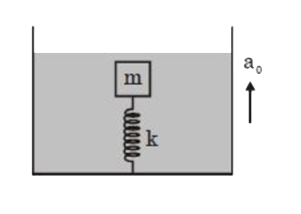
A block of mass m and relative density `y( lt 1)` si attached to an ideal spring of constant K. The system is initially at rest and at equilibrium. If the container acceleration upwards with `a_(0)`, find the increase in the elongation of the spring in equilibrium.

A

`(ma_(0))/(gammaK)`

B

`(ma_(0))/(K) (1-gamma)`

C

`(ma_(0))/(K) ((1)/(gamma)-1)`

D

`(ma_(0))/(K)(gamma-1)`

Text Solution

Verified by Experts

The correct Answer is:
C

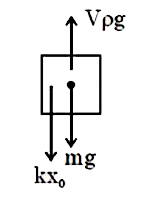
Initially

`rArr Vpg = kx_(0) +mg…(i)`
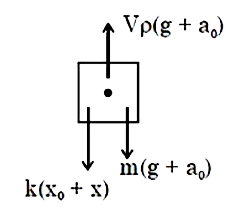
Finally

`rArr V rho (g+ a_(0)) =k(x_(0) +x) +m(g+a_(0)) …(ii)`
`(ii)-(i)`
`V rhoa_(0) =kx +ma_(0)`
`x=(Vpa_(0)-ma)/(k)`
`x=(ma_(0))/(k) ((V rho)/(m)-1)`
`x=(ma_(0))/(k) ((Vrho)/(Vrho_(m))-1)`
`x=(ma_(0))/(k)((1)/(gamma)-1)`
Promotional Banner

Topper's Solved these Questions

  • NTA TPC JEE MAIN TEST 47

    NTA MOCK TESTS|Exercise PHYSICS (SUBJECTIVE NUMERICAL)|10 Videos
  • NTA TPC JEE MAIN TEST 46

    NTA MOCK TESTS|Exercise PHYSICS|30 Videos
  • NTA TPC JEE MAIN TEST 48

    NTA MOCK TESTS|Exercise PHYSICS |29 Videos

Similar Questions

Explore conceptually related problems

A block of mass m having charge q is attached to a spring of spring constant k . This arrangement is placed in uniform electric field E on smooth horizontal surface as shown in the figure. Initially spring in unstretched. Find the extension of spring in equilibrium position and maximum extension of spring.

A block of mass m can slide along a frictionless inclined plane, is attached to a ideal spring of spring constant as shown in the figure. Find the period of its oscillation. (Frame of reference attached to the wedge is at rest)

A block of mass 5 kg having charge q is attached to a spring of constant K = 10^(4) N//m . A charge -q is placed below the block at separation 0.5 m . If the maximum elongation of spring is 0.5 m . If the maximum elongation of spring is 0.1 m , find q . Assume the initial elongation of spring is zero.

A block is attached with an ideal spring and string, and is in equilibrkum as shown in Figure. The acceleration of the block just after breaking the string is a_(1) and just after breaking the spring is a_(2) . Then

A block ofmass m is attached with a spring in its natural length, of spring constant k. The other end A of spring is moved with a constant acceleration 'a' away from the block as shown in the figure -3.74 . Find the maximum extension in the spring. Assume that initially block and spring is at rest w.r.t ground frame:

A block of mass m hangs from a vertical spring of spring constant k. If it is displaced from its equilibrium position, find the time period of oscillations.

One end of a spring of force constant k_1 is attached to the ceiling of an elevator. A block of mass 1.5kg is attached to the other end. Another spring of force constant k_2 is attached to the bottom of the mass and to the floor of the elevator as shown in figure. At equilibrium, the deformation in both the spring is equal and is 40cm . If the elevator moves with constant acceleration upward, the additional deformation in both the spring is 8cm . Find the elevator's accelerationn ( g=10ms^-2 ).

A pulley with two blocks system is attached to the ceiling of a lift upward with an acceleration a_(0) . Find the deformation in the spring.

A bullted of mass m embeds itself in a block of mass M resting on a smooth horizontal surface, attached to a spring of force constant k. If the initial sped of the bullet is v_(0) along horizontal, find (a) the maximum compression of the spring and (b) the time forthe bullet - block system to come to rest.

Block of mass 2 m is given v_(0) towards the right. If L is the natural length of spring constant k , find the maximum elongation of the spring.