Home
Class 12
PHYSICS
One mole of a diatomic ideal gas (gamma=...

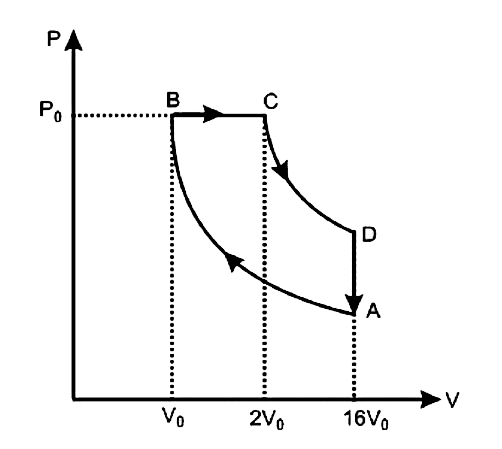
One mole of a diatomic ideal gas `(gamma=1.4)` is taken through a cyclic process starting from point A. The process `AtoB` is an adiabatic compression, `BtoC` is isobaric expansion, `CtoD` is an adiabatic expansion, and `DtoA` is isochoric. The volume ratios are `V_A//V_B=16 and V_C//V_B=2` and the temperature at A is `T_A=300K`. Calculate the temperature of the gas at the points B and D and find the efficiency of the cycle.

Text Solution

Verified by Experts

The correct Answer is:
`61.40`

The corresponding `p - V` diagram is as shown
Given `T_(A) = 300K, n = 1, gamma - 1.4, (V_(A))/(V_(B))=16 and (V_(C ))/(V_(B)) = 2 `

Let `V_(B)=V_(0) and p_(B)=p_(0)`
Then, `V_(C )=2V_(0) and V_(A)=16V_(0)`
Efficiency of cycle
Efficiency of cycle (in percentage) is defined as
`eta=("Net work done in the cycle")/("Heat absorbed in the cycle") xx 100`
Or `eta=(W_("Total"))/(O_(+ve))xx 100`
`=(Q_(+ve)-Q_(-ve))/(Q_(+ve))xx 100 =(1-(Q_(1))/(Q_(2))) xx 100 " " ...(i)`
where, `Q_(1) =` Negative heat in the cycle (heat released)
and `Q_(2) =` Positive heat in the cycle (heat absorbed) In the cycle
`Q_(AB)=Q_(CD)=0" "`(Adiabatic process)
`Q_(DA)=nc_(v) DeltaT =(1) ((5)/(2)R) (T_(A)-T_(D))`
(`C_(v)=(5)/(2)` R for a diatomic gas)
`=(5)/(2) xx 8.31 (300-791.4)J`
or `Q_(DA) = -10208.8J`
and `Q_(BC)=nc_(p) DeltaT =(1)((7)/(2)R) (T_(C )-T_(B))`
(`c_(p)=(7)/(2)R` for a diatomic gas)
`=((7)/(2))(8.31) (1818-909)J`
or `Q_(BC)=26438.3J`
Therefore, substituting `Q_(1) = 10208.8 J and Q_(2) = 26438.3 J` in Eq. (i), we get
`:.eta={1-(10208.8)/(26438.3)} xx 100`
or `eta=61.4%`
Promotional Banner

Topper's Solved these Questions

  • NTA TPC JEE MAIN TEST 47

    NTA MOCK TESTS|Exercise PHYSICS (SUBJECTIVE NUMERICAL)|10 Videos
  • NTA TPC JEE MAIN TEST 46

    NTA MOCK TESTS|Exercise PHYSICS|30 Videos
  • NTA TPC JEE MAIN TEST 48

    NTA MOCK TESTS|Exercise PHYSICS |29 Videos

Similar Questions

Explore conceptually related problems

A monatomic idea gas of 2 mol is taken through a cyclic process starting from A as shown in figure. The volume ratio are V_(B)//V_(A)=2 and V_(D)//V_(A)=4 . If the temperature T_(A) at A is 27^(@)C , and gas constant is R . Calculate. The temperature of the gas at point B

A mono-atomic ideal gas of two moles is taken through a cyclic process starting from A as shwon in the figure below. The volume ratios are V_(B)//V_(A) = 2 and V_(D)//V_(A) = 4 . If the temperature T_(A) at A is 27^(@)C . Calculate a. The temperature of gas at B . b. Heat absorbed or evolved in each process. c. Total wrok done in cyclic process.

One mole of a diatomic ideal gas undergoes a cyclic process ABC as shown in figure. The process BC is adiabatic. The temperature at A,B and C are 400K, 800K and 600K respectively. Choose the correct statement:

A monoatomic ideal gas of two moles is taken through a cyclic process starting from A as shown in figure. The volume ratios are (V_B)/(V_A)=2 and (V_D)/(V_A)=4 . If the temperature T_A at A is 27^@C . Calculate, (a) the temperature of the gas at point B, (b) heat absorbed or released by the gas in each process, (c) the total work done by the gas during the complete cycle. Express your answer in terms of the gas constant R.

A monoatomic ideal gas of two moles is taken through a cyclic process starting from A as shown in figure. The volume ratios are (V_(B))/(V_(A))=2 and (V_(D))/(V_(A))=4 . If the temperature T_(A) at A is 27^(@)C , calculate: (a) The temperature of the gas at point B . (b) Heat absorbed or released by the gas in each process. (c) The total work done by the gas during complete cycle.

A monatomic idea gas of 2 mol is taken through a cyclic process starting from A as shown in figure. The volume ratio are V_(B)//V_(A)=2 and V_(D)//V_(A)=4 . If the temperature T_(A) at A is 27^(@)C , and gas constant is R . Calculate. The total work done by the gas during the complete cycle.

A monotomic ideal gas of two metal is taken through a cyclic process straining from A as shown V_(B)//V_(A)=2 and V_(D)//V_(A)=4 Temperature T_(A) is 27^(@)C The work done during the process C to D is

