Home
Class 12
PHYSICS
A solid cylinder of radius r and mass m ...

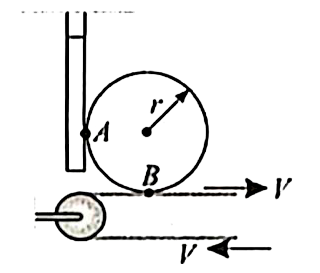
A solid cylinder of radius r and mass m is placed with no initial velocity on a moving belt 'B'. It is placed against a rough wall ’A', which restricts the sliding of the cylinder on the belt as shown in the figure. Assuming that the

coefficient of friction at A and B is `mu(lt 1)`, the angular acceleration of the cylinder will be

A

`g/r (mu/(1 + mu))`

B

`(2g)/(r)((mu)/(1 + mu))`

C

`g/(2r) ((mu)/(1 + mu))`

D

`g/r ((mu)/(2 + mu))`

Text Solution

Verified by Experts

The correct Answer is:
B

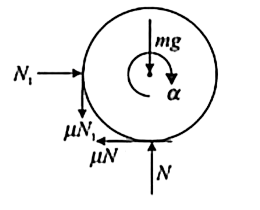
For linear motion, apply newton.s laws
`N_1 - muN = 0 mu_1 = mu N " "......(i)`
`mu N_1 + mg = N .......(ii)`

For rotation motion.
`(mu N - mu N_1) • r = ((mr^2)/(2alpha))`
` (mu mg)/(1 - mu^2) - (mu^2 mg)/(1 - mu^2) = (mr)/2 alpha implies alpha = (2mug)/(r(1 + mu))`
Promotional Banner

Topper's Solved these Questions

  • NTA TPC JEE MAIN TEST 63

    NTA MOCK TESTS|Exercise PHYSICS|30 Videos
  • NTA TPC JEE MAIN TEST 65

    NTA MOCK TESTS|Exercise PHYSICS |30 Videos

Similar Questions

Explore conceptually related problems

A force F is applied horizontally on a cylinder in the line of centre as shown in the figure. The cylinder is on a rough surface of coefficient of fricition mu . The direction of the friction force acting on the cylinder will be

A solid cylinder of mass m is wrapped with an inextensible light string and, is placed on a rough inclined plane as shown in the figure. The frictional force acting between the cylinder and the inclined plane is : [The coefficient of static friction, mu_(s)" is 0.4"]

A rope is wound round a hollow cylinder of mass M and radius R. If the rope is pulled with a force F newton, then the angular acceleration of the cylinder will be

A rope is wound round a hollow cylinder of mass M and radius R. If the rope is pulled with a force F newton, then the angular acceleration of the cylinder will be

A rod bent at right angle along its centre line is placed on a rough horizontal fixed cylinder of radius R as shown in the figure. Mass of the rod is 2m and the rod is in equilibrimu. Assume that the friction force on rod at A and B is equal in magnitude.

A plank of mass M , is placed on a smooth surface over which a cylinder of mas m(=M) annd radius R=1m is placed as shown in figure. Now the plane is pulled towards the right wilth an external force F(=2Mg) . If the cyinder does not slip over the surfcace of the plank, find the linear acceleration of he plank and the cylinder and the angular acceleration of the cylinder. (Take g=10 ms^(2) )

A uniform circular cylinder of mass m and radius r is given an initial angular velocity omega_() and no initial translational velocity it is placed in contact with a plane inclined at an angle alpha to the horizontal. If there is a coefficient of friction mu for sliding between the cylinder and plane. Find the distance the cylinder moves up before sliding stops also calculate the maximum distance it travels up the plane assume mugttanalpha .

A uniform cylinder of mass m lies on a fixed plane inclined at a angle theta with the horizontal. A light string is tied to the cylinder at the rightmost point, and a mass m hangs from the string as shown. Assume that the coefficient of friction between the cylinder and the incline plane is sufficiently large to prevent slipping. for the cylinder to remain static the value of m is

A plank of mass M is placed on a smooth surface over which a cylinder of mass m and radius R is placed as shown in figure-5.63. Now the plank is pulled towards right with an external force F. If cylinder does not slip over the surface of plank find the linear acceleration of plank and cylinder and the angular acceleration of the cylinder.

NTA MOCK TESTS-NTA TPC JEE MAIN TEST 64-PHYSICS
  1. There is a hole h metre from its top of a tank filled with water. Calc...

    Text Solution

    |

  2. The ratio of thickness of plates of two transparent medium A and B is ...

    Text Solution

    |

  3. A convex lens of refractive index 1.5 is given. It also has the radius...

    Text Solution

    |

  4. The figure shows a uniform disc, with mass M = 2.4 kg and radius R= 20...

    Text Solution

    |

  5. A solid cylinder of radius r and mass m is placed with no initial velo...

    Text Solution

    |

  6. 1 gm of ice at 0^@C is converted to steam at 100^@C the amount of heat...

    Text Solution

    |

  7. Let gamma denote the ratio of specific heat for an ideal gas. Then cho...

    Text Solution

    |

  8. Young's double slit experiment is being performed with a light of wave...

    Text Solution

    |

  9. A particle which is constant to move along the x- axis , is subjected ...

    Text Solution

    |

  10. Two particles A and B of masses 10 kg and 38 kg, respectively, are mov...

    Text Solution

    |

  11. The maximum mass of photons emitted by an X-ray tube when a voltage of...

    Text Solution

    |

  12. In a particular photoelectric setup it is observed that the maximum ve...

    Text Solution

    |

  13. A small source placed 1 m away from a photocell.It is illuminated by s...

    Text Solution

    |

  14. A junction diode of negligible forward resistance is used as a half-wa...

    Text Solution

    |

  15. A planet has a core of density rho1 and the density of the outer shell...

    Text Solution

    |

  16. Find the temperature T, At which the r.m.s. speed of oxygen molecules ...

    Text Solution

    |

  17. The susceptibility of magnesium at 27^@C is 1.2 xx 10^(-5). The temper...

    Text Solution

    |

  18. In a resonance-tube experiment, the first and the second resonances oc...

    Text Solution

    |

  19. A single drop of water with radius R is formed from coalesce of many i...

    Text Solution

    |

  20. An iron plate is uniformly heated from 20^@C to 80^@C. The change in d...

    Text Solution

    |

