



Home
Class 12
PHYSICS
Two particles A and B of masses 10 kg an...

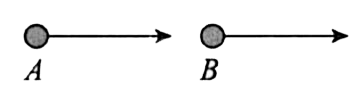
Two particles A and B of masses 10 kg and 38 kg, respectively, are moving along the same straight line with velocities 15 m/s and 3 m/s, respectively, in the same direction. After elastic collision, the velocities of A and B are `v_A `and `v_B`, respectively, in the direction of initial motion. Then

A

`v_A = 20 m//s, v_B = 8 m/s `

B

`v_A = – 4 m//s, v_B = 8 m//s`

C

`v_A = 16 m/s, v_B = 28 m//s`

D

`v_A = – 5 m//s, v_B = 10 m//s`

Text Solution

Verified by Experts

The correct Answer is:
B

Using the values given in question and applying momentum conservation we get

`10 xx 15 + 38 xx 3 = 10 xx v_A + 38 xx v_B " ".......(i)`
Now in elastic collision Velocity of approach = Velocity of seperation
We get
`15 – 3 = v_B - v_A" " ....(ii)`
On solving (i) & (ii) equation
`v_A = - 4m//s , v_B = 8 m//s`
Alternate solution
Apply Direct Formula
`v_A = (m_A - m_B)/(m_A + m_B) u_A + (2m_B)/(m_A + m_B) u_B`
`v_B = (2m_A)/(m_A + m_B) u_A + (m_B + m_A)/(m_A + m_B) u_B`

where `u_A = 15m//s , u_B = 3m//s`
on substituting values we get
`v_A = - 4m//s , v_B = 8 m//s`
Promotional Banner

Topper's Solved these Questions

  • NTA TPC JEE MAIN TEST 63

    NTA MOCK TESTS|Exercise PHYSICS|30 Videos
  • NTA TPC JEE MAIN TEST 65

    NTA MOCK TESTS|Exercise PHYSICS |30 Videos

Similar Questions

Explore conceptually related problems

Two bodies of masses 5 kg and 3 kg moving in the same direction along the same straingh line with velocities 5 ms^(-1) and 3 ms^(-1) respectively suffer one-dimensional elastic collision . Find their velocities after the collision .

Two elastic bodies P and Q having equal mases are moving along the same line with velocities of 16 m/s and 10 m/s respectively. Their velocities after the elastic collision will be in m/s :

Two equal masses m_1 and m_2 moving along the same straight line with velocites +3 m//s and - 5 m//s respectively collide elastically. Their velocities after the collision will be respectively.

Two spheres of masses 1 kg and 2 kg are moving with velocities of 10 m/s and 5 m/s respectively in the same direction. After the collision the velocity of the lighter sphere decreases by 4 m/s. What is the coefficient of restitution?

Two balls of masses 10 kg and 20 kg approach each other with velocities 30 m/s and 20 m/s respectively . Calculate their velocities after they undergo a perfectly eleastic collision .

Two perfectly elastic particles A and B of equal masses travelling along a line joining them with velocities 15 m//s and 10m//s respectively collide. Their velocities after the elastic collision will be (in m/s) respectively

Two particle of mass 2 kg and 1 kg are moving along the same straight line with speeds 2m//s and 5m//s respectively. What is the speed of the centre of mass of the system if both the particles are moving (a) in same direction (b) in opposite direction ?

Two particles having masses of 2 kg and 3 kg are moving along the same straight line with velocities of 3 ms^(-1) and 6 ms^(-1) respectively. Calculate the speed of centre of mass of system if particles are moving in (a) same direction. (b) in opposite direction.

Two particles of mass 1kg and 2kg are moving along the same line with speeds 2m//s and 4m//s respectively. Calculate the speed of the centre of mass of the system if both the particles are moving in the same direction.

NTA MOCK TESTS-NTA TPC JEE MAIN TEST 64-PHYSICS
  1. There is a hole h metre from its top of a tank filled with water. Calc...

    Text Solution

    |

  2. The ratio of thickness of plates of two transparent medium A and B is ...

    Text Solution

    |

  3. A convex lens of refractive index 1.5 is given. It also has the radius...

    Text Solution

    |

  4. The figure shows a uniform disc, with mass M = 2.4 kg and radius R= 20...

    Text Solution

    |

  5. A solid cylinder of radius r and mass m is placed with no initial velo...

    Text Solution

    |

  6. 1 gm of ice at 0^@C is converted to steam at 100^@C the amount of heat...

    Text Solution

    |

  7. Let gamma denote the ratio of specific heat for an ideal gas. Then cho...

    Text Solution

    |

  8. Young's double slit experiment is being performed with a light of wave...

    Text Solution

    |

  9. A particle which is constant to move along the x- axis , is subjected ...

    Text Solution

    |

  10. Two particles A and B of masses 10 kg and 38 kg, respectively, are mov...

    Text Solution

    |

  11. The maximum mass of photons emitted by an X-ray tube when a voltage of...

    Text Solution

    |

  12. In a particular photoelectric setup it is observed that the maximum ve...

    Text Solution

    |

  13. A small source placed 1 m away from a photocell.It is illuminated by s...

    Text Solution

    |

  14. A junction diode of negligible forward resistance is used as a half-wa...

    Text Solution

    |

  15. A planet has a core of density rho1 and the density of the outer shell...

    Text Solution

    |

  16. Find the temperature T, At which the r.m.s. speed of oxygen molecules ...

    Text Solution

    |

  17. The susceptibility of magnesium at 27^@C is 1.2 xx 10^(-5). The temper...

    Text Solution

    |

  18. In a resonance-tube experiment, the first and the second resonances oc...

    Text Solution

    |

  19. A single drop of water with radius R is formed from coalesce of many i...

    Text Solution

    |

  20. An iron plate is uniformly heated from 20^@C to 80^@C. The change in d...

    Text Solution

    |