Home
Class 12
PHYSICS
When both the listener and source are mo...

When both the listener and source are moving towards each other, then which of the following is true regarding frequency and wavelength of wave observed by the observer?

A

More frequency, more wavelength

B

More frequency, more

C

Less frequency, less wavelength

D

More frequency, constant wavelength

Text Solution

Verified by Experts

The correct Answer is:
A

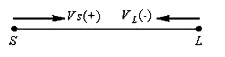
According to Doppler.s effect, whenever there is a relative motion between a source of sound and listener, the apparent frequency of sound heard by the listener is different from the actual frequency of sound emitted by the source. Let S be source of sound and L the listener of sound. Let v be the actual frequency of sound emitted by the source and `lambda` be the actual wavelength of the sound emitted.
If v is velocity of sound in still air, then
`lambda = v/V`
If velocity of listener is `v_(L)`, and velocity of source is `v_s`, then apparent frequency of sound waves heard by the listener is :
`v^(..) = (v-v_(L))/(v-v_(s)) xx V`
Here, both source and listener are approaching each other.

Then `v_s` is positive and `v_L` is negative.
`therefore v^(n) = (v-(-v_(L)))/(v-v_(s)) v = (v + v_(L))/(v-v_(l)) v`
i.e. `v^(n) gt v`
Also `lambda^(..) lt lambda`
So, listener listens more frequency and observes less wavelength.
Promotional Banner

Topper's Solved these Questions

  • NTA TPC JEE MAIN TEST 105

    NTA MOCK TESTS|Exercise PHYSICS |30 Videos
  • NTA TPC JEE MAIN TEST 107

    NTA MOCK TESTS|Exercise PHYSICS|30 Videos

Similar Questions

Explore conceptually related problems

When both the listener and source are moving towards each other, then which of the following is true regarding frequency and wavelength of wave obserseved by the observer?

Source of sound and observer are moving towards each other, the observer will hear

When the light source is moving towards an observer,

A source of sound moves towards an observe.

A source of sound is located in a medium in which speed of sound is V and an observer is located in a medium in which speed of sound is 2V. Both the source and observer are moving directly towards each other at velocity V/5 . The source has a frequency of f_(0) . (a) Find the wavelength of wave in the medium in which the observer is located. (b) Find the frequency received by the observer.

An observer moves towards a stationary source of sound with a speed ((1)/(5)) th of the speed of sound. The wavelength and frequency of the source emitted are lamda and f, respectively. The apparent frequency and wavelength recorded by the observer are, respectively.

A source and a listener are both moving towards each other with speed v//10 , where v is the speed of sound. If the frequency of the note emitted by the source is f , the frequency heard by the listener would be nearly

NTA MOCK TESTS-NTA TPC JEE MAIN TEST 106-PHYSICS
  1. The average translational K.E. in one millitre volume of oxygen at NTP...

    Text Solution

    |

  2. Consider the situation shown in the figure. The wall is smooth but the...

    Text Solution

    |

  3. If only one hundredth part of total current flowing in the circuit is ...

    Text Solution

    |

  4. The velocity of sound in air at NTP is 330 m/s. What will be its value...

    Text Solution

    |

  5. When both the listener and source are moving towards each other, then...

    Text Solution

    |

  6. A small drop of water falls from rest through a large height h in air,...

    Text Solution

    |

  7. A small coin is resting on the bottom of a beaker filled with a liquid...

    Text Solution

    |

  8. Two loops P and Q are made from a uniform wire. The redii of P and Q a...

    Text Solution

    |

  9. The angular velocity of a body is vec(omega)=2hati+3hatj+4hatk and a t...

    Text Solution

    |

  10. If the temperature of the sink of a Carnot engine having an efficiency...

    Text Solution

    |

  11. Which one of the following phenomena is not explained by Huygen’s cons...

    Text Solution

    |

  12. The half-life of a radioactive nuclide is 20 hours. What fraction of o...

    Text Solution

    |

  13. A wire of length L and 3 identical cells of negligible internal resist...

    Text Solution

    |

  14. Power gain for a common base amplifier is 400 and voltage gain 420. F...

    Text Solution

    |

  15. Two balls A and B are projected from the same position with horizontal...

    Text Solution

    |

  16. In the XY- plane , the region y gt 0 has a uniform magnetic field B1 ...

    Text Solution

    |

  17. A mass (M) attached to a spring, oscillates with a period of (2 sec). ...

    Text Solution

    |

  18. Coefficient of thermal conductivity is the product of heat, distance a...

    Text Solution

    |

  19. It is known that it takes five minutes to empty a rectangular vessel w...

    Text Solution

    |

  20. Liquids A and B are at 30^(@) C and 20^(@) C, respectively. When mixed...

    Text Solution

    |

