Home
Class 12
PHYSICS
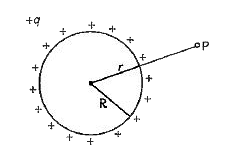
Electric field intensity' at point P due...

Electric field intensity' at point P due to 'charge distributed over a sphere is: '

A

`E=1/(4piepsilon_0)q/r`

B

`E = (sigmaR^2)/(epsilon_0r^2)`

C

`E=1/(4piepsilon_0)r/q`

D

E = 0

Text Solution

Verified by Experts

Promotional Banner

Topper's Solved these Questions

  • SAMPLE PAPER 9

    EDUCART PUBLICATION|Exercise SECTION - B|22 Videos
  • SAMPLE PAPER 9

    EDUCART PUBLICATION|Exercise SECTION - C|3 Videos
  • SAMPLE PAPER 7

    EDUCART PUBLICATION|Exercise SECTION-C|6 Videos
  • SAMPLE PAPER SELF- ASSESSMENT -(10)

    EDUCART PUBLICATION|Exercise SECTION-B|17 Videos

Similar Questions

Explore conceptually related problems

Electric field due to point charge

Electric intensity at a place due to a charge is

Derive an expression for the electric field intensity at a point outside a charged conducting sphere.

Assertion: Electric field intensity at a point due to a positive charge is always opposite in direction to electric field intensity due to negative charge, and it is independent to locațions of charges. Reason: The direction of electric field due to a point charge is away from the positive charge and towards the negative charge along the line joining the point charge and location where the electric field is to be calculated.

Electric field intensity at a point due to an infinite sheet of charge having surface charge density sigma is E .If sheet were conducting electric intensity would be

Statement 1:Electric field intensity at surface of uniformly charged spehrical shell is E if the shell is puncurted at a point then intensity at punctured point becomed E//2 . Statement 2:Electric field intensity due to spherical charge distribution can be found out by using Gauss Law .

Electric field intensity due to a charged sphere at a point outside the sphere decreases with "……………….." .

Electric field due to spheres

The magnitude of electric field intensity and electric potential due to a point charge at a point is 72 N/C and 36V, respectively. Calculate magnitude of the charge and distance of the point from point charge.

