Home
Class 12
PHYSICS
A car moves in a straight line, the car ...

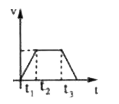
A car moves in a straight line, the car accelerates from rest with a constant acceleration `alpha` on a straight road. After gaining a velocity `v`, the car moves with that velocity for sometime. Then car decelerates with a retardation `beta`, If the total distance covered by the car is equal to `s` find the total time of its motion.

Text Solution

Verified by Experts
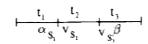

`V=0+alphat, t_1=v/alpha`
`S_1=1/2alphat_1^2=v^2/(2alpha)`
`O-V=betat_3 , t_3=v/beta`
`O^2-V^2=-2betaS_3`
`S_3=v_2/(2beta)=1/2 betat_3^2`
`t_2=S_2/V=(S-(S_1+S_3))/V=(S-v^2/2(1/alpha+1/beta))/V`
`t=t_1+t_2+t_3`
`=v/alpha+s/v-v/(2alpha)-v/(2beta)+v/beta`
`t=s/v+v/2((alpha+beta)/(alphabeta))`
`s_2=s-(s_1+s_2)=s-(v^2/(2alpha)+v^2/(2alpha))`
`=s-v^2/alpha=s-(vt-s)`
`s_2=2s-vt`
[`S_2` = distance travelled with constant velocity]
Promotional Banner

Topper's Solved these Questions

  • MOTION IN A STRAIGHT LINE

    AAKASH SERIES|Exercise EXERCISE -I|58 Videos
  • MOTION IN A STRAIGHT LINE

    AAKASH SERIES|Exercise EXERCISE -II|80 Videos
  • MOTION IN A PLANE

    AAKASH SERIES|Exercise QUESTION FOR DESCRIPTIVE ANSWER|7 Videos
  • MOVING CHARGES AND MAGNETISM

    AAKASH SERIES|Exercise EXERCISE-III|49 Videos

Similar Questions

Explore conceptually related problems

A car moves in a straight line, the car accelerates from rest with a constant acceleraation alpha on a straight foad. After gaining a velocity v , the car moves with that velocity for somerime. Then car decelerates with a retardation beta , If the total distance covered by the car is equal to s find the total time of its motion.

A car moving on a straight road is an example of:

A car, starting from rest, accelerates at the rate f through a distance s, then continues at constant speed for time t and then decelerates at the rate f/ 2 to come to rest. If the total distance travelled is 15 s, then

A car, starting from rest, accelerates at the rate f through a distance s, then continues at constant speed for time t and then decelerates at the rate f/ 2 to come to rest. If the total distance travelled is 15 s, then

A car accelerates from rest at a constant rate alpha for some time, after which it decelerates at a constant rate beta, to come to rest. If the total time elapsed is t seconds. Then evalute the maximum velocity aquired by the car is

A car starts form rest and accelerates uniformly for 10 s to a velocity of 8 ms ^(-1) . It then runs at a constant velocity an dis finally brought to rest in 64 m with a constant retardation. The totla distance covered by the car is 584 m Find the value of acceleration, retardation, and totl time taken.

A car accelerates from rest at a constant rate alpha for some time, after which it decelerates at a constant rate beta, to come to rest. If the total time elapsed is t seconds. Then evalute (a) the maximum velocity reached and (b) the total distance travelled.

A car accelerates from rest at a constant rate alpha for some time, after which it decelerates at a constant rate beta, to come to rest. If the total time elapsed is t seconds. Then evalute (a) the maximum velocity reached and (b) the total distance travelled.

A car accelerates from rest at a constant rate alpha for some time, after which it decelerates at a constant rate beta, to come to rest. If the total time elapsed is t seconds. Then evalute (a) the maximum velocity reached and (b) the total distance travelled.

A car starts from rest and accelerates uniformly to a speed of 180 kmh^(-1) in 10 s. The distance covered by the car in the time interval is