Home
Class 12
PHYSICS
What is the displacement of the point of...

What is the displacement of the point of a wheel initially in contact with the ground when the wheel rolls forward half a revolution? Take the radius of the wheel as R and the x-axis as the forward direction?

Text Solution

Verified by Experts
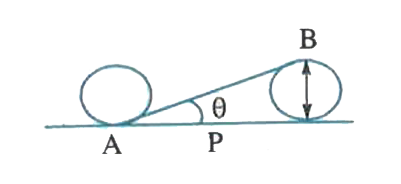
From figure during half revolution of the wheel , the point A covers ` pi R (=AC )` horizontal distance while 2R =(BC ) vertical distance while 2R (=BC ) vertical distance
so here `P = pi R , Q = 2R `
` therefore ` displacement `b= sqrt( p^2 +q^2)`
` = sqrt( (pi R^2 ) +(2R)^2 ) = R sqrt( pi^2 +4)`
` and theta = Tan^(-1) (Q/P)= tan ^(-1) ((2R)/(pi R))= tan^(-1)"" ((2)/(pi)) ` with x axis
Promotional Banner

Topper's Solved these Questions

  • ELEMENTS OF VECTORS

    AAKASH SERIES|Exercise LONG ANSWER TYPE QUESTIONS|5 Videos
  • ELEMENTS OF VECTORS

    AAKASH SERIES|Exercise SHORT ANSWER TYPE QUESTIONS|10 Videos
  • ELECTROSTATICS

    AAKASH SERIES|Exercise ADDITIONAL PRACTICE EXERCISE (PRACTICE SHEET (ADVANCED) INTEGER TYPE QUESTIONS)|5 Videos
  • GEOMETRICAL OPTICS

    AAKASH SERIES|Exercise ADDITIONAL PRACTICE EXERCISE (LEVEL-II PRACTICE SHEET (ADVANCED) INTEGER TYPE QUESTIONS)|10 Videos

Similar Questions

Explore conceptually related problems

What is the displacement of the point of a wheel initially in contact with the ground when the wheel rolls forward half a revolution ? Take the radius of the wheel as R and the the x - axis as the forward direction ?

A Wheel of circumference C is at rest on the ground.When the wheel rolls forward through half a revolution ,then the displacement of point contact will be

A wheel of perimeter 4pi is rolling on a horizontal surface. The displacement of the point of contact of wheel and ground when the wheel completes one quarter of revolution is

A wheel is released on a rough horizontal floor after imparting it an initial horizontal velocity v_(0) and angular velocity omega_(0) as shown in the figure below. Point O is the centre of mass of the wheel and point P is its instantaneous point of contact with the groundl. The radius of wheel is r and its radius of gyration about O is k . Coefficient of friction between wheel and ground is mu . A is a fixed point on the ground. If above question , distance travelled by centre of mass of the wheel before it stops is -

A wheel is released on a rough horizontal floor after imparting it an initial horizontal velocity v_(0) and angular velocity omega_(0) as shown in the figure below. Point O is the centre of mass of the wheel and point P is its instantaneous point of contact with the groundl. The radius of wheel is r and its radius of gyration about O is k . Coefficient of friction between wheel and ground is mu . A is a fixed point on the ground. If the wheel comes to permanent rest after sometimes, then :

A wheel is released on a rough horizontal floor after imparting it an initial horizontal velocity v_(0) and angular velocity omega_(0) as shown in the figure below. Point O is the centre of mass of the wheel and point P is its instantaneous point of contact with the groundl. The radius of wheel is r and its radius of gyration about O is k . Coefficient of friction between wheel and ground is mu . A is a fixed point on the ground. Which of the following is conserved ?

If a given point P is in contact with ground initially and wheel of radius R is in pure rolling, then the displacement of point P when point P reaches topmost of the sphere for the first time will be

A bicycle wheel rolls without slipping on a horizonatal floor.W hich one of the following is true about the motion of points on the rim of the wheel, relative to the axis at the wheel's centre?

The drwing shows a bicycle wheel of radius r, resting against a small step whose height is h = r//5 . A clockwise torque increases, there comes a time when the wheel just begins to rise up and loses contact with the ground. Let this torque be T. What is the magniitude of the horizontal component of the acceleration of the centre of the wheel when a torque of 2T is applied? Assume that the wheel doesn't slip at the edge of the step when this torque is applied (ignore the mass of the spokes).

A constant horizontal force of 10 N is applied at the centre of a wheel of mass 10 kg and radius 0.30 m . The wheel rolls without slipping on the horizontal surface, and the acceleration of the centre of mass is 0.60 m//s^(2) . a. What are the magnitude and direction of the frictional force on the wheel? b. What is the rotational inertia of the wheel about an axis through its centre of mass and perpendicular to the plane of the wheel?

