Home
Class 12
PHYSICS
The pulley arrangements in the figure (A...

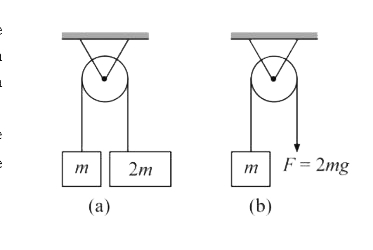
The pulley arrangements in the figure (A) and (B) are identical. The mass of the rope is negligible. In figure (A), the mass m is lifted up by attaching a mass 2m to the other end of the rope. In figure (B), m is lifted up by pulling the other end of the rope with a constant downward force F = 2 mg . The acceleration of m is the same in both cases.

Text Solution

Verified by Experts
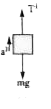
In figure (a), for the motion of mass m,
`T - mg = ma " "` …..(1)
For motion of mass 2m figure (b)
`2mg-T=(2m)a " "` …..(2)
Adding equation (1) and (2), we get
`2mg-mg=2ma+ma`
`mg=3ma rArr a=(g)/(3)`
Case II :
In figure (c ) `T^(1) -mg = ma^(1)`
But `T^(1)=2mg`
`therefore 2mg - mg = a^(1)`
`therefore a^(1)=g`
Promotional Banner

Topper's Solved these Questions

  • LAWS OF MOTION

    AAKASH SERIES|Exercise Application|6 Videos
  • LAWS OF MOTION

    AAKASH SERIES|Exercise EXERCISE - I|157 Videos
  • LAWS OF MOTION

    AAKASH SERIES|Exercise QUESTIONS FOR DESCRIPTIVE ANSWER|5 Videos
  • GEOMETRICAL OPTICS

    AAKASH SERIES|Exercise ADDITIONAL PRACTICE EXERCISE (LEVEL-II PRACTICE SHEET (ADVANCED) INTEGER TYPE QUESTIONS)|10 Videos
  • LOGIC GATES

    AAKASH SERIES|Exercise Exercise (Very Short Answer)|10 Videos

Similar Questions

Explore conceptually related problems

The pulley arrangements of Figs. (a) and (b) are identical. The mass of the rope is negligible. In (a) the mass m is lifted up by attaching a mass 2m to the other end of the rope. In (b), m is lifted up by pulling the other end of the rope with a constant downward force F=2mg . The acceleration of m is the same in both cases

The pulley arrangement in Fig are identical .The mass of the rope is negligble in figure the mass m is lifted up by atteched a mass 2m to the other end of the rope . In (b), m is lifed up by pulley the other end of the rope with a constant in both cases

The pulley arrangements shown in figure are identical, the mass of the rope being negligible. In case I the mass m is lifted by attaching a mass 2m to the other end of rope with a constant downward force F =2mg , where g is acceleration due to gravity The acceleration of mass m in case I is .

Figure shown two pulley arrangments for lifting a mass m . In case-1, the mass is lifting by attaching a mass 2m while in case-2 the mass is lifted by pulling the other end with a downward force F=2mg . If a_(a) and a_(b) are the accelerations of the two masses then (Assumme string is massless and pulley is ideal).

A man of mass m stands on a frame of mass M. He pulls on a light rope, which passes over a pulley. The other end of the rope is attached to the frame. For the system to be in equilibrium, what force must the man exert on the rope?

Figure a) shows a spring of force constant k clamped rigidly at once end and a mass m attached to its free end. A force F applied at the free end stretches the spring. Figure b) shows the same spring with both ends free and attached to a mass m at either end. Each end of the spring in figure is stretched by the same force F. (a) What is the maximum extension of the spring in the two cases ? (b) If the mass in figure and the two masses in figure are released free, what is the period of oscillation in each case?

Figure a) shows a spring of force constant k clamped rigidly at once end and a mass m attached to its free end. A force F applied at the free end stretches the spring. Figure b) shows the same spring with both ends free and attached to a mass m at either end. Each end of the spring in figure is stretched by the same force F. (a) What is the maximum extension of the spring in the two cases ? (b) If the mass in figure and the two masses in figure are released free, what is the period of oscillation in each case?

In the figure shown, all surfaces are smooth and the pulley is massless. A constant force of magnitude F = (mg)/(2) is acting on the block of mass M. The acceleration of the block M is :

The pulley A and C are fixed while the pulley B is movable. A mass M_2 is attached to pulley B , while the string has masses M_1 and M_3 at the two ends. Find the acceleration of each mass .

AAKASH SERIES-LAWS OF MOTION-Problem
  1. Three blocks connected together by strings are pulled along a horizont...

    Text Solution

    |

  2. Two masses of 3 kg and 4 kg are connected at the two ends of a light i...

    Text Solution

    |

  3. The pulley arrangements in the figure (A) and (B) are identical. The m...

    Text Solution

    |

  4. Figure shows three blocks of mass m each hanging on a string passing o...

    Text Solution

    |

  5. A man of mass 60 kg is standing on a weighing machine kept in a box of...

    Text Solution

    |

  6. In the above problem, what force should the man exert on the rope to g...

    Text Solution

    |

  7. A monkey of mass 40 kg climbs on a rope (Fig 5.20 ) which can stand a ...

    Text Solution

    |

  8. A monkey of mass m moving up on a massless string so as to just lift a...

    Text Solution

    |

  9. Two blocks of masses 2kg and 5kg are at rest on ground. The masses are...

    Text Solution

    |

  10. A string of negligible mass passes over a pulley of mass m which is cl...

    Text Solution

    |

  11. Two weights w(1) and w(2) are suspended from the ends of a light strin...

    Text Solution

    |

  12. In the arrangement shown , by what acceleration the boy must go up so ...

    Text Solution

    |

  13. The block has to be raised to a height L in the same time t. In which ...

    Text Solution

    |

  14. A block of mass 25 kg is raised by a 50 kg man in two different ways a...

    Text Solution

    |

  15. A helicopter of mass 1000 kg rises with a vertical acceleration of 15 ...

    Text Solution

    |

  16. In the given diagram , find the relation between acceleration of block...

    Text Solution

    |

  17. A block of mass m slides down on a wedge of mass M as shown in figur...

    Text Solution

    |

  18. If the blocks are connected as shown in fig, the relation between thei...

    Text Solution

    |

  19. A rod of length 'l' is inclined at an angle 'theta' with the floor aga...

    Text Solution

    |

  20. In the fig, find the acceleration of mass m(2)

    Text Solution

    |

