Home
Class 12
PHYSICS
For an ideal gas, the graph representing...

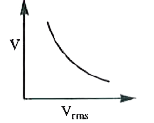
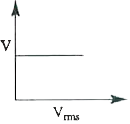
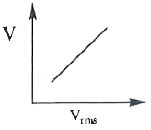
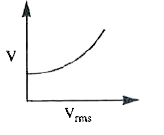
For an ideal gas, the graph representing the variation of the speed of sound (v) in a gas, with the r.m.s. speed (vrms) of its gas molecules with be

A

B

C

D

Text Solution

AI Generated Solution

The correct Answer is:

To solve the problem of how the speed of sound (v) in an ideal gas varies with the root mean square speed (v_rms) of its gas molecules, we can follow these steps: ### Step 1: Understand the formulas The root mean square speed (v_rms) of gas molecules is given by the formula: \[ v_{rms} = \sqrt{\frac{3RT}{M}} \] where: - \( R \) is the universal gas constant, - \( T \) is the absolute temperature in Kelvin, - \( M \) is the molar mass of the gas. The speed of sound (v_s) in an ideal gas is given by: \[ v_s = \sqrt{\frac{\gamma RT}{M}} \] where: - \( \gamma \) is the adiabatic index (ratio of specific heats, \( C_p/C_v \)). ### Step 2: Relate the two speeds To find the relationship between \( v_{rms} \) and \( v_s \), we can divide the two equations: \[ \frac{v_{rms}}{v_s} = \frac{\sqrt{\frac{3RT}{M}}}{\sqrt{\frac{\gamma RT}{M}}} \] In this expression, \( R \), \( T \), and \( M \) will cancel out: \[ \frac{v_{rms}}{v_s} = \sqrt{\frac{3}{\gamma}} \] ### Step 3: Express \( v_{rms} \) in terms of \( v_s \) From the above relationship, we can express \( v_{rms} \) in terms of \( v_s \): \[ v_{rms} = v_s \cdot \sqrt{\frac{3}{\gamma}} \] This shows that \( v_{rms} \) is directly proportional to \( v_s \). ### Step 4: Graphical representation Since \( v_{rms} \) is proportional to \( v_s \), we can represent this relationship graphically. If we let \( v_{rms} \) be on the x-axis and \( v_s \) be on the y-axis, the equation can be rearranged to: \[ v_s = \frac{1}{\sqrt{\frac{3}{\gamma}}} v_{rms} \] This is a linear equation of the form \( y = mx \), where \( m \) is a constant. Therefore, the graph will be a straight line passing through the origin. ### Conclusion The graph representing the variation of the speed of sound (v) in a gas with the root mean square speed (v_rms) of its gas molecules will be a straight line.
Promotional Banner

Topper's Solved these Questions

  • WAVES

    AAKASH SERIES|Exercise EXERCISE-II (Pipes)|13 Videos
  • WAVES

    AAKASH SERIES|Exercise EXERCISE-II (Beats : )|20 Videos
  • WAVES

    AAKASH SERIES|Exercise EXERCISE-II (Strings (Speed of a travelling wave:))|23 Videos
  • WAVE OPTICS

    AAKASH SERIES|Exercise PROBLEMS (LEVEL - II)|33 Videos
  • WAVES OPTICS

    AAKASH SERIES|Exercise EXERCISE -III (POLARISITION)|10 Videos

Similar Questions

Explore conceptually related problems

The rms speed of a gas molecule is

A student plotted the following four graphs representing the variation of velocity of sound in a gas with the pressure P. Whic one is correct?

Explain why the speed of sound through a gas cannot be greater than the r.m.s. speed of the molecules of the gas.

Define average speed and r.m.s. speed of a gas molecule.

Find the rms speed of oxygen molecules in a gas at 300K.

The ratio of the speed of sound in nitrogen gas to that in helium gas, at 300K is

The ratio of the speed of sound in nitrogen gas to that in helium gas, at 300K is

The r.m.s speed of the molecules of an ideal gas Is V_0 If pressure of the gas is halved but temperature is kept constant then r.m.s. speed of the gas molecule will be

Speed of sound in a gas at constant temperature depends on

If v_(rms) is the rms speed of molecules in a gas and v is the speed of sound waves in the gas, then the ratio (v_(rms))/v is
