Home
Class 12
PHYSICS
Three charges-q(1),+q(2) and -q(3) are p...

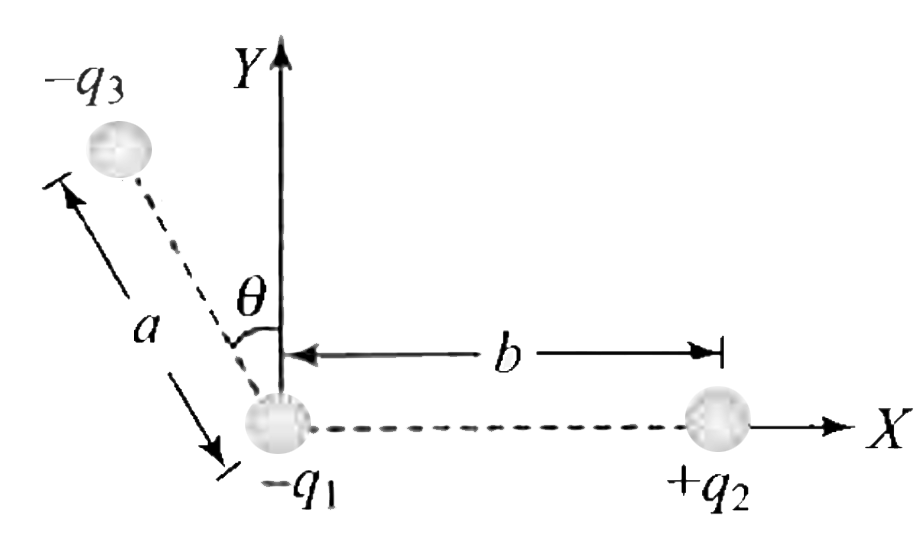
Three charges-`q_(1),+q_(2)` and `-q_(3)` are placed as shown in the figure. The x-component of the force on `-q_(1)` is proportional to

A

`(q_(2))/(b^(2))-(q_(3))/(a^(2))costheta`

B

`(q_(2))/(b^(2))+(q_(3))/(a^(2))sintheta`

C

`(q_(2))/(b^(2))+(q_(2))/(a^(2))costheta`

D

`(q_(2))/(b^(2))-(q_(2))/(a^(2))sintheta`

Text Solution

Verified by Experts

The correct Answer is:

B
Promotional Banner

Topper's Solved these Questions

  • ELECTROSTATICS

    AAKASH SERIES|Exercise LECTURE SHEET (EXERCISE - I) (LEVEL - II (ADVANCED ) MORE THAN ONE CORRECT ANSWER TYPE QUESTIONS)|1 Videos
  • ELECTROSTATICS

    AAKASH SERIES|Exercise LECTURE SHEET (EXERCISE - I) (LEVEL - II (ADANCED) INTEGER TYPE QUESTIONS)|3 Videos
  • ELECTROSTATICS

    AAKASH SERIES|Exercise ADDITIONAL PRACTICE EXERCISE (PRACTICE SHEET (ADVANCED) INTEGER TYPE QUESTIONS)|5 Videos
  • ELECTROMAGNETICS

    AAKASH SERIES|Exercise ADDITIONAL EXERCISE|13 Videos
  • ELEMENTS OF VECTORS

    AAKASH SERIES|Exercise QUESTIONS FOR DESCRIPTIVE ANSWERS|10 Videos

Similar Questions

Explore conceptually related problems

In an isolated parallel plate capacitor of capacitance C the four surfaces have charges Q_(1), Q_(2), Q_(3) and Q_(4) as shown in the figure. The potential difference between the plates is :

Three charges -q,+Q and -q are placed in a straight line as shown If the total potential energy of the system is zero, then the ratio (q)/(Q) is

Charge 2Q and -Q are placed as shown in figure. The point at which electric field intensity is zero will be somewhere

A charge Q located at a point vec r is in equilibrium under the combined field of three charges q_(1), q_(2) and q_(3) . If the charges q_(1) and q_(2) are located at point vec r_(1) and vec r_(2) respectively, find the direction of the force on Q due to q_(3) in terms of q_(1),(q_2), vec r_(1) vec r_(2) , and vec(r) .

Conisder a system of three charges q//3 , q//3 and -2q//3 placed at point A, B and C, respectively, as shown in the figure. Take O to be centre of the circle of radius R and angle CAB=60^@

Threee charges +Q_(1),+Q_(2) and q are placed on a straight line such that q is somewhere in between +Q_(1) and Q_(2) . If this system of charges is in equlibirium what should be the magnitude and sign of charge q?

Consider three charges q_(1),q_(2) and q_(3) each equal to q , at the vertices of an equilateral triangle of side l. What is the force on a charge Q placed at the centroid of the triangle?

Consider three charges q_(1),q_(2) and q_(3) each equal to q , at the vertices of an equilateral triangle of side l. What is the force on a charge Q placed at the centroid of the triangle?

Three charges q_(1) = 1 mu C, q_(2) = -2 muC and q_(3) = 3mu C are placed on the vertices of an equilateral triangle of side 1.0 m. find the net electric force acting on charge q_(1) . How to proceed Charge q_(2) will attract charge q_(1) (along the line joining them) and charge q_(3) will repel charge q_(1) . Therefore, two forces will act on q_(1) , one due to q_(2) and another due to q_(3) . Since , the force is a vector quantity both of these force (say F_(1) and F_(2) ) will be added by vector method. Following are two methods of their addition

Three charges +q , +q, and Q are placed at the comers of a right angled isosceles triangle as shown in the figure. If the net potential energy of the system is zero then value of Q is
