Home
Class 12
PHYSICS
In a decay process A decays to B. AtoB. ...

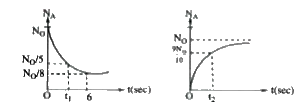
In a decay process A decays to B. `AtoB`. Two graphs of number of nuclei of A and B versus time is given then

A

`t_(2)-t_(1)=4sec`

B

`t_(2)-t_(1)=2sec`

C

`t_(1)=2log_(2)5sec`

D

`t_(2)=2log_(2)100sec`

Text Solution

Verified by Experts

The correct Answer is:

B
Promotional Banner

Topper's Solved these Questions

  • NUCLEAR PHYSICS

    AAKASH SERIES|Exercise ADDITIONAL PRACTICE PRACTICE SHEET (ADVANCED) Linked Comprehension Type Questions Passage-I :|2 Videos
  • NUCLEAR PHYSICS

    AAKASH SERIES|Exercise ADDITIONAL PRACTICE PRACTICE SHEET (ADVANCED) Linked Comprehension Type Questions Passage-II :|3 Videos
  • NUCLEAR PHYSICS

    AAKASH SERIES|Exercise ADDITIONAL PRACTICE PRACTICE SHEET (ADVANCED) (Straight Objective Type Questions)|10 Videos
  • MOVING CHARGES AND MAGNETISM

    AAKASH SERIES|Exercise EXERCISE-III|49 Videos
  • NUCLEI

    AAKASH SERIES|Exercise Practice Exercise|40 Videos

Similar Questions

Explore conceptually related problems

Consider radioactive decay of A to B with which further decays either to X or Y , lambda_(1), lambda_(2) and lambda_(3) are decay constant for A to B decay, B to X decay and Bto Y decay respectively. At t=0 , the number of nuclei of A,B,X and Y are N_(0), N_(0) zero and zero respectively. N_(1),N_(2),N_(3) and N_(4) are the number of nuclei of A,B,X and Y at any instant t . The net rate of accumulation of B at any instant is

Consider radioactive decay of A to B with which further decays either to X or Y , lambda_(1), lambda_(2) and lambda_(3) are decay constant for A to B decay, B to X decay and Bto Y decay respectively. At t=0 , the number of nuclei of A,B,X and Y are N_(0), N_(0) zero and zero respectively. N_(1),N_(2),N_(3) and N_(4) are the number of nuclei of A,B,X and Y at any instant t . The number of nuclei of B will first increase and then after a maximum value, it decreases for

Nucleus A decays to B with decay constant lambda_(1) and B decays to C with decay constant lambda_(2) . Initially at t=0 number of nuclei of A and B are 2N_(0) and N_(0) respectively. At t=t_(o) , no. of nuclei of B is (3N_(0))/(2) and nuclei of B stop changing. Find t_(0) ?

A factory produces a radioactive substance A at a constant rate R which decays with a decay constant lambda to form a stable substance. Find (a) the number of nuclei of A and (b) number of nuclei of B, at any time t assuming the production of A starts at t=0 . (c ) Also, find out the maximum number of nuclei of A present at any time during its formation.

Two radioactive materials A & B have decay constant 3lamda and 2lamda respectively. At t=0 the numbers of nuclei of A and B are 4N_(0) and 2N_(0) respectively then,

A radioactive element A of decay constant lamda_(A) decays into another radioactive element B of decay constant lamda_(B) . Initially the number of active nuclei of A was N_(0) and B was absent in the sample. The maximum number of active nuclei of B is found at t=2. In 2//lamda_(A) . The maximum number of active nuclei of B is

Nucleus A decays into B with a decay constant lamda_(1) and B further decays into C with a decay constant lamda_(2) . Initially, at t = 0, the number of nuclei of A and B were 3N_(0) and N_(0) respectively. If at t = t_(0) number of nuclei of B becomes constant and equal to 2N_(0) , then

The rate at which a particular decay process occurs in a radio sample, is proportional to the number of radio active nuclei present . If N is the number of radio active nuclei present at some instant, the rate of change of N is "dN"/"dt"=-lambdaN . Consider radioactive decay of A to B which may further decay either to X or to Y, lambda_1, lambda_2 and lambda_3 are decay constants for A to B decay , B to X decay and B of Y decay respectively. if at t=0 number of nuclei of A,B , X and Y are N_0, N_0 ,zero and zero respectively and N_1 , N_2, N_3,N_4 are number of nuclei A,B , X and Y at any instant. The number of nuclei of B will first increase then after a maximum value, it will decreases, if

The rate at which a particular decay process occurs in a radio sample, is proportional to the number of radio active nuclei present . If N is the number of radio active nuclei present at some instant, the rate of change of N is "dN"/"dt"=-lambdaN . Consider radioactive decay of A to B which may further decay either to X or to Y, lambda_1, lambda_2 and lambda_3 are decay constants for A to B decay , B to X decay and B of Y decay respectively. if at t=0 number of nuclei of A,B , X and Y are N_0, N_0 ,zero and zero respectively and N_1 , N_2, N_3,N_4 are number of nuclei A,B , X and Y at any instant. At t=oo , which of the following is incorrect ?

Nuclei of radioactive element A are produced at rate t^(2) (where t is time) at any time t . The element A has decay constant lambda . Let N be the number of nuclei of element A at any time t . At time t=t_(0), dN//dt is minimum. The number of nuclei of element A at time t=t_(0) is
