Home
Class 12
PHYSICS
Two metal strips, each of length, each ...

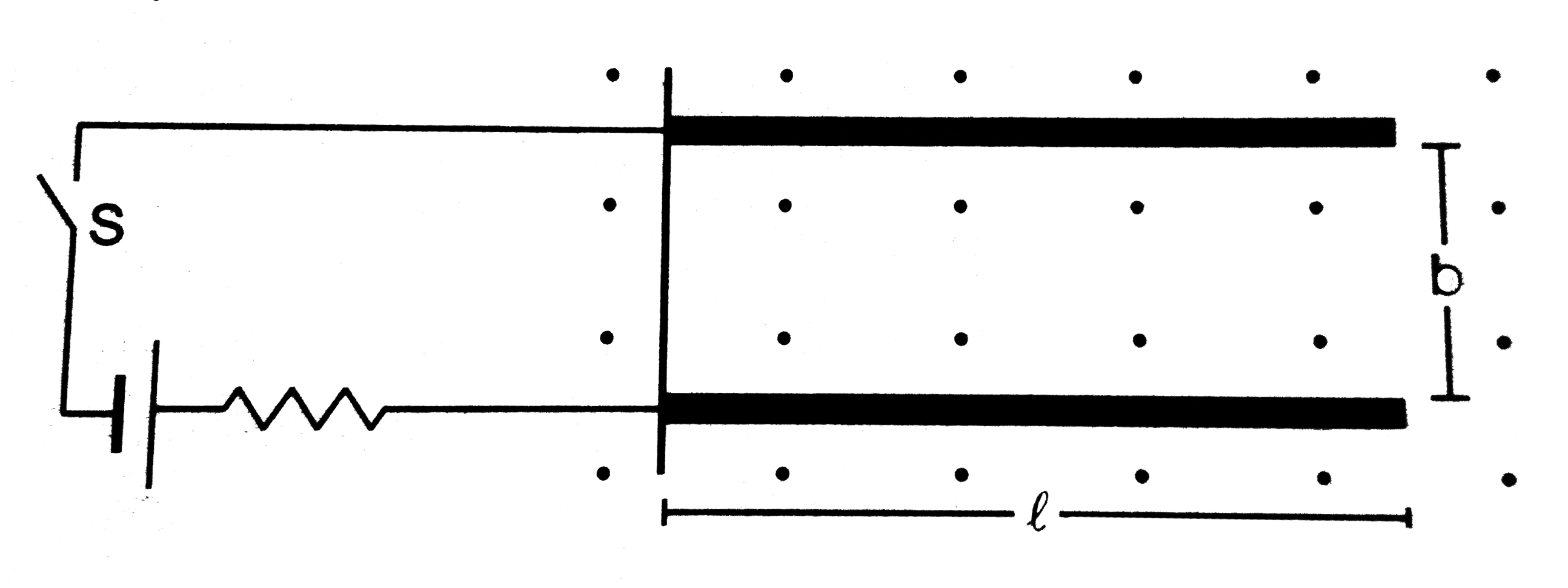
Two metal strips, each of length, each of length l, are clamped parallel to each other on a horizontal floor with a separation b between them. A wire of mass m line on them perpendicularly as shown in figure. A vertically upward magnetic field of strenght B exists in the space. The matal strips are smooth but the cofficient of freiction between the wire and the floor is `mu`. A current i is established when the switch S is closed at the instant `t=0`. Discuss the motion of the wire after the switch is closed. How far away from the strips will the wire reach?

Text Solution

Verified by Experts

When current starts flowing in the wire, it experiences a force, F =Bib of constant magnitude due to which it accelerates on the metal strips. There after when wire falls on the floor, it retards due to friction and finally stops. Thus
`a = (F)/(m) = (Bib)/(m)`
The velocity gained by the wire on the strips
`v^2 = 0 + 2al = 2 (Bib l)/(m)`
Let x be the distance moved by the wire on the floor.
Its final velocity becomes zero, and so
`= v^2 -2a.x or x = (v^2)/(2a.)`
Here ` a. = (mu mg)/(m) = mu g`
`therefore x = ([(2Bib l)/(m)])/(2mug) = (Bib l)/(mu mg)`
Note : Try usiing work - energy theorem
Promotional Banner

Topper's Solved these Questions

  • ELECTROMAGNETICS

    AAKASH SERIES|Exercise EXERCISE (LONG ANSWER QUESTIONS)|5 Videos
  • ELECTROMAGNETICS

    AAKASH SERIES|Exercise EXERCISE (SHORT ANSWER QUESTIONS)|6 Videos
  • ELECTROMAGNETIC WAVES

    AAKASH SERIES|Exercise EXERCISE -II|22 Videos
  • ELECTROSTATICS

    AAKASH SERIES|Exercise ADDITIONAL PRACTICE EXERCISE (PRACTICE SHEET (ADVANCED) INTEGER TYPE QUESTIONS)|5 Videos

Similar Questions

Explore conceptually related problems

A wire of infinite length bent as shown in figure carries current l. What is the magnetic field at the point P ?

A straight wire of length l can slide on two parallel plastic rails kept in a horizontal plane with a separation d. The coefficient of friction between the wire and the rails is mu . If the wire carries a current I, what minimum magnetic field should exist in the space in order to slide the wire on the rails.

Two thin long wires are parallel to each other at a separation d apart and they carry equal currents l each along the same direction as shown in figure. The magnetic field (B) at a point P varieswith x according to graph.

A conducting stick of length 2L and mass m is moving down a smooth inclined plane of inclination 60^(@) with constant speed 5m/s. A current 2A is flowing in the conductor perpendicular to the paper inwards. A vertically upward magnetic field B exists in space there. The magnitude of magnetic field B is

A conducting rod of length l and mass m is moving down a smooth inclined plane of inclination theta with constant i is flowing in the conductor in a direction perpendicular to paper inwards. A vertically upward magnetic field vec B exists in space. Then, magnitude of magnetic field vec B is

A conducting rod of length l and mass m is moving down a smooth inclined plane of inclination theta with constant i is flowing in the conductor in a direction perpendicular to paper inwards. A vertically upward magnetic field vec B exists in space. Then, magnitude of magnetic field vec B is

Two electrons move parallel to each other with equal speed 'V' the ratio of magnetic & electric force between them is

Two wedges, each of mass m , are placed next to each other on a flat horizontal floor. A cube of mass M is balanced on the wedges as shown in figure. Assume no friction between the cube and the wedges, but a coefficent of static friction mult1 between the wedges and the floor. What is the largest M that can be balanced as shown without motion of the wedges ?

A current carrying wire AB of the length L is turned along a circle, as shown in figure. The magnetic field at the centre O.

A particle of mass m strikes a horizontal smooth floor with velocity u making an angle theta with the floor and rebound with velocity v making an angle theta with the floor. The coefficient of restitution between the particle and the floor is e . Then
