Home
Class 12
PHYSICS
Two identical particles having the same ...

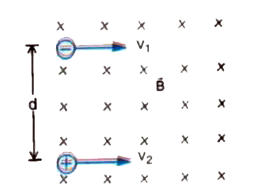
Two identical particles having the same mass m and charges +q and - q separated by a distance d enter a uniform magnetic field `barB` as shown in the figure. For what value of d the particles will not collide?

Text Solution

Verified by Experts

`d gt (2m)/(Bq) (V_1 + V_2)`
Promotional Banner

Topper's Solved these Questions

  • ELECTROMAGNETICS

    AAKASH SERIES|Exercise ADDITIONAL EXERCISE|13 Videos
  • ELECTROMAGNETICS

    AAKASH SERIES|Exercise PROBLEMS (LEVEL -I)|40 Videos
  • ELECTROMAGNETIC WAVES

    AAKASH SERIES|Exercise EXERCISE -II|22 Videos
  • ELECTROSTATICS

    AAKASH SERIES|Exercise ADDITIONAL PRACTICE EXERCISE (PRACTICE SHEET (ADVANCED) INTEGER TYPE QUESTIONS)|5 Videos

Similar Questions

Explore conceptually related problems

Two identical particles having the same mass m and charges +q and -q separated by a distance d enter a uniform magnetic field B directed perpendicular to paper inwards with speeds v_1 and v_2 as shown in Fig. 1.139. The particles will not collide if

When a charged particle enters a uniform magnetic field its kinetic energy

A charge particle of mass m and charge q enters in a region of uniform magnetic field as shown in figure.The magnitude of change in linear momentum due to magnetic field will be

Two particle, each having a mass m are placed at a separation d in a uniform magnetic field B as shown in figure.They have opposite charges of equal magnitude q .At time t=0 , the particles are projected towards each other, each with a speed v . What would be the maximum separation between the particles if v=v_(m)/4 ?

Two particle, each having a mass m are placed at a separation d in a uniform magnetic field B as shown in figure.They have opposite charges of equal magnitude q .At time t=0 , the particles are projected towards each other, each with a speed v . What would be the minimum separation between the particles if v=v_(m)/4 ?

Two particle, each having a mass m are placed at a separation d in a uniform magnetic field B as shown in figure.They have opposite charges of equal magnitude q .At time t=0 , the particles are projected towards each other, each with a speed v . At what instant will a collision occur between the particles if v=2v_(m) ?

Two particle, each having a mass m are placed at a separation d in a uniform magnetic field B as shown in figure.They have opposite charges of equal magnitude q .At time t=0 , the particles are projected towards each other, each with a speed v . Suppose v=2v_(m) and they stick to each other after the collision.Describe the motion after the collision (neglect the magnetic, gravitational & electric forces between charges).

Two particles, each having a mass m are placed at a separation d in a uniform magnetic field B as shown in they have opposite charges of equal magnitude q. at time t =0, the particles are projectd towards each other,each with a speed v. suppose the coulomb force between the charges is switched off. (a) Find the maximum value v_m of the projection speed so that the two particles do not collide. (b) What would be the minimum and maximum separation between the particles if v = v_m /2? (c) At what instant will a collision occur between the particles if v = 2v_m ? (d) Suppose v =2v_m and the collision between the particles is completely inelastic. Describe the motion after the collision.

A particle with mass m and charge q moving with a velocity v , enters a region of uniform magnetic field B , shown, in the figure above. The particle strikes the wall at a distance d from the entance slit. If the paticle's velocity stays the same but its charge to mass ratio is doubled, distance frm the entrance slit where the particle strike the wall is d/n , then find n

A particle with mass m and charge q moving with a velocity v , enters a region of uniform magnetic field B , shown, in the figure above. The particle strikes the wall at a distance d from the entance slit. If the paticle's velocity stays the same but its charge to mass ratio is doubled, distance frm the entrance slit where the particle strike the wall is d/n , then find n

AAKASH SERIES-ELECTROMAGNETICS-PROBLEMS (LEVEL -II)
  1. A rectangular loop of wire is oriented with the left corner at the ori...

    Text Solution

    |

  2. Two coils each of 100 turns are held at right angles such that one lie...

    Text Solution

    |

  3. Magnetic field at a distance a from long current carrying wire is prop...

    Text Solution

    |

  4. A system of long four parallel conductors whose sections with the plan...

    Text Solution

    |

  5. A cylindrical conductor of radius R carries a current along its length...

    Text Solution

    |

  6. A square current carrying loop made of thin wire and having a mass m=1...

    Text Solution

    |

  7. A current I flows through an infinitly long wire having infinite brand...

    Text Solution

    |

  8. Figure here shows three cases, in all cases the circular path has radi...

    Text Solution

    |

  9. Find magnetic field at O due to the current carrying conductor as show...

    Text Solution

    |

  10. Two identical particles having the same mass m and charges +q and - q ...

    Text Solution

    |

  11. In the figure shown, a semi-circular wire loop of radius R is placed i...

    Text Solution

    |

  12. A flat dielectric disc of radius R carries an excess charge on its sur...

    Text Solution

    |

  13. Consider a solid sphere of radius r and mass m which has charge q dist...

    Text Solution

    |

  14. A thin uniform ring of radius R carrying charge q and mass m rotates a...

    Text Solution

    |

  15. A wire carrying current i has the configuration as shown in figure. Tw...

    Text Solution

    |

  16. A uniform constant magnetic field B is directed at an angle of 45^(@) ...

    Text Solution

    |

  17. A sphere of radius R, uniformly charged with the surface charge densit...

    Text Solution

    |

  18. A ring of radius R having uniformly distributed charge Q. is mounted o...

    Text Solution

    |

  19. Given figure shows a coil bent with all edges of length 1 m and carryi...

    Text Solution

    |

  20. A long, straight wire carries a current i. A particle having a positiv...

    Text Solution

    |
