Home
Class 12
PHYSICS
Three charges of equal magnitude q is pl...

Three charges of equal magnitude q is placed at the vertices of an equilateral triangle of side l. The force on a charge Q placed at the centroid of the triangle is

Text Solution

Verified by Experts
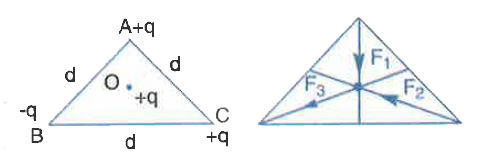
Let the force acting on +q charge at O due to +q at A be `F_(1)`, +q at B be `F_(2)` and -q at C be `F_(3)`
Here `AO=BO=CO=(d)/(sqrt(3))`

In magnitude `F_(1)=F_(2)=F_(3)=(1)/(4pi in_(0))(3q^(2))/(d^(2))`
Resultant of `F_(1) and F_(2)` is `F_(4)=(1)/(4pi in_(0)) (3q^(2))/(d^(2))`
(as angle between `F_(1) and F_(2)` is `120^(0)`)
Direction of `F_(4)` is along the direction of `F_(3)`. Hence the resultant force on +q at O is
`F=F_(3)+F_(4)=(3q^(2))/(2pi in_(0)d^(2))`
Promotional Banner

Topper's Solved these Questions

  • ELECTRIC FIELD AND POTENTIAL

    AAKASH SERIES|Exercise EXERCISE (LONG ANSWER QUESTIONS)|3 Videos
  • ELECTRIC FIELD AND POTENTIAL

    AAKASH SERIES|Exercise EXERCISE (SHORT ANSWER QUESTIONS)|6 Videos
  • ELECTRIC CHARGES AND FIELDS

    AAKASH SERIES|Exercise Practice Exercise|57 Videos
  • ELECTROMAGNETIC INDUCTION

    AAKASH SERIES|Exercise Additional Exercise|11 Videos

Similar Questions

Explore conceptually related problems

Consider three charges q_(1),q_(2) and q_(3) each equal to q , at the vertices of an equilateral triangle of side l. What is the force on a charge Q placed at the centroid of the triangle?

Consider three charges q_(1),q_(2) and q_(3) each equal to q , at the vertices of an equilateral triangle of side l. What is the force on a charge Q placed at the centroid of the triangle?

Consider the charges q,q and -q placed at the vertices of an equilateral triangle of each side l. What is the force on each charge ?

Consider three charges q_(1), q_(2), q_(3) each equal to q at the vertices of an equilateral triangle of side l. What is the force on a charge Q (with the same sign as q) placed at the centroid of the triangle, as shown in Fig. ?

Three equal masses 2m each are placed at the vertices an equilateral triangle PQR (i) What is the force acting on a mass m placed at the centroid G of the triangle ? (ii) What is the force on mass m if the mass at the vertex P is quadrupled ? Take PG = QG = RG = 1m

Three positive charges of equal magnitude q are placed at the vertics of and equilatral triangle of side l. How can the system of charges be palced in equilibrium?

Three charges each of value q are placed at the corners of an equilateral triangle. A fourth charge Q is placed at the center of the triangle. a. Find the net force on charge q. b. If Q = -q , will the charges at the corners move toward the center or fly away from it ? c. For what value of Q at O will the charges remain stationary ? d. In situation (c), how much work is done in removing the charges to infinity?

Three masses each of mass m are palced at the vertices of an equilateral triangles ABC of side l as shown in figure. The force acting on a mass 2m placed at the centroid O of the triangle is

Three point masses m,m and 2m are placed on the vertex of an equilateral triangle of side 'a' Another point mass 'm' is placed at the centroid of the triangle as shown in the figure. If the magnitude of net force on the point mass placed at centroid is (KGm^2)/(a^2) then find the value of K (G= universal gravitational constant )

Three particles of equal mass 'm' are situated at the vertices of an equilateral triangle of side L . The work done in increasing the side of the triangle to 2L is

AAKASH SERIES-ELECTRIC FIELD AND POTENTIAL-PROBLEMS (LEVEL-II)
  1. Three charges of equal magnitude q is placed at the vertices of an equ...

    Text Solution

    |

  2. A metal sphere with its centre at A and radius R has a charge 2q on it...

    Text Solution

    |

  3. Two similar metal spheres are suspended by silk threads from the same ...

    Text Solution

    |

  4. A body of mass 2 gm is projected horizontally from the top of tower of...

    Text Solution

    |

  5. A body of mass 10 gm and having charge 2C is attached to a spring whic...

    Text Solution

    |

  6. Four charges Q, q, Q and q are placed at the corners A, B, C and D of ...

    Text Solution

    |

  7. A charge Q is fixed on the X-Y plane at point (0, a). Find the electri...

    Text Solution

    |

  8. Two charges 4q and q are fixed at points (0,9) and (12, 0) respectivel...

    Text Solution

    |

  9. Four point charges +q,+q,-q and -q are placed on the corners of a squa...

    Text Solution

    |

  10. Two point charges 4muC and 9muC are separated by 50 cm. The potential ...

    Text Solution

    |

  11. Two insulating plates are uniformly charged in such a way that the pot...

    Text Solution

    |

  12. A field of 100Vm^(-1) is directed at 30° to positive x-axis. Find (VA...

    Text Solution

    |

  13. A hollow sphere of radius 2R is charged to V volts and another smalle...

    Text Solution

    |

  14. Two identical particles of mass m carry a charge Q each. Initially one...

    Text Solution

    |

  15. Two dipoles that are back to back form a linear quadrapole i)...

    Text Solution

    |

  16. Two particles of mass m and 2m with charges 2q and q are placed in a u...

    Text Solution

    |

  17. A cone made of insulating material has a total charge Q spread uniform...

    Text Solution

    |

  18. Electrical potential .v. in space as a function of co-ordinates is giv...

    Text Solution

    |

  19. A solid dielectric (K = 1) sphere of radius R is charged uniformly by ...

    Text Solution

    |

  20. A uniform rod of length l and mass m is given a charge Q and is suspen...

    Text Solution

    |

  21. A rod of length L has a total charge Q distributed uniformly along its...

    Text Solution

    |

