Home
Class 12
CHEMISTRY
(a) Complete the following chemical equa...

(a) Complete the following chemical equations .
(i) `XeF_(4) + SbF_(5) rarr` , (ii) `Cl_(2) + F_(2) ("excess") rarr`
(b) explain each of the following :
(i) Nitrogen is much less reactive than phosphorus.
(ii) The stability of `+5` oxidation state decreases down group 15.
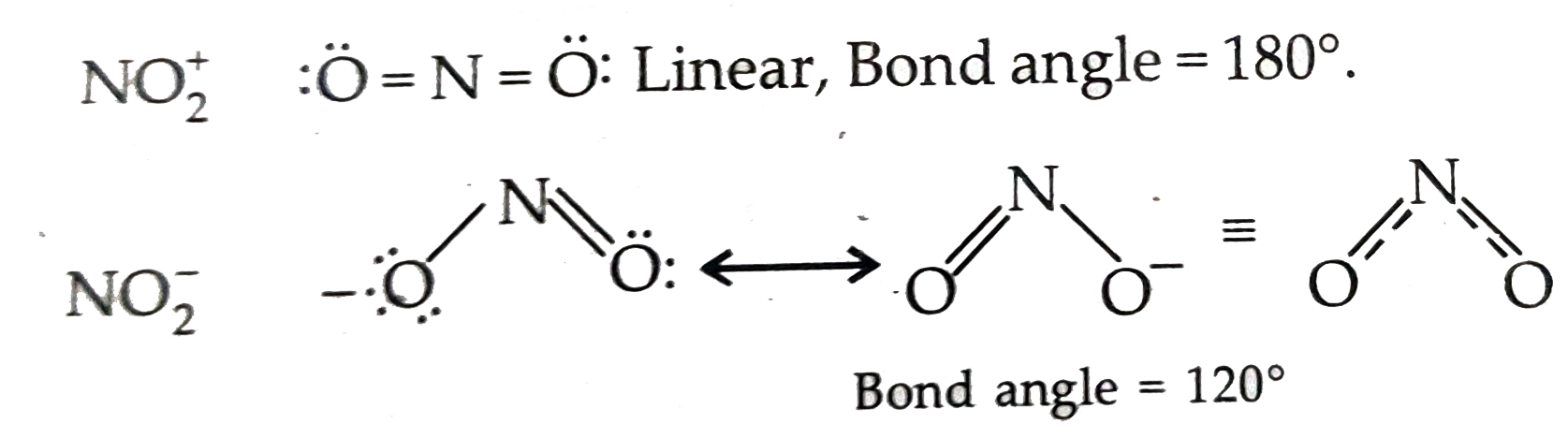
(iii) The bond angles `(O-N-O)` are not of the value in `NO_(2)^(-)` and `NO_(2)^(+)`.

Text Solution

Verified by Experts
(a) (i) `XeF_(4) + SbF_(5) rarr [XeF_(3)]^(+)[SbF_(6)]^(-)`
(ii) `Cl_(2) + 3F_(2)("excess") overset(573 K) rarr 2 Cl F_(3)`.
(b) (i) Nitrogen is associated with high bond dissociation energy and hence unreactive.
(ii) The stability of `+5` oxidation states decreases down group 15. All the elements present in this group show +3 and +5 oxidation states. This is due to inert pair effect.
(iii) The difference in bond angle is due to the fact that `NO_(2)^(+)` has linear shape but `NO_(2)^(-)` has bent shape .
Promotional Banner

Topper's Solved these Questions

  • XII BOARDS

    XII BOARDS PREVIOUS YEAR|Exercise Delhi Board : Set - II|7 Videos
  • XII BOARDS

    XII BOARDS PREVIOUS YEAR|Exercise Delhi Board : Set - III|7 Videos
  • XII BOARDS

    XII BOARDS PREVIOUS YEAR|Exercise Set II|10 Videos
  • SAMPLE PAPER 2019

    XII BOARDS PREVIOUS YEAR|Exercise SECTION: D|1 Videos

Similar Questions

Explore conceptually related problems

Complete the following chemical equation (i) F_(2) + 2Cl^(-) rarr (ii) 2XeF_(2) + 2H_(2)O rarr

(a) complete the following chemical equation : (i) P_(4)+NaOH+H_(2)Orarr (ii) XeF_(4)+O_(2)F_(2)rarr

Complete the following chemical equations : (i) P_(4) + SOCl_(2) rarr (ii) F_(2) "(Excess)" + Cl_(2) overset(300^(@)C)to

Complete the following chemical reaction equations : (i) XeF_(2)+H_(2)Oto (ii) PH_(3)+HgCl_(2)to

Complete the following chemical equations : (i) SO_(2) + MnO_(4)^(-) + H_(2)O to (ii) F_(2)(g) + H_(2)O (l) to

Complete and balance the following chemical equations. (i) P_(4)O_(10) +PCI_(5) rarr (ii) SnCI_(4) + C_(2)H_(5)CI + Na rarr

Complete the following chemical equations : (i) Cr_(2)O_(7)^(-) + H^(+) + I^(-) rarr (ii) MnO_(4)^(-) + NO_(2)^(-) + H^(+) rarr

Complete the following reaction : (i) NH_(3) + 3Cl_(2) ("excess") rarr (ii) XeF_(6) + 2H_(2)O rarr

XII BOARDS PREVIOUS YEAR-XII BOARDS-Set III
  1. Write the structure of 3-Bromo-2-methylprop-1-ene

    Text Solution

    |

  2. Write IUPAC name of the following compound (CH(3))(2) N - CH(2) CH(3...

    Text Solution

    |

  3. Write the reactions involved in the following reactions: (i) Clemmen...

    Text Solution

    |

  4. Draw the structures of the following : (i) H(4)P(2)O(7) (ii) XeOF(...

    Text Solution

    |

  5. Define the following terms: (i) Abnormal molar mass (ii) Van't Hoff ...

    Text Solution

    |

  6. Complete the following chemical equation (i) F(2) + 2Cl^(-) rarr (...

    Text Solution

    |

  7. What happens when (i) HCl is added to MnO(2)? (ii) PCl(5) is heated ...

    Text Solution

    |

  8. Define the following (i) Anionic detergents (ii) Limited spectrum ...

    Text Solution

    |

  9. Write the structure of the monomers used for getting the following pol...

    Text Solution

    |

  10. Write one difference between each of the following: (i) Multimolecul...

    Text Solution

    |

  11. (i) What type of isomerism is shown by complex [Co(en)(3)]Cl(3)? (ii...

    Text Solution

    |

  12. Of PH(3) and H(2)S which is more acidic and why ?

    Text Solution

    |

  13. Draw the structure of hex-1-en-3-ol compound.

    Text Solution

    |

  14. Explain the following terms giving one example for each : (i) Miscel...

    Text Solution

    |

  15. 15.0 g of an unknown molecular material was dissolved in 450 g of wate...

    Text Solution

    |

  16. Explain the following observations giving an appropriate reason for ea...

    Text Solution

    |

  17. Write the name, the structure and the magnetic behaviour of each one o...

    Text Solution

    |

  18. Explain the following terms giving one example of each type . (i) An...

    Text Solution

    |

  19. (a) Draw the molecular structure of following compounds : (i) XeF(6)...

    Text Solution

    |

  20. (a) Complete the following chemical equations . (i) XeF(4) + SbF(5) ...

    Text Solution

    |

