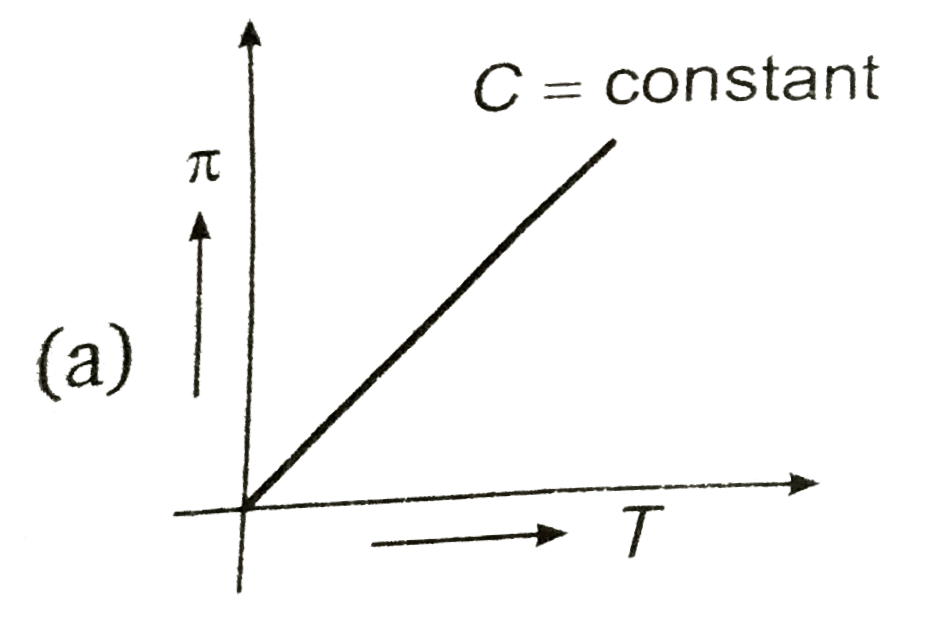
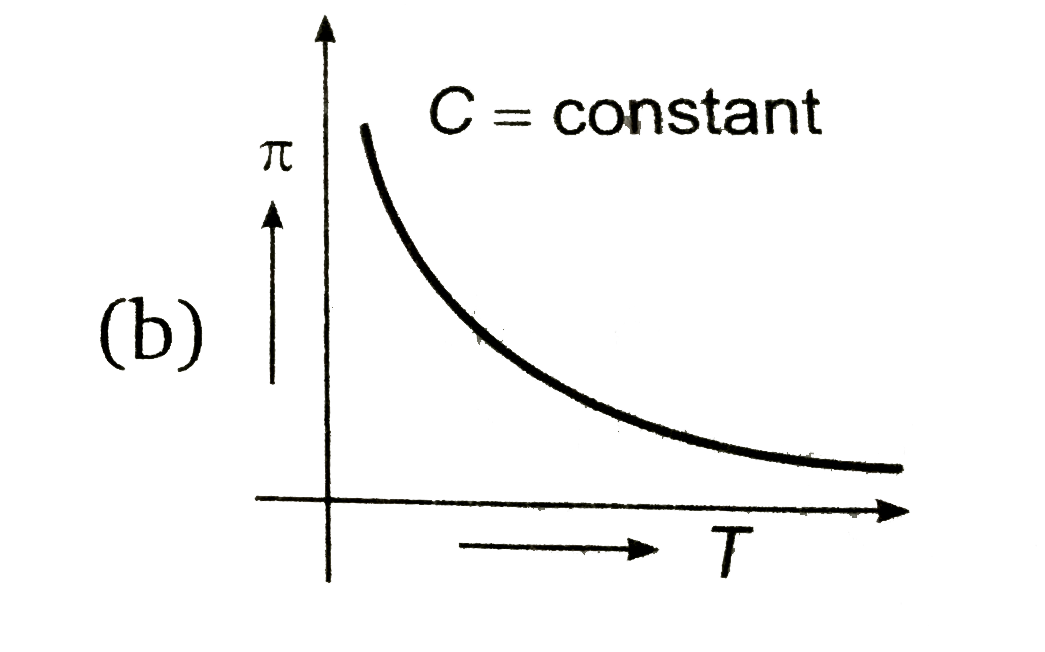
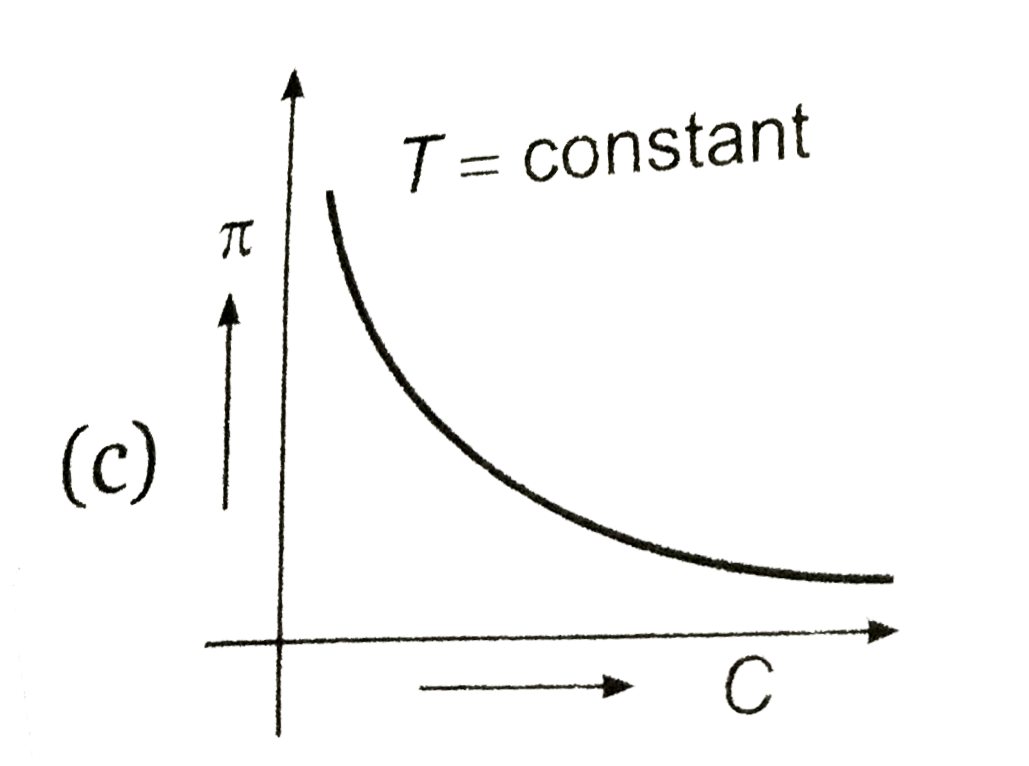
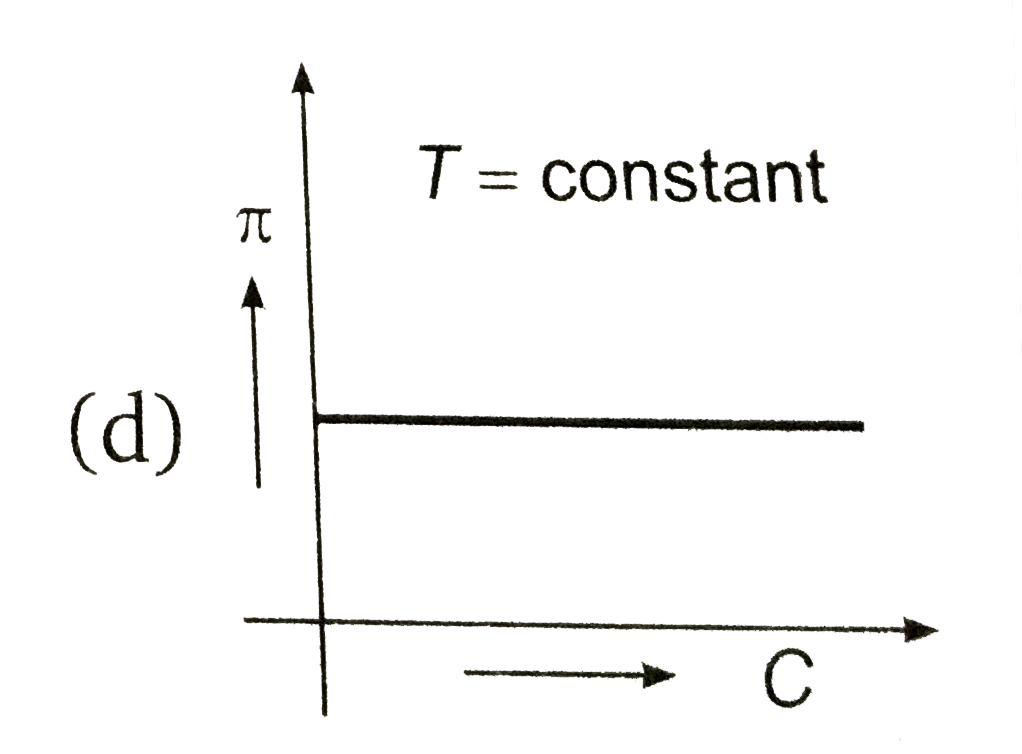
van't Hoff proved that osmotic pressure (`pi`) is a colligative property. For an ideal solution, osmotic pressure(`pi`) is helpful to determine that molecular mass of solute using `M_(B)=(W_(B)RT)/(pi.V)` Relation can exxpressed by the curve (C = concentration) :
A
B
C
D
Text Solution
Verified by Experts
The correct Answer is:
a
Topper's Solved these Questions
DILUTE SOLUTION
NARENDRA AWASTHI|Exercise Level 2|1 Videos
DILUTE SOLUTION
NARENDRA AWASTHI|Exercise Level 3 - Match The Column|1 Videos
Define the terms osmotic and osmatic pressure. What is the advantage of using osmatic pressure as compared to their colligative properties for the determination of mobr masses of solute in solutions?
Assertion:Osmotic pressure of 0.1M glucose is less than 0.1M MgCl_2 solution. Reason: Colligative properties do not depend on the concentration of solution.
When some amount of non-volatile solute is dissolved in a solvent to prepare a dilute solution, the vapour pressure of the solvent is lowered and it is directly proportional to the mole fraction of solvent in the solution . Relative lowering in vapour pressure is equal to mole fraction of solute . Elevation in boiling point of solvent is a collgative property like lowering in vaour pressure of solvent in solution , K_(b) i.e., molal elevation constant is calculated by the formula, K_(b)=DeltaT_(b)// molality and also by the expression, K_(b)=RT_(b)^(2)//1000l_(v) where T_(b) is boiling point of solvent and I_(v) is latent heat of vapourisation for 1 gm solvent . Abnormal elevation is boiling point =iX elevation in boiling point in ideal solution where i=van't Hoff factor Lowering in vapour pressure in an experiment was found to be x mm of Hg. It is : Lowering in vapour pressure in an experiment was found to be x mm of Hg. It is
When some amount of non-volatile solute is dissolved in a solvent to prepare a dilute solution, the vapour pressure of the solvent is lowered and it is directly proportional to the mole fraction of solvent in the solution . Relative lowering in vapour pressure is equal to mole fraction of solute . Elevation in boiling point of solvent is a collgative property like lowering in vaour pressure of solvent in solution , K_(b) i.e., molal elevation constant is calculated by the formula, K_(b)=DeltaT_(b)// molality and also by the expression, K_(b)=RT_(b)^(2)//1000l_(v) where T_(b) is boiling point of solvent and I_(v) is latent heat of vapourisation for 1 gm solvent . Abnormal elevation is boiling point =iX elevation in boiling point in ideal solution where i=van't Hoff factor Relative lowering in vapour pressure :
When some amount of non-volatile solute is dissolved in a solvent to prepare a dilute solution, the vapour pressure of the solvent is lowered and it is directly proportional to the mole fraction of solvent in the solution . Relative lowering in vapour pressure is equal to mole fraction of solute . Elevation in boiling point of solvent is a collgative property like lowering in vaour pressure of solvent in solution , K_(b) i.e., molal elevation constant is calculated by the formula, K_(b)=DeltaT_(b)// molality and also by the expression, K_(b)=RT_(b)^(2)//1000l_(v) where T_(b) is boiling point of solvent and I_(v) is latent heat of vapourisation for 1 gm solvent . Abnormal elevation is boiling point =iX elevation in boiling point in ideal solution where i=van't Hoff factor Molal elevation (K_(b))
(A) : Osmotic pressure method is the most suitable method to determine the number average molecular masses of polymers. (R) : Osmotic pressure can be accurately determined for polymer of high molecular mass as it is a colligative property.
At 10^@C , the osmotic pressure of 1% (w/v) solution of 'X' is 7.87 xx 10^(4) Nm^(-2) . What is the molecular weight of solute X ?
A solution containing 4.0 g of PVC in 2 litre of dioxane (industrial solvent ) was found to have an osmotic pressure 3.0xx10^(-4) atm at 27^(@)C The molecular mass of the polymer will be :
NARENDRA AWASTHI-DILUTE SOLUTION-Level 3 - Match The Column