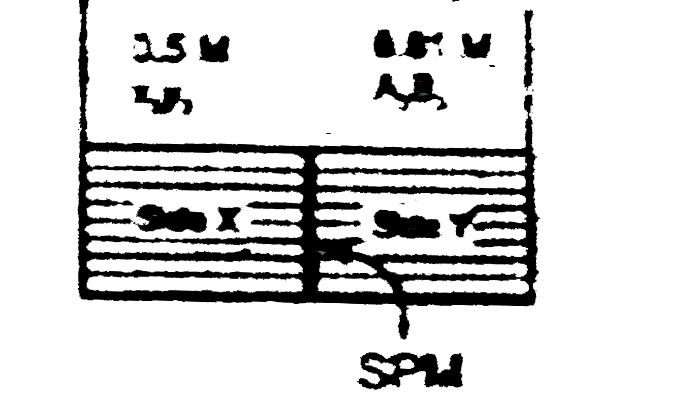
`X_(3)Y_(2)(i=5)` when reacted with `A_(2)B_(3)(i=5` in aqueous solution gives brown colour. These are separated by a semipermeable membrane `AB` as shown. Due to oxmosis there is `:`
A
brown colour formation in side X
B
brown colour formation in side Y
C
formation in both of the sides X and Y
D
no brown colour formation
Text Solution
Verified by Experts
The correct Answer is:
d
Topper's Solved these Questions
DILUTE SOLUTION
NARENDRA AWASTHI|Exercise Level 2|1 Videos
DILUTE SOLUTION
NARENDRA AWASTHI|Exercise Level 3 - Match The Column|1 Videos
FeCl_(3) on reactiSon with K_(4)[Fe(CN)_(6)] in aq solution gives blue colour of these are separated by a semi permeable memrane AB as shown, Due to osmosis there is
FeCl_(3) on reaction with K_(4)[Fe(CN)_(6)] in aqueous solution gives a blue colour . These two solutions are separated by a semipermeable membrane as shown in the figure . Both the solutions are sufficiently dilute & osmosis will take place as there is a difference in concentration of the solutions. Imagine the experiment is carried out at 27^(@)C . The osmotic flow will take place in onedirection and not in both . The osmotic pressure (pi) of FeCl_(3) Solution can expressed as
FeCl_(3) on reaction with K_(4)[Fe(CN)_(6)] in aqueous solution gives a blue colour . These two solutions are separated by a semipermeable membrane as shown in the figure . Both the solutions are sufficiently dilute & osmosis will take place as there is a difference in concentration of the solutions. Imagine the experiment is carried out at 27^(@)C . The osmotic flow will take place in onedirection and not in both . Which of the following observations may be recorded after a while ?
State as to why (i) An aqueous solution of Na_(2)CO_(3) is alkaline.
Find 5 solutions for the equation 3x-2y=5
A pale green crystalline inorganic salt (A) dissolves freely in water. It gives a brown precipitate on addition of aqueous NaOH. The solution of (A) also gives a black precipitate on bubbling H_(2)S in alkaline medium. An aqueous solution of (A) decolourises the pink colour of the permanganate solution. The metal in the salt solution is :
A hydrated metallic salt(A), light green in colour on earful heating gives a white anhydrous residue(B). (B) is soluble in water and its aqueous solution reacts with No to give a dark brown compound (C). (B) gives a brown residue (D) and a mixture oftwo gases (E) and (F). The gaseous mixture when passed through an acidified KMnO_4 solution dischanges the pink colour and when passed through acidified BaCl_2 solution gave a white precipitate. A may be
A hydrated metallic salt(A), light green in colour on earful heating gives a white anhydrous residue(B). (B) is soluble in water and its aqueous solution reacts with No to give a dark brown compound (C). (B) gives a brown residue (D) and a mixture oftwo gases (E) and (F). The gaseous mixture when passed through an acidified KMnO_4 solution dischanges the pink colour and when passed through acidified BaCl_2 solution gave a white precipitate. C may be
NARENDRA AWASTHI-DILUTE SOLUTION-Level 3 - Match The Column