Home
Class 11
CHEMISTRY
A manometer attached to a flask contains...

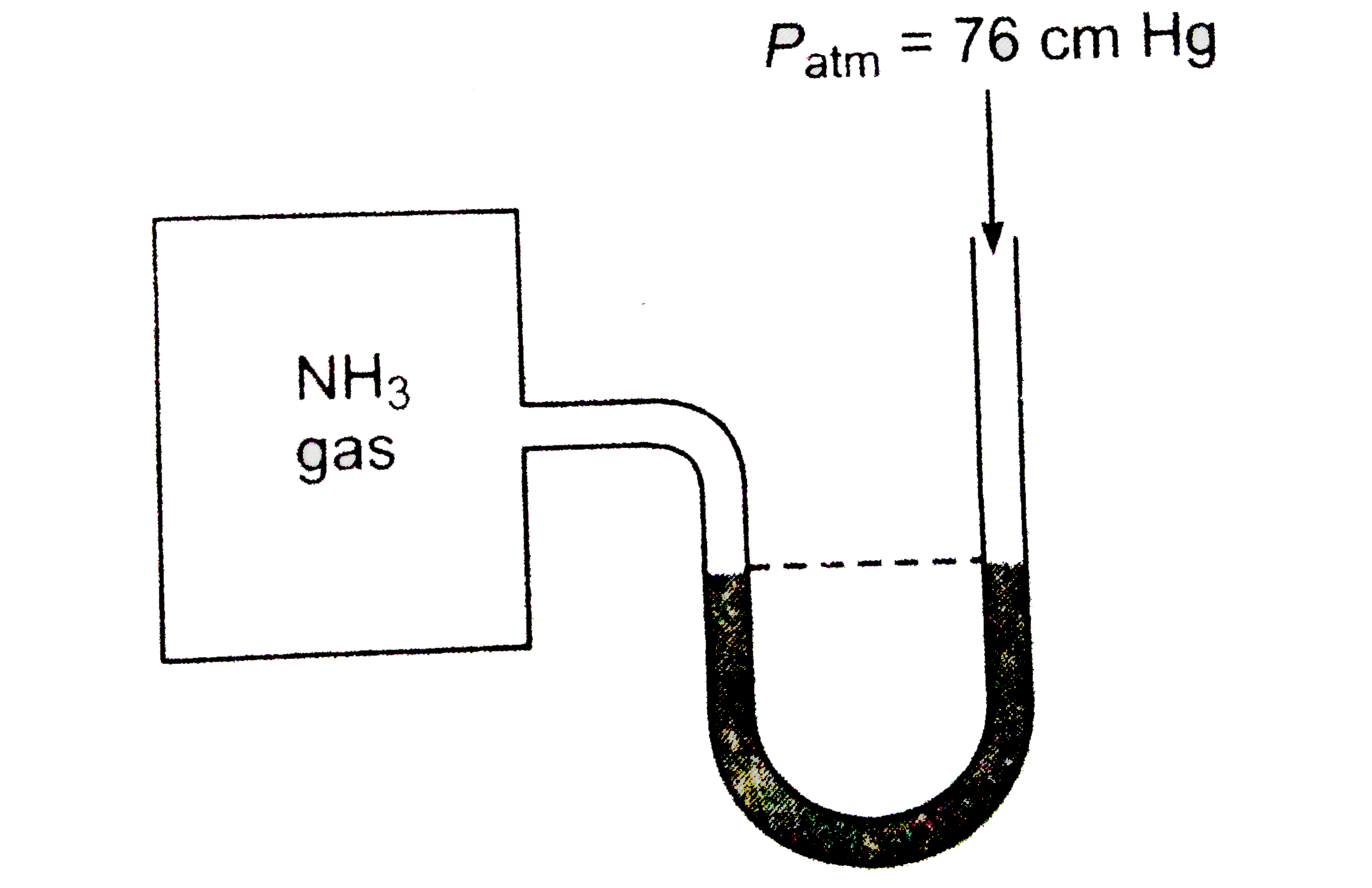
A manometer attached to a flask contains with ammonia gas have no difference in mercury level initially as shown in diagram. After sparking into the flask, ammonia is partially dissociated as `2NH_(3)" (g)"rarr N_(2)" (g)"+3H_(2)" (g)"` now it have difference of 6 cm in mercury level in two columns, what is partial pressure of `H_(2)" (g)"` at equilibrium?

A

9 cm Hg

B

18 cm Hg

C

27 cm Hg

D

None of these

Text Solution

Verified by Experts

The correct Answer is:

a

(a) `{:((a),2NH_(3)(g),to,N_(2)(g), +, 3H_(2)(g)),("Before sparking"," "76 ,, " " 0,, 0),("After sparking", 76-2x,," "x,,3x),("at eqm",,,,,):}`
Increase in pressure `2x=6, x=3cm Hg`
Partial pressure of `H_(2)=3xx3=9cmHg`
Promotional Banner

Topper's Solved these Questions

  • GASEOUS STATE

    NARENDRA AWASTHI|Exercise Level 1 (Q.31 To Q.60)|1 Videos
  • GASEOUS STATE

    NARENDRA AWASTHI|Exercise Level 1 (Q.121 To Q.150)|1 Videos
  • ELECTROCHEMISTRY

    NARENDRA AWASTHI|Exercise Level 3 - Subjective Problems|1 Videos
  • IONIC EEQUILIBRIUM

    NARENDRA AWASTHI|Exercise Assertin-Reason Type Questions|1 Videos

Similar Questions

Explore conceptually related problems

In the reaction 2 SO_(3 (g)) , hArr 2 SO_(2 (g)) + O_(2 (g)) , SO_(3 (g)) is 50 % dissociated at 27^(@)C when the equilibrium pressure is 0.5 atm . Partial pressure of SO_(3 (g)) at Equilibrium is

Peqfor NH_(4)COONH_(2(s)) harr 2NH_(3(g))+ CO_(2(g)) at certain temperature is 0.9 atm. Then, partial pressure of Ammonia at equilibrium (in atm)

Which one of the following equations is correct for the reaction N_(2)(g) + 3H_(2)(g) to 2NH_(3)(g) ?

N_(2(g)) + 3H_(2(g)) hArr 2NH_(3(g)) for the reaction initially the mole ratio was 1: 3 of N_(2). H_(2) . At equilibrium 50% of each has reacted. If the equilibrium pressure is p, the partial pressure of NH_(3) at equilibrium is

To measure the pressure exerted by a trapped gas A, an open ended mercury manometer is used. After sparking the gas A, it dissociates as, A(g) to B(g) + 3C(g). If the pressure of A decreases to 0.9 atm, then (assume temperature to be constant, 300K)

In the equilibrium NH_(4) HS_(s) hArr NH_(3(g)) + H_(2) S_((g)) . the forward reaction can be favoured by

H_(2)S_((g)) intially at a pressure of 10 atm anda temperature of 800K, dissociates as 2H_(2)S_((g)) hArr 2H_(2) +S_(2(g)) At equilibrium, the partial pressure of S, vapour is 0.02 atm. Thus, K_(p) is

The K_(p) values for the reaction H_(2)(g)+I_(2)(g)hArr2HI(g) at 460^(@)C is 49. If the initial pressure of H_(2) and I_(2) are 0.5 atm respectively, determine the partial pressure of each gases at equilibrium.
