Home
Class 11
CHEMISTRY
When two cotton plugs, one moistened wit...

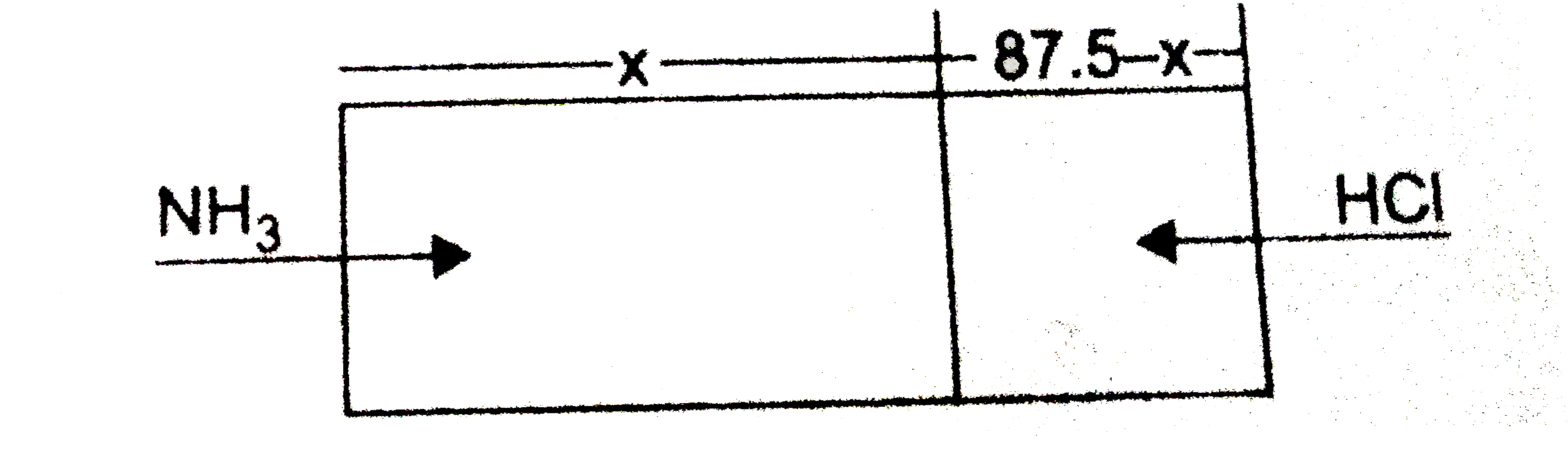
When two cotton plugs, one moistened with ammonia and the other with hydrochloric acid, are sumulataneously inserted into opposite ends of a glass tube 87.0 cm long, a white ring of `NH_(4)Cl` forms where gaseous `NH_(3)` and gaseous HCl first come into contact.
`NH_(3)(g)+HCl(g)rarrNH_(4)Cl(s)`
At what distance from the ammonis-moistened plug does this occur?

A

51.7 cm from `NH_(3)` end

B

51.7 cm from HCl end

C

43.5 at mid point

D

None of these

Text Solution

Verified by Experts

The correct Answer is:
a

(a) `(r_(NH_(3)))/(r_(HCl))=sqrt((36.5)/(17))=(x)/(87.5-x)`

`x=51.7cm`
Promotional Banner

Topper's Solved these Questions

  • GASEOUS STATE

    NARENDRA AWASTHI|Exercise Level 1 (Q.31 To Q.60)|1 Videos
  • GASEOUS STATE

    NARENDRA AWASTHI|Exercise Level 1 (Q.121 To Q.150)|1 Videos
  • ELECTROCHEMISTRY

    NARENDRA AWASTHI|Exercise Level 3 - Subjective Problems|1 Videos
  • IONIC EEQUILIBRIUM

    NARENDRA AWASTHI|Exercise Assertin-Reason Type Questions|1 Videos

Similar Questions

Explore conceptually related problems

The reaction between gaseous NH_3 and HBr produces a white solid NH_4Br . Suppose that NH_3 and HBr are introduced simultaneously into the opposite ends of an open tube of 1 metre length. Where would you expect the white solid to form?s

The reaction between gaseous NH_3 and HBr produces a white solid NH_4Br . Suppose that NH_3 and HBr are introduced simultaneously into the opposite ends of an open tube of 1 metre length. Where would you expect the white solid to form?

A straight glass tube has two inlets X and Y at the two ends. The length of the tube is 200 cm. HCl gas through inlet X and NH_(3) gas through inlet Y are allowed to enter the tube at the same time. White fumes appear at a point P inside the tube. Find the distance of P from X.

On treatment of [Ni(NH_(3))_(4)]^(+2) with conc.HC/ two compounds I and II having the same formula [Ni(NH_(3))_(2)Cl_(2)] are obtained, I can be converted into II by boiling with dil.HCI. A solution of I reacts with oxalic acid to form [Ni(NH_(3))_(2)(C_(2)O_(4))] where as II does not react. Point out the correct statement from the following

When degenerate d-orbitals of an isolated atom/ion come under influence of magnetic field of ligands, the degeneracy is lost. The two sets t_(2g)(d_(xy),d_(yz),d_(xz))ande_(g)(d_(z^(2)),d_(x^(2)-y^(3))) are either stabilized or destabilized depending upon the nature of magnetic field. It can be expressed diagramatically as : Value of CFS depends upon nature of ligand and a spectro-chemical series has been made experiment-ally, for tetrahedral complexes Delta_(i) is about 4/9 times to Delta_(0) (CFSE for octahedral complexes). The energy lies in visible region and i.e., why electronic transition t_(2_(g))hArre_(g) are responsible for colour. Such transitions are not possible with d^(0) and d^(10) configuration. Cr^(3+) form four complexes with four different ligands which are [Cr(Cl)_(6)]^(3-),[Cr(H_(2)O)_(6)]^(3+),[Cr(NH_(3))_(6)]^(3+) and [Cr(CN)_(6)]^(3-) . The order of CFSE (Delta_(a)) in these complexes is :

A flask of 1L having NH_(3)(g) at 2.0atm and 200K is connected with another flask of vol 800ml having HCl(g) at 8atm & 200K through tube of negligible volume. The two gases reacts to form NH_(4)Cl(s) with evolution of 43 KJ/mol heat. If heat capacity of at constant volume is 20J/K/mol and neglecting heat capacity of flask and solid, volume of solid formed and its pressure (R = 0.08). The final pressure in the flask is

