Home
Class 11
CHEMISTRY
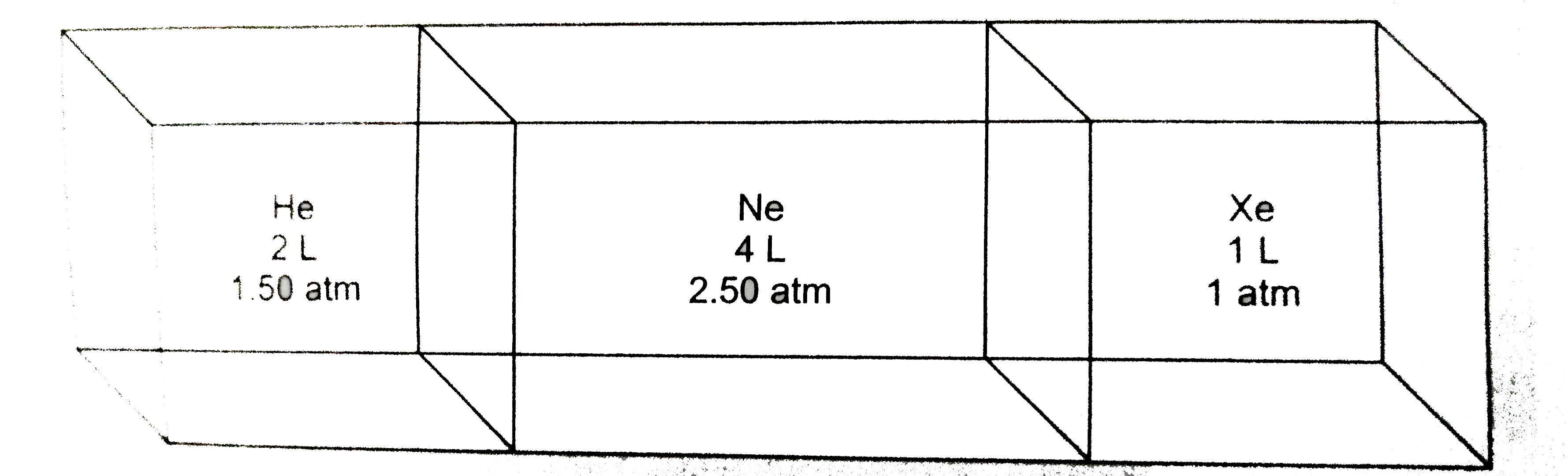
Consider the composite system, which is ...

Consider the composite system, which is held at 300 k , shown in the following figure. Assuming ideal gas behavior, calculate the total pressure if the barriers sparating the compartments are removed. Assume that the volume of the barriers is negligible. (Given : R =0.082 atm L/mol. K)

A

1 atm

B

2 atm

C

2.3 atm

D

3.2 atm

Text Solution

Verified by Experts

The correct Answer is:

b

(b) The number of moles of He, Ne and Xe is given by
`n_(He)=(PV)/(RT)=(3)/(RT)," "n_(Ne)=(PV)/(RT)=(10)/(RT),`
`n_(Xe)=(PV)/(RT)=(1)/(RT),`
`n=n_(He)+n_(Ne)+n_(Xe)=((3+10+1))/(RT)`
The total pressure is given by
`P=((n_(He)+n_(Ne)+n_(Xe))RT)/(V)`
`P_("total")=((3+10+1))/(RT)xx(RT)/(7)=2atm`
Promotional Banner

Topper's Solved these Questions

  • GASEOUS STATE

    NARENDRA AWASTHI|Exercise Level 1 (Q.31 To Q.60)|1 Videos
  • GASEOUS STATE

    NARENDRA AWASTHI|Exercise Level 1 (Q.121 To Q.150)|1 Videos
  • ELECTROCHEMISTRY

    NARENDRA AWASTHI|Exercise Level 3 - Subjective Problems|1 Videos
  • IONIC EEQUILIBRIUM

    NARENDRA AWASTHI|Exercise Assertin-Reason Type Questions|1 Videos

Similar Questions

Explore conceptually related problems

Calculate the total pressure in a 10 L cylinder which contains 0.4 g of helium, 1.6 g of oxygen and 1.4 g of nitrogen at 27^(@) C. Also calculate the partial pressures of He gas in the cylinder. Assume Ideal behaviour for gases. R = 0.082 L atm k^(-1) mol^(-1)

A container of volume 1m^(3) is divided into two equal compartments, one of which contains an ideal gas at 300K. The other compartment is vaccum. The whole system is thermally isolated from its surroundings. The partition is removed and the gas expands to occupy the whole volume of the container. Its temperature now would be

What is the compressibility facto (Z) for 0.02 mole of a van der Waal's gas at pressure of 0.1 atm. Assume the size of gas molecules is neligible. Given : RT = 20 L. atm "mol^(-1) and alpha = 1000 atm L^(2) "mol^(-2)

At 27^@C , one mole of an ideal gas exerted a pressure of 0.821 atmospheres. What is its volume in litres ? (R = 0.082 "lit-atm/mol"^(-1) K^(-1))

Using van der Waals equation, calculate the constant, a when two moles of a gas confined in a four litre flask exerts a pressure of 11.0 atmospheres at a temperature of 300 K. The value of b is 0.05 L "mol"^(-1)

Ideal gas equation is represented as PV=nRT . Gases present in the universe were found ideal n the Boyle's temperature range only. The compressibility factor for an ideal gas, Z= (PV)/(nRT) . The main cause to show deviations were due to wrong assumptions made bout forces of attractions (which becomes significant at high pressure). olume occupied by molecules V, in PV = nRT, is supposed to be volume of as or, the volume of container in which gas is placed by assuming that aseous molecules do not have appreciable volume. Actual volume of the as is that volume in which each molecule of a gas can move freely. If olume occupied by gaseous molecule is not negligible, then the term V hould be replaced by the ideal volume which is available for free motion of ach molecule of gas. Similarly for n moles of gas V_("actual") = V-nb The excluded volume can be calculated by considering bimolecular collisions. The excluded volume is the volume occupied by the sphere of 2r for each pair of molecule. Thus, excluded volume for one pair of molecules = 4/3 pi (2r)^3 = (4 xx 8 pi r^3)/3 The excluded volume for 1 molecule = 2/3 xx 8 pi r^3 = 4 xx (4/3 pi r^3) = 4V The excluded volume for N molecules = 4NV = b (where N is Avogadro's No.) The compressibility factor for N_2 at -50^@C and 800 atm pressure is 1.95. Number of moles of N_2 required to fill a balloon of 100 L capacity is :
