Home
Class 12
PHYSICS
Two conducting plates A and B are placed...

Two conducting plates A and B are placed parallel to each other. A is given a charge. `Q_1` and B a charge `Q_2`. Find the distribution of charges on the four surface.

Text Solution

Verified by Experts
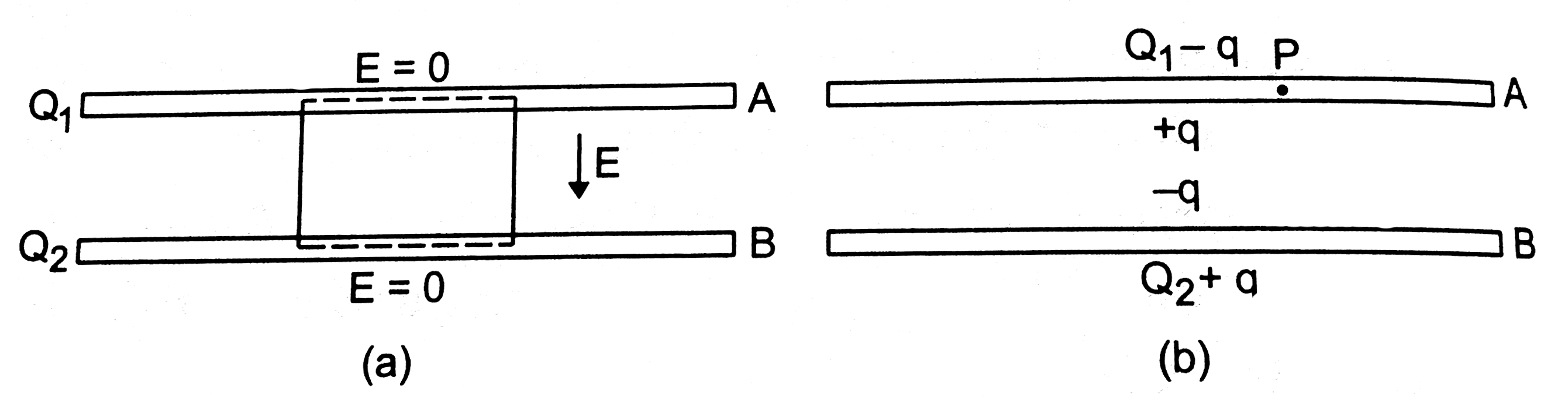
Consider a Gaussian surface as shown in figure . Two faces of this closed surface lie completely inside the condector where the electric field is zero. The flux through these faced is, therefore, zero. The other parts of the closed surface which are outside the conductor arl parallel to the electric fieeld and hence the electric field through the closed surface is, therefore, zero. From Fauss's law, the total charge inside this closed surface should be zero. The charge on the inner surface of A should be equal and opposite to that on the inner surface of B.
The distribution should be like the one shown in figure (30-W6b). To find the value of q, consider the field at a point P inside the plate A. Suppose, the surface area of the plate (one side) is A. Using the equation `E= sigma/(2epsilon_0)`, the electric field at P
due to the charge `Q_1- q= Q_1- q/ 2 A epsilon_0` (downward),
due to the charge `+q= q/ 2A epsilon_0` ( upward),
due to the charge `-q= q/2Aepsilon_0` (downward),
and due to the charge `Q_2 +a= Q_2 + a/ 2A epsilon` (upward).
The net electric field at P due to all the four charged surfaces is ( in the downward direction)
`Q_1 - a/ 2A epsilon_0 - q/2A epsilon_0 + q/2A epsilon_0- Q_2+q/2A epsilon_0.
As the point P is inside the conductor, this field should be zero. Hence,
`Q_1-q-Q_2-q=0`
or, `q= Q_-Q_2/2`. `........(1)`
Thus, `Q_1-q= Q_1=Q_2 /2` ..........(2)
and `Q_2+q = Q_1 + Q_2/2`.
Using these equation, the distribution shown in the figure (30W6) can be redrawn as in figure (30-W7).
This result is a special case of the following result. When charge conducting plates are placed parallel to each other, the twon outermost surfaces get equal charges and the facing surface get equal nad opposite charges.
Promotional Banner

Topper's Solved these Questions

Similar Questions

Explore conceptually related problems

Two conducting plates A and B are placed parallel to each other. A is given a charge Q_1 and B a charge Q_2 . Prove that the charges on the inner surfaces are of equal magnitude and opposite sign.

X and Y are large, parallel conducting plates close to each other. Each face has an area A . X is given a charge Q . Y is without any charge. Points A,B and C are as shown in the figure.

Three large conducting sheets placed parallel to each other at a finite distance contain charges Q,-2Q, and 3Q , respectively. Find the electric fields at points A, B, C, and D.

Two infinite linear charges are placed parallel to each other at a distance 0.1 m from each other. If the linear charge density on each is 5 mu C//m , then the force acting on a unit length of each linear charge will be:

Shown in the figure a spherical shell with an inner radius 'a' and an outer radius 'b' is made of conducting metarial. A charge +Q is placed at the centre of the spherical shell and a total charge -q s placed on the shell. Charge -q is districuted on the surfaces as :

Prove that if an isolated (isolated means no charges are near the sheet) large conducting sheet is given a charge then the charge distributes equally on its two surfaces.

Two large thin metal plates are parallel and close to each other on their inner faces the plates have surface charges densites of opposite region of the first plate (b) in the outer region of the second plate and (c ) between the plates

The figure shows three infinite non-conducting plates of charge perpendicular to the plane of the paper with charge per unit area +sigma, +2sigma and -sigma . Find the ratio of the net electric field at that point a to that at point B.

Charges +q and -q are located at the corners of a cube of side as show in the figure. Find the work done to separate the charges to infinite distance

Figure shows three large metallic plates with chrges -Q, 3Q and Q respectively. Determine the final charges on all the surfaces.

