Home
Class 12
PHYSICS
A charge q is placed at the centre of th...

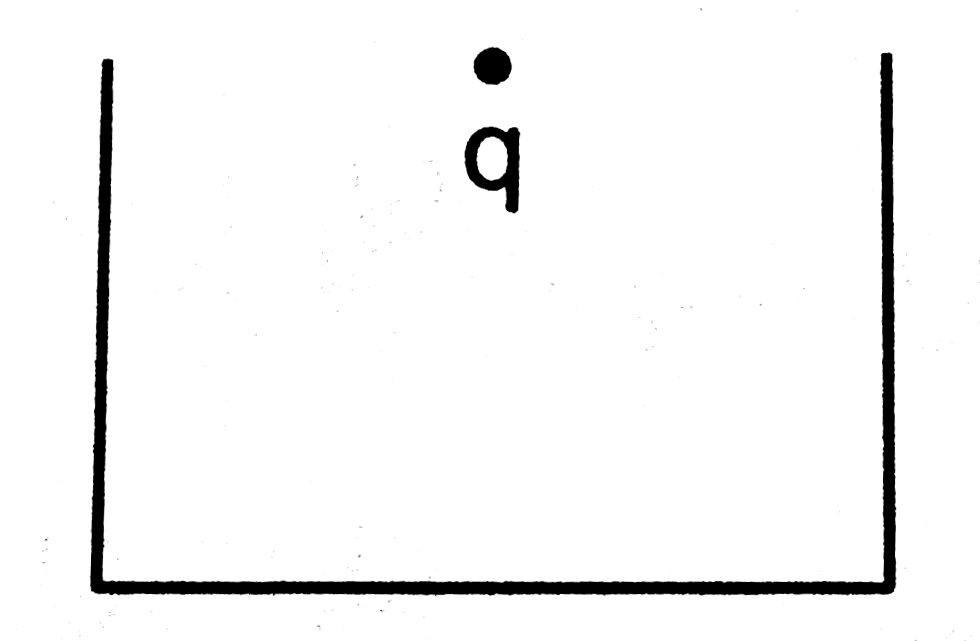
A charge q is placed at the centre of the open end of a cylindrical vessel . The flux of the electric field through the surface of the vessel is

A

zero

B

`q/epsilon_0`

C

`q/2epsilon_0`

D

`2q/2epsilon_0`.

Text Solution

Verified by Experts

The correct Answer is:

C
Promotional Banner

Topper's Solved these Questions

Similar Questions

Explore conceptually related problems

The Electric flux through the surface:

A charge Q is uniformly distributed over a rod of length l . Consider a hypothetical cube of edge l with the centre of the cube at one end of the rod. Find the minimum possible flux of the electric field through the entire surface of the cube.

A spherical conducting shell of inner radius r_(1) and outer radius r_(2) has a charge Q. (a) A charge q is placed at the centre of the shell. What is the surface charge density on the inner and outer surfaces of the shell? (b) Is the electric field inside a cavity (with no charge) zero, even if the shell is not spherical, but has any irregular shape? Explain.

Shown in the figure a spherical shell with an inner radius 'a' and an outer radius 'b' is made of conducting metarial. A charge +Q is placed at the centre of the spherical shell and a total charge -q s placed on the shell. Charge -q is districuted on the surfaces as :

A point charge q is placed at the centre of a cube of side length L . The electric flux emerging from the cube is……

A point charge of 2.0 mu c is at the centre of a cubic gaussian surface 9.0 cm on edge what is the net electric flux through the surface

A point charge of 2.0 muC is at the centre of a cubic Gaussian surface 9.0 cm on edge. What is the net electric flux through the surface ?

An arbitrary surface encloses a dipole. What is the electric flux through this surface ?

Five charges, q each are placed at the corners of a regular pentagon of side 'a' as in figure: (a) (i) What will be the electric field at O, the centre of the pentagon ? (ii) What will be the electric field at O if the charge from one of the corners (say A) is removed ? (iii) What will be the electric field at O if the charge q at A is replaced by -q ? (b) How would your answer to (a) be affected if pentagon is replaced by n-sided regular polygon with charge q at each of its corners ?

The length of each side of a cubical closed surface is l If charge q is situated on one of the vertices of the cube , then find the electric flux passing through shaded face of the cube. .
